
Dwarves (Dvergar)
The Norse dvergar: earth-born craftsmen who forged Mjolnir and Draupnir, turn to stone in sunlight, and resist every tidy definition scholars give them.
All-wise Answers Thor, W. G. Collingwood, 1908 · Public domain · source
Maggots Given Minds
Voluspa says the dwarves came from the earth, and Snorri is more specific and more unsettling: they formed as maggots in the flesh of the giant Ymir, and only afterward were given human understanding and shape by the gods, by their own decree 1,2. Two of the first, Motsognir and Durin, are named as the ones who then went on to make more of their kind out of the earth itself 1. Every dvergr after them inherits that origin — not divine, not giant, but grown out of dead matter and improved by a decision the gods made about it rather than one the dwarves made for themselves.
The Dvergatal: A List as a Fence
The strangest surviving dwarf-text is not a story at all but a list. A long passage in Voluspa, the dvergatal, simply names dozens of dwarves in a row — Nyi, Nidi, Nordri, Sudri, Austri, Vestri and on — with no accompanying plot, and several of those names, such as Alfr ("elf") and Gandalfr ("wand-elf"), are indistinguishable from words for elves 1,4. Rudolf Simek's dictionary treats the dvergatal as evidence that medieval poets themselves were not always sure where the category of dwarf stopped and the category of elf began, and Snorri's own attempt to sort them — calling the dark-elves who live underground "blacker than pitch" and effectively dwarves under another name — reads less like received doctrine and more like his own effort to impose order on a genuinely blurry tradition 2,7.
Master Smiths of the Gods
Nearly every famous object in Norse myth passes through a dwarf's hands. The sons of Ivaldi forge the ship Skidbladnir, Odin's spear Gungnir, and new golden hair for Sif; the brothers Brokkr and Eitri, working a wager against Loki's own head, answer with the boar Gullinbursti, the ring Draupnir, and the hammer Mjolnir, its handle famously short because Loki sabotaged the bellows mid-forge 2,4. Dwarves also forge Gleipnir, the ribbon-thin fetter that finally binds Fenrir, and brew the mead of poetry from the blood of Kvasir 2,8. Not every dwarf in the corpus is generous with what he makes: Andvari, forced by Loki to surrender his gold and a cursed ring, later supplies the hoard that destroys Fafnir and everyone who touches it afterward — proof that a dwarf's craft in this mythology is a source of power for the gods, but never a favour done out of loyalty to them 4,8.
Stone, Sun, and the Underground
Dwarves belong to rock in a way no other beings in the cosmology do. Voluspa calls them "wise ones of the rock-wall," Snorri has them living inside stones and mountains, and Ynglinga saga tells of a legendary Swedish king, Sveigdir, lured by a dwarf standing in a doorway carved into a boulder and never seen again once the stone closes behind him 1,2,3. Lotte Motz reads this stone-and-mound association as older than the smith stories, arguing the dwarves' original ground is the same ground the dead occupy in barrow-burial — earth-dwellers whose craft-magic is one expression of a broader link to the mound rather than the whole of their identity 5. The clearest rule about them is Alvissmal's: dwarves cannot survive daylight, and sunrise turns one to stone outright, which is usually read as the literal explanation for why the wise old rocks of the countryside look the way they do 1,4.
Outwitted at Dawn
That rule is also the whole plot of Alvissmal. The dwarf Alviss arrives at Asgard to claim Thor's daughter Thrud as a bride the gods had promised him, and Thor — unwilling to hand her over but unable simply to refuse a dwarf who knows his rights — stalls him with a contest instead, asking him to name, in dwarvish, giant, and human speech, dozens of things: the sky, the sea, the moon, ale itself 1,4. Alviss, flattered into answering question after question through the whole night, never notices the sun coming up until Thor points it out and laughs at him, frozen where he stands 1. It is one of the few Eddic poems built entirely around a dwarf's own voice, and its outcome — brains outlasted by simple patience — sets the tone for how the gods generally treat their smiths: useful, resented, and, in the end, disposable 4,7.
Reading the Dvergar
Ármann Jakobsson's study of the type argues dwarves resist definition on purpose within the medieval texts themselves — sometimes human-sized craftsmen, sometimes tiny, sometimes barely distinguishable from elves or from the dead, always defined more by what they are not (not gods, not giants, not quite human) than by any positive trait held in common 6. That instability is worth keeping in mind against the modern fantasy dwarf — bearded, mining, speaking in a stock accent — which owes far more to nineteenth- and twentieth-century invention than to Voluspa's maggot-born craftsmen who are afraid of the sun and unhappy to be asked for anything for free 6,7.
Continue Exploring
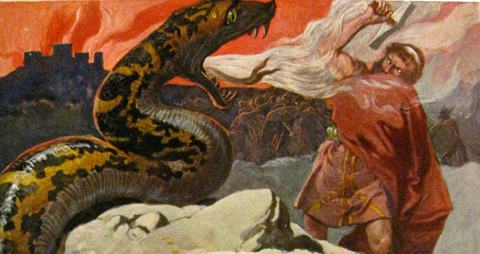
Hammer of Thor. Dwarf-forged, short in the handle, it strikes like lightning, hallows oaths and the dead, and always returns to the hand that throws it.
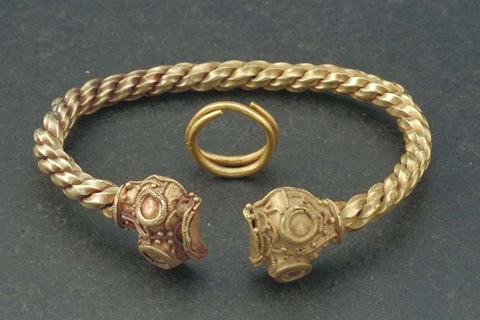
The dripping ring. Odin's gold arm-ring, which sheds eight more of its own weight every ninth night — burned on Baldr's pyre, and sent back from Hel.
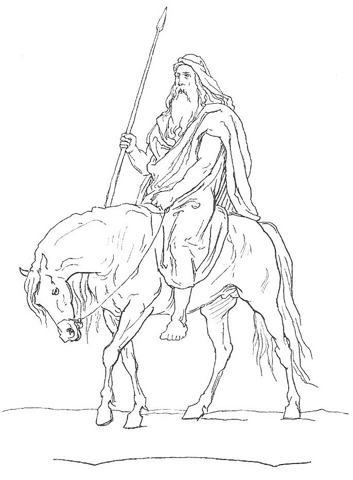
Odin's spear. Dwarf-made, rune-carved, and thrown over an army to hand it to the god of the hanged — the weapon that starts the first war in the world.
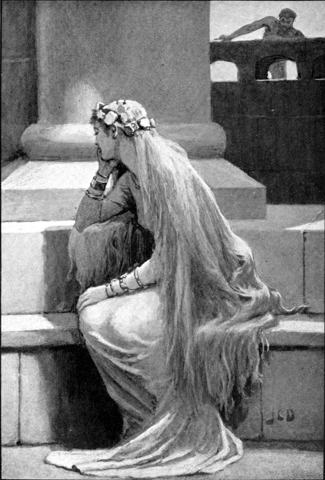
Thor's golden-haired wife, whose shorn hair forced Loki to commission the dwarf-made treasures of the gods, Mjolnir among them.
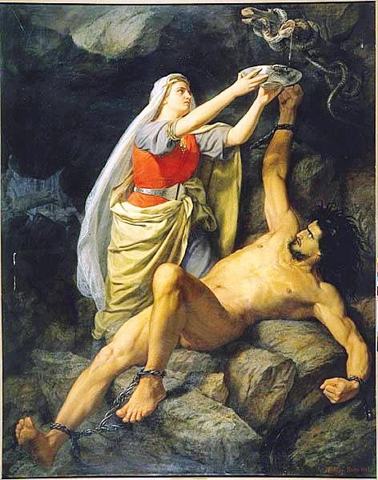
The Trickster. Shape-shifter of giant blood counted among the gods — their cleverest ally, the father of monsters, and the spark of Ragnarok.
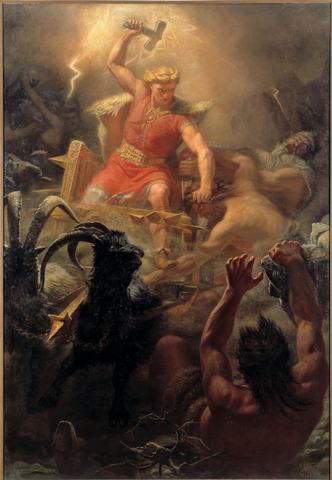
God of Thunder. Son of Odin and the earth, wielder of Mjolnir, and the gods' front line against the giants — fated to fall with the World Serpent.
Also mentioned inElves (Alfar)
Sources & Further Reading
- 1.Poetic Edda — Voluspa and Alvissmal (Codex Regius, 13th century).
- 2.Snorri Sturluson, Prose Edda — Gylfaginning and Skaldskaparmal (c. 1220).
- 3.Snorri Sturluson, Ynglinga saga, in Heimskringla (c. 1230).
- 4.Larrington, Carolyne (trans.). The Poetic Edda. Rev. ed., Oxford World's Classics, 2014.
- 5.Motz, Lotte. "The Craftsman in the Mound." Folklore 88, no. 1 (1977).
- 6.Jakobsson, Armann. "The Hole: Problems in Medieval Dwarfology." Arv: Nordic Yearbook of Folklore 61 (2005).
- 7.Simek, Rudolf. Dictionary of Northern Mythology. Trans. Angela Hall. D.S. Brewer, 1993.
- 8.Lindow, John. Norse Mythology — A Guide to the Gods, Heroes, Rituals, and Beliefs. Oxford University Press, 2001.
Spot an error or have a source to suggest? Write to info@viseterna.com. We cite primary sources and modern scholarship, and we correct fast.