
Sif
Thor's golden-haired wife, whose shorn hair forced Loki to commission the dwarf-made treasures of the gods, Mjolnir among them.
Sif, John Charles Dollman, from H. A. Guerber, Myths of the Norsemen from the Eddas and Sagas, 1909 · Public domain · source
Name and Household
Sif is the wife of Thor, and Snorri's standing epithet for her is hárfagra — the fair-haired, or more precisely the beautiful-haired 2,3. Her name is not decorative: Old Norse sif belongs to the same family as sifjar, "kinship by marriage, affinity", and is cognate with English sib and German Sippe. It amounts to naming a goddess "in-law", which most scholars take as a sign that her original province was the bond of marriage itself and the peace between families that a marriage was supposed to create 6,7.
Her household straddles two generations of gods. By Thor she is the mother of Thrud, a daughter whose name means "strength" and who turns up mainly in kennings and in one obscure episode involving a dwarf suitor 3,5. She is also the mother of Ullr by a father the sources never name; Snorri calls Ullr Thor's stepson, and Grimnismal gives him the hall Ydalir, "yew-dales", in the same stanza that gives Alfheim to Freyr 2,4. Ullr is a hunter, a skier and an archer of some antiquity in the Scandinavian place-name record, which makes Sif the connection point between the old thunder cult and an older cult still 4,7.
The Shorn Hair and the Six Treasures
The one narrative that turns on Sif is told in Skaldskaparmal, and it is the origin story for nearly every famous object the gods own 3. Loki, out of pure malice, cut off all of Sif's hair while she slept. Thor caught him and would have broken every bone in his body; Loki bought his life by swearing to get the dark-elves to make Sif hair of gold that would grow like real hair 3.
He went to the dwarfs called the sons of Ivaldi, who made the hair, and also the ship Skidbladnir and the spear Gungnir. Loki then wagered his own head with the dwarf Brokkr that Brokkr's brother Eitri could not match them. Eitri worked the forge while Brokkr pumped the bellows and a fly — Loki — bit him at the critical moments; out came the boar Gullinbursti, the ring Draupnir, and the hammer Mjolnir, whose handle came out short because Brokkr let go of the bellows for an instant to swat at his eyelid 3. The gods judged Mjolnir the greatest of the six, since it was the defence of Asgard against the frost-giants, and Loki kept his head only by the lawyer's argument that he had wagered his head and not his neck 3.
The whole apparatus of divine hardware, in other words, exists because Loki gave a woman a bad haircut. Whether the story was built to explain the treasures or the treasures were hung on an older story about Sif is not recoverable 5,6.
Golden Hair, Golden Grain
A long-standing interpretation reads Sif's hair as ripe grain: the golden crop cut down and regrown, married to the thunder god whose rain makes it grow. Turville-Petre and others found the reading attractive, and it fits Thor's practical role as the god farmers actually prayed to for weather 7. It is, however, an inference rather than a source statement — no Norse text says Sif is grain — and more cautious handbooks flag it as a nineteenth-century nature-mythology reading that has outlived some of its evidence 5,6. Both positions are still argued.
What the sources do preserve is the kenning tradition. Gold is called "Sif's hair" in skaldic verse, and Thor is routinely identified as "Sif's husband", which shows the hair myth was common property among poets long before Snorri wrote it down 3,5.
Accusations in the Hall
Sif's other appearances are brief and mostly hostile. In Lokasenna she comes forward late, pours Loki a cup of mead and asks him to admit that she at least is blameless. He drinks and answers that she would be, except that he himself has been her lover — a claim no other source supports and which the poem's own logic invites the reader to doubt 1,8. In Harbardsljod, Odin in disguise needles Thor with the news that Sif has a lover waiting at home; Thor's reaction is the point of the taunt, not its truth 1,5.
She has quieter moments too. In Hymiskvida she is at the feast when the gods need a cauldron large enough to brew for them all, and in Thrymskvida she is present in the household as Thor's theft-stricken hammer is negotiated for 1. Snorri lists her among the Asyniur, the goddesses, without further comment 2.
What She Amounts To
Sif is not a goddess of action in the surviving literature. She is a name, a head of gold hair, a marriage, and the hinge of the most consequential accident in Norse myth. Scholars who work on her tend to argue that the thinness is a symptom of transmission rather than of her original importance — that a goddess whose name means the tie between families, married to the most widely worshipped god in Scandinavia, is unlikely to have been minor in practice, and that what reached the thirteenth century was mostly what the poets needed for kennings 5,6,7. On the evidence available, that has to remain a reasonable guess rather than a conclusion.
Continue Exploring
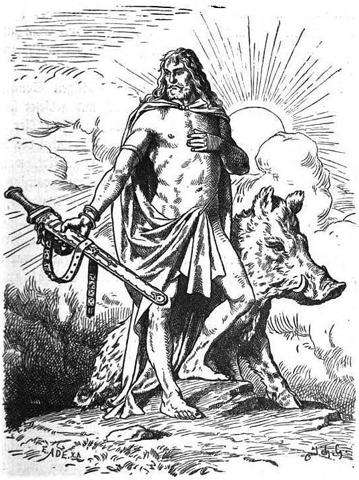
Vanir god of harvest, peace and kingship. Owner of the golden boar Gullinbursti, he traded away his sword for love and pays for it at Ragnarok.
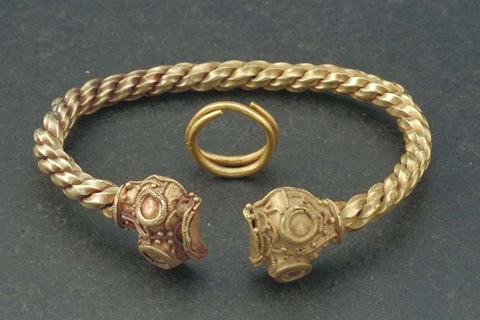
The dripping ring. Odin's gold arm-ring, which sheds eight more of its own weight every ninth night — burned on Baldr's pyre, and sent back from Hel.
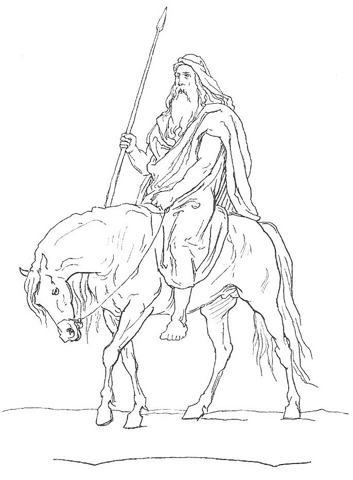
Odin's spear. Dwarf-made, rune-carved, and thrown over an army to hand it to the god of the hanged — the weapon that starts the first war in the world.
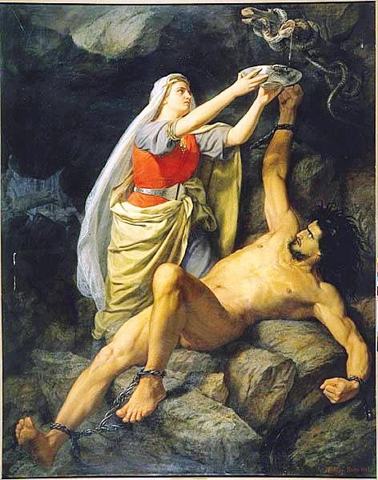
The Trickster. Shape-shifter of giant blood counted among the gods — their cleverest ally, the father of monsters, and the spark of Ragnarok.
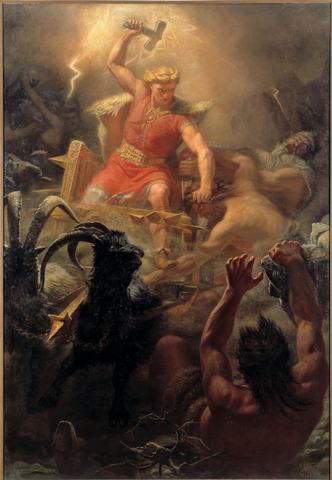
God of Thunder. Son of Odin and the earth, wielder of Mjolnir, and the gods' front line against the giants — fated to fall with the World Serpent.
The stronghold of the AEsir. A walled citadel of halls at the top of the world tree, reached by the rainbow bridge and built on a bargain the gods broke.
Also mentioned inDwarves (Dvergar)Svartalfheim
Sources & Further Reading
- 1.Poetic Edda — Lokasenna, Harbardsljod, Hymiskvida and Thrymskvida (Codex Regius, 13th century).
- 2.Snorri Sturluson, Prose Edda — Gylfaginning (c. 1220).
- 3.Snorri Sturluson, Prose Edda — Skaldskaparmal (c. 1220).
- 4.Poetic Edda — Grimnismal, on Ydalir and Ullr (Codex Regius, 13th century).
- 5.Lindow, John. Norse Mythology — A Guide to the Gods, Heroes, Rituals, and Beliefs. Oxford University Press, 2001.
- 6.Simek, Rudolf. Dictionary of Northern Mythology. Trans. Angela Hall. D.S. Brewer, 1993.
- 7.Turville-Petre, E.O.G. Myth and Religion of the North. Weidenfeld & Nicolson, 1964.
- 8.Larrington, Carolyne (trans.). The Poetic Edda. Rev. ed., Oxford World's Classics, 2014.
Spot an error or have a source to suggest? Write to info@viseterna.com. We cite primary sources and modern scholarship, and we correct fast.