
Skadi (Skaði)
Giantess turned goddess of winter and the hunt. She came armed to Asgard for her father's blood-price and chose a husband by his feet alone.
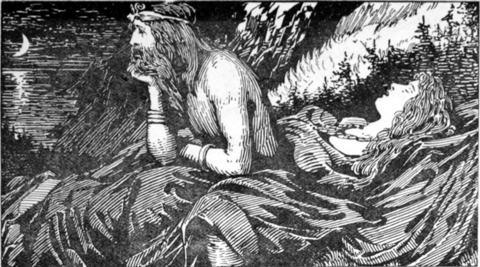
Skadi Hunting in the Mountains, signed 'H. L. M.', 1901 · Public domain · source
The Snowshoe Goddess
Skadi — Old Norse Skaði — is a jotunn by birth who ends up seated among the gods, and the Norse sources never quite resolve the contradiction. Snorri calls her öndurdis and öndurguð, "snowshoe-goddess" and "ski-god", and describes her going about on skis with a bow, shooting game in the mountains 2,3. Her hall is Thrymheim, inherited from her father, high in the rock where the winter never fully leaves.
Her name is grammatically masculine in form, which is unusual for a goddess and has attracted a good deal of comment. Etymologies proposed for it include Old Norse skaði, "harm", and a root meaning "shadow"; the suggestion that Scandinavia preserves her name is old, repeatedly revived, and regarded by most scholars as unproven 6,7.
The Blood-Price for Thjazi
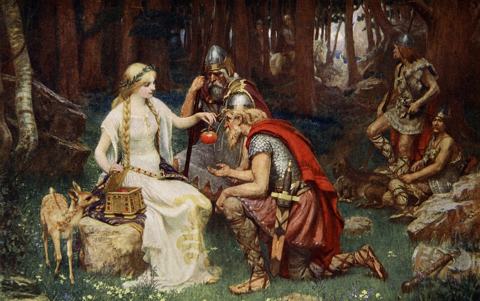
Skadi's father was Thjazi, the giant who abducted Idunn and her apples and was burned to death at the wall of Asgard when he pursued Loki home in eagle shape 3. The oldest surviving version of that story is the ninth-century skaldic poem Haustlong by Thjodolf of Hvinir, which Snorri quotes; his prose account fills in the rest 3.
Skadi then did what any wronged party in Norse law would do: she armed herself with helmet and mail and went to Asgard to take vengeance or take payment. The gods offered settlement, and the terms are among the strangest in the corpus. First, she was to choose a husband from among them by looking at nothing but their feet. Second, they had to make her laugh, which she believed impossible 3.
She saw one pair of feet more beautiful than the rest and took them, expecting Baldr; the man attached to them was Njord of Noatun 3. As for the laughter, Loki tied a cord between a goat's beard and his own body and the two of them pulled and shrieked until he fell into Skadi's lap, and she laughed 3. Snorri adds that Odin completed the atonement by taking Thjazi's eyes and throwing them into the sky as two stars 3. In Harbardsljod, however, Thor claims that deed as his own — one of the flat contradictions between Snorri and the eddic poems, and a reminder that the mythology was never a single fixed system 1,5.
A Marriage That Failed
The marriage to Njord is the best-known thing about Skadi, and it does not last. They agreed to alternate: nine nights in Thrymheim, three at Noatun 2. Snorri gives them a verse apiece. Njord complains that he could not bear the howling of wolves after the song of swans; Skadi answers that the shrieking of gulls over the surf woke her every morning and she could not sleep 2. She went back to the mountains, to the skis and the bow.
Scholars have generally read the pair as an image of two irreconcilable landscapes — the fertile, trafficked shoreline and the barren high country — rather than as a domestic anecdote 5,7. Whatever its original point, the story leaves Skadi permanently ambiguous: married into the Aesir, seated at their feasts in Lokasenna, still a giant's daughter with a giant's grievance.
Skadi, Odin and the Jarls of Hladir
Snorri's Ynglinga saga takes her story further. After leaving Njord she was married to Odin and bore him many sons, of whom Saeming was the ancestor of the jarls of Hladir, the great ruling family of Trondelag 4. Haleygjatal, the dynastic poem by Eyvind Skaldaspillir that Snorri drew on, is the source of this claim, and it is best read as a tenth-century Norwegian house asserting divine descent rather than as an independent myth 4,5. The eddic poem Hyndluljod likewise groups her among the divine genealogies 1.
The Serpent Over Loki
Skadi's last appearance is her coldest. In Lokasenna she is at Aegir's feast when Loki insults every god present. She warns him that his time in the open is short, and that the gods will bind him to a rock with the guts of his own son. Loki answers that she should remember he was foremost among those who killed her father, and she does not deny it 1.
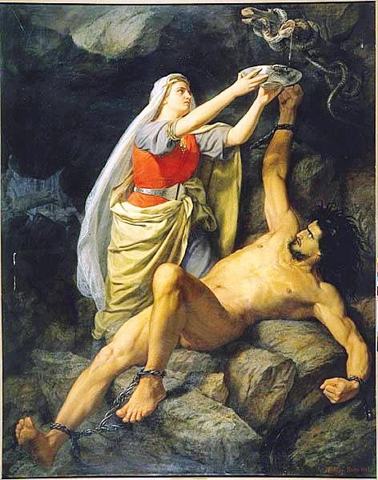
The prose passage appended to the poem, and Snorri's parallel account, then describe the binding — and it is Skadi who fastens a venomous serpent above Loki's face so that the poison drips onto him, with his wife Sigyn holding a bowl to catch it and Loki convulsing whenever she turns away to empty it 1,2. The gods' judgment is collective; the specific cruelty is hers, and the sources present it as the completion of her father's blood-feud, not as a fit of spite 5,6.
Cult and Afterlife
Direct evidence for the worship of Skadi is thin compared with Njord or Freyja. A small number of Swedish place names — Skedvi and its relatives — have been argued to contain her name, but the readings are contested and no reliable liturgical or votive material attaches to her 6,7. What she has instead is an unusually vivid literary presence: a woman who walks into the hall of her enemies in armour, negotiates, marries badly, leaves, and settles the account herself in the end 5,8.
Continue Exploring
Vanir god of harbours, wind and wealth. Sent to the Aesir as a hostage; father of Freyr and Freyja; husband of a mountain giantess, briefly.
Norse goddess who guards the apples that keep the gods young. Her abduction by the giant Thjazi ages the whole pantheon and forces Loki to fetch her back.
The Trickster. Shape-shifter of giant blood counted among the gods — their cleverest ally, the father of monsters, and the spark of Ragnarok.
The stronghold of the AEsir. A walled citadel of halls at the top of the world tree, reached by the rainbow bridge and built on a bargain the gods broke.
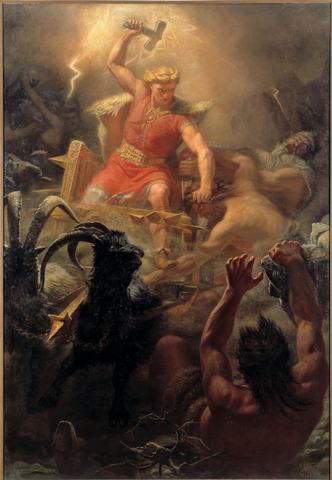
God of Thunder. Son of Odin and the earth, wielder of Mjolnir, and the gods' front line against the giants — fated to fall with the World Serpent.
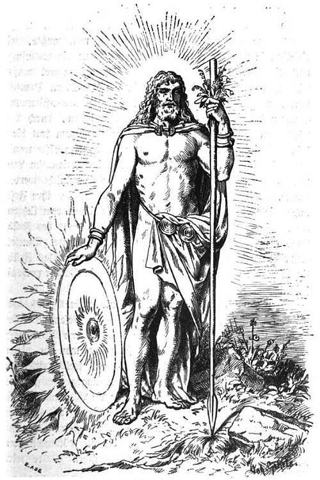
God of Light. The most beloved of the Aesir, made immune to all harm but one plant — and killed by it, which set the world's ending in motion.
Sources & Further Reading
- 1.Poetic Edda — Lokasenna (with its prose ending), Grimnismal and Hyndluljod (Codex Regius, 13th century).
- 2.Snorri Sturluson, Prose Edda — Gylfaginning (c. 1220).
- 3.Snorri Sturluson, Prose Edda — Skaldskaparmal, including Thjodolf of Hvinir's Haustlong (c. 1220).
- 4.Snorri Sturluson, Ynglinga saga, in Heimskringla (c. 1230).
- 5.Lindow, John. Norse Mythology — A Guide to the Gods, Heroes, Rituals, and Beliefs. Oxford University Press, 2001.
- 6.Simek, Rudolf. Dictionary of Northern Mythology. Trans. Angela Hall. D.S. Brewer, 1993.
- 7.Turville-Petre, E.O.G. Myth and Religion of the North. Weidenfeld & Nicolson, 1964.
- 8.Larrington, Carolyne (trans.). The Poetic Edda. Rev. ed., Oxford World's Classics, 2014.
Spot an error or have a source to suggest? Write to info@viseterna.com. We cite primary sources and modern scholarship, and we correct fast.