
Alfheim
The realm of the light-elves, given to Freyr as a baby present — one of the least described places in the Norse cosmos.
The Lovesickness of Frey (Skirnismal), W.G. Collingwood, 1908 · Public domain · source
A Tooth-Gift and Almost Nothing Else
Alfheim owes its entire textual existence to one line. Grimnismal, listing the halls and holdings of the gods, says that in the earliest days the gods gave Freyr the realm of Alfheim as a tannfe — a tooth-gift, the customary present made to an infant on the appearance of its first tooth 1,7. That is the whole of what the Poetic Edda tells us about it: a name, an owner, and the strange domestic detail that an entire world once changed hands as a baby present.
Nothing in the poem describes Alfheim's landscape, its borders, or a single event that happens there. Everything else attributed to the realm — a shining country, elf-halls, a court — is filled in by inference from its inhabitants rather than read off the page 1,4,5.
Light-Elves and Dark-Elves
Snorri supplies the one description of the alfar, "elves," themselves, and even this is organised as a contrast rather than a portrait of Alfheim specifically. In Gylfaginning he distinguishes the ljosalfar, "light-elves," who live in Alfheim and are said to be fairer to look at than the sun, from the dokkalfar, "dark-elves," who live down in the earth and are unlike the light-elves in appearance and, he adds, still more unlike them in nature 2. Beyond that opposition Snorri says little, and the dark-elves he describes here are suspiciously close to the dwarves he discusses elsewhere, a slippage scholars have long noted without fully resolving 2,4,5.
Simek and Lindow both caution against treating this binary as inherited doctrine rather than Snorri's own tidying. Pre-Christian elf-belief, so far as it can be reconstructed from names, charms and later folklore, looks considerably messier than a clean split between bright sky-elves and dark earth-elves — closer to a broad category of powerful, potentially dangerous beings associated with land, mounds and ancestors than to a fixed race with an address 4,5,6.
A Real Sacrifice, If Not a Real Address
The strongest evidence that elf-belief was a living practice, rather than only literary furniture, comes from outside the Eddas entirely. The skald Sigvatr Thordarson, travelling through Sweden around 1019, records in his Austrfararvisur being turned away from a farmstead because the household was holding an alfablot, a sacrifice to the elves, and would not admit a stranger while it was underway 3. The verse survives because Snorri quotes it in Heimskringla, and it is about as concrete as pre-Christian elf-worship gets: a real household, a real closed door, a rite the poet is not allowed to see 3,4.
Nothing connects that ritual to Alfheim as a place. The alfablot was local and domestic, tied to land and family rather than to a cosmological realm across the sky — a reminder that "the elves" as an object of worship and "Alfheim" as a location in Snorri's geography may never have been the same idea to the people who held either belief 3,5,6.
Freyr's Country
What can be said about Alfheim mostly comes by way of its owner. Freyr is a god of fertility, prosperity and the harvest, and the association between him and the alfar — never fully explained in the sources — has struck scholars as fitting: both are linked to the land's yield and, more speculatively, to the cult of the dead in the burial mound 1,4. Whether the elves were imagined as his subjects, his kin, or simply his tenants is not a question the Poetic Edda answers, and Snorri does not return to fill in the gap.
The elves persisted long after the medieval sources thin out, surfacing across Scandinavian folklore as the huldufolk, "hidden people," of later Icelandic belief. Turville-Petre and Simek both flag this continuity as suggestive rather than proven — centuries of oral transmission and later collection stand between the Eddic alfar and the folkloric hidden people, and treating the two as one unbroken tradition overstates what can actually be shown 5,6.
What the Sources Don't Give You
It is worth stating plainly what Alfheim lacks. Unlike Jotunheim, it has no named hall, no described landscape, no visiting god's journey, and no story set within its borders anywhere in the surviving corpus. Unlike Vanaheim, it does not even get a second passing mention to confirm the first. What survives is a single line assigning ownership, a systematising passage from Snorri distinguishing two kinds of elf, and one real fragment of ritual practice that never claims to be about the realm at all 1,2,3.
The modern picture of Alfheim as a shining elf-kingdom with its own court and culture is a reasonable extrapolation for a game or a novel, but it is an extrapolation. Honestly reported, Alfheim is less a described place than a gap the alfar are assumed to fill 1,2,4,5.
Continue Exploring
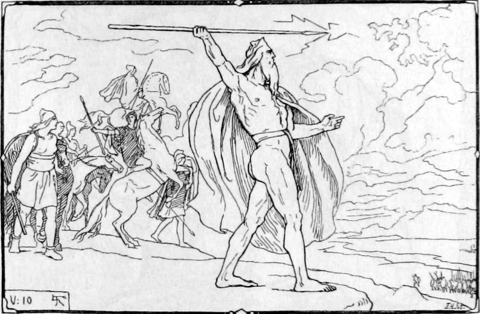
Home of the Vanir — named exactly once in the surviving sources, as the place Njord came from. Everything else about it is inference from its famous emigrants.
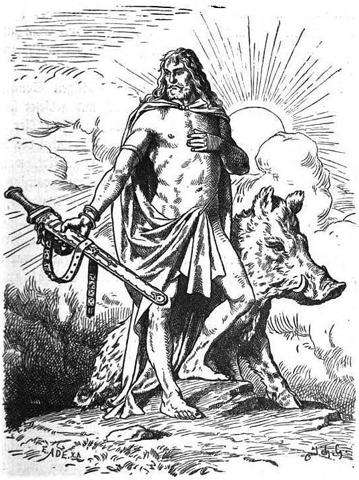
Vanir god of harvest, peace and kingship. Owner of the golden boar Gullinbursti, he traded away his sword for love and pays for it at Ragnarok.
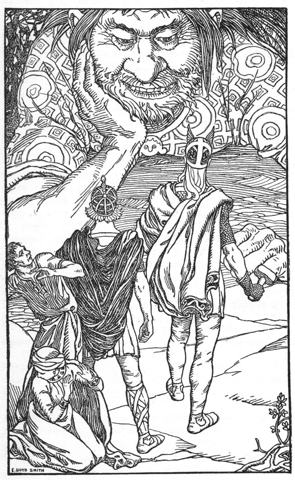
Land of the giants. The wild country east of the fence, older than the gods, holding the wisdom and the brides the AEsir keep going out to take.
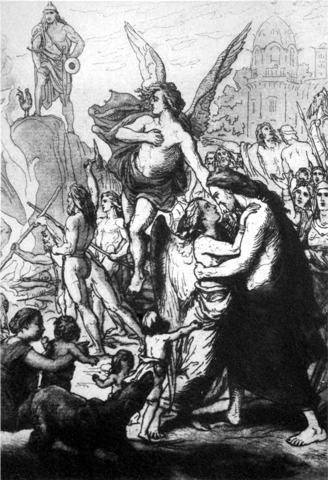
The stronghold of the AEsir. A walled citadel of halls at the top of the world tree, reached by the rainbow bridge and built on a bargain the gods broke.
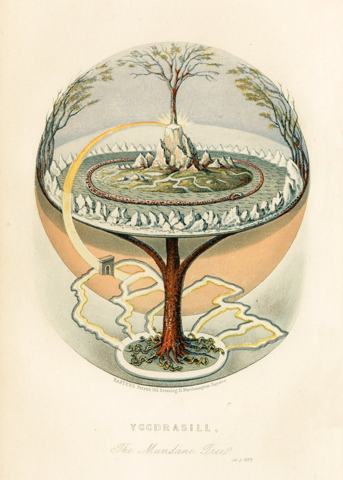
The World Tree. The great ash whose roots reach three wells and nine worlds, tended by the norns, eaten from every side, and still standing when the sky burns.
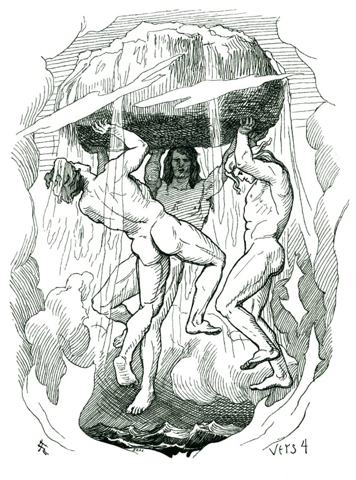
The middle enclosure. The human world, built from a murdered giant's body, fenced by his eyebrows, and ringed by a serpent that will one day let go of its tail.
Sources & Further Reading
- 1.Poetic Edda — Grimnismal (Codex Regius, 13th century).
- 2.Snorri Sturluson, Prose Edda — Gylfaginning (c. 1220).
- 3.Sigvatr Thordarson, Austrfararvisur (c. 1019), preserved in Snorri Sturluson's Heimskringla — Olafs saga helga.
- 4.Lindow, John. Norse Mythology — A Guide to the Gods, Heroes, Rituals, and Beliefs. Oxford University Press, 2001.
- 5.Simek, Rudolf. Dictionary of Northern Mythology. Trans. Angela Hall. D.S. Brewer, 1993.
- 6.Turville-Petre, E.O.G. Myth and Religion of the North — The Religion of Ancient Scandinavia. Weidenfeld & Nicolson, 1964.
- 7.Larrington, Carolyne (trans.). The Poetic Edda. Rev. ed., Oxford World's Classics, 2014.
Spot an error or have a source to suggest? Write to info@viseterna.com. We cite primary sources and modern scholarship, and we correct fast.