
Svartalfheim
The underground realm of the dwarves and their forges — a name that appears only in Snorri Sturluson's Prose Edda, not in the older Poetic Edda at all.
The Rhinegold and the Valkyrie (Wagner), Arthur Rackham, 1910 · Public domain · source
A Name Only Snorri Uses
Svartalfaheimr, "home of the black elves," never once appears in the Poetic Edda. It is Snorri Sturluson's term, used twice in the Prose Edda — once in Skaldskaparmal, when Loki travels there to have treasures forged, and once in Gylfaginning, when the gods send for dwarves to make the chain that will bind Fenrir — and nowhere else in the surviving corpus 2,3. Whether Snorri was naming a real, older piece of tradition or coining a label for a concept the earlier poems left unnamed is genuinely not known, and that uncertainty sits at the centre of this entry 4,5.
Voluspa, by contrast, names a different dwarf-locale entirely: Nidavellir, "the dark fields," said to hold a hall roofed in red gold 1,7. Whether Nidavellir and Svartalfheim are the same place under two names, two neighbouring regions, or two poets' unrelated inventions is a question the sources simply do not settle 1,4,5.
Loki's Debt and the Dwarves' Contest
The fullest scene set in Svartalfheim is also one of the best stories in the Prose Edda. Having cut off Sif's hair as a prank, Loki is sent to the sons of Ivaldi in Svartalfheim to have new hair of real gold made for her, and comes away with two further wonders besides — the ship Skidbladnir and the spear Gungnir 3. Not satisfied with having got so much, Loki then wagers his own head with another dwarf, Brokkr, that Brokkr's brother Eitri cannot match the gifts. Working through a fly's stinging interruptions — Loki in disguise, sabotaging the forge — Eitri and Brokkr produce the boar Gullinbursti, the ring Draupnir, and the hammer Mjolnir, slightly short-hafted from the interrupted bellows-work but judged the finest gift of all 3.
Every one of the Aesir's signature weapons and treasures in this telling comes out of Svartalfheim's forges, made by hands that are never divine. Norse myth is consistent on this point across several realms: real power in Asgard is commissioned from outside it, not manufactured within it, and the dwarves of Svartalfheim are the craftsmen the gods depend on and never quite repay in kind 3,4,6.
Sent for Gleipnir
Svartalfheim's second appearance is more workmanlike. When the ordinary bonds tried on Fenrir all fail, the Aesir send a messenger — Skirnir, in Snorri's account — to the dwarves of Svartalfheim, who forge Gleipnir: a ribbon soft as silk and thin as a thread, made from six impossible ingredients, a cat's footfall, a woman's beard, a mountain's roots, a bear's sinews, a fish's breath, and a bird's spittle 2. Snorri adds the dry aside that this is why none of those six things can be found in the world any more 2.
The errand confirms the pattern set in Skaldskaparmal: Svartalfheim is where the gods go, or send, when a problem needs a craftsman rather than a fighter, and the dwarves who live there always deliver 2,3.
Dwarves, Dark-Elves, and a Confused Taxonomy
Snorri's own vocabulary works against him here. The beings he calls svartalfar, "black elves," in connection with this realm look, in every story, exactly like the dvergar, "dwarves," he writes about at length elsewhere — underground craftsmen born, in his creation account, as maggots in the flesh of Ymir before the gods gave them human wit and form. Whether "black elf" and "dwarf" were ever distinct categories in older belief, or whether Snorri is simply using two words for one thing, is unresolved, and Gylfaginning's separate claim that dark-elves are "unlike" light-elves in nature does nothing to clarify which group Svartalfheim's inhabitants actually belong to 2,4,5.
Clunies Ross reads this kind of overlap as typical of Snorri's method rather than a sign of confusion in the underlying tradition: he is a compiler working scattered kennings and half-remembered story fragments into a single coherent system, and coherence sometimes costs precision 6.
A Modern Realm Built on One Author
It is worth being honest about how thin the foundation here actually is. Nearly everything popular culture knows as "Svartalfheim" — an underground dwarf-kingdom of forges and tunnels, distinct from a separate realm of elves — rests on two short passages in one thirteenth-century Christian author's systematising retelling, not on a body of older poetic tradition comparable to what survives for Jotunheim or Asgard 2,3,4. That does not make the material less real as medieval Icelandic literature, and Snorri's dwarf-craft stories are among the best-told episodes in the whole Prose Edda 3,6. It does mean the realm itself, as opposed to the objects that come out of it, is very much Snorri's own construction, built from fragments — Nidavellir, the dwarves' maggot-origin, the black-elf/dark-elf language — that an earlier poet might never have assembled into one place at all 1,4,5.
Continue Exploring
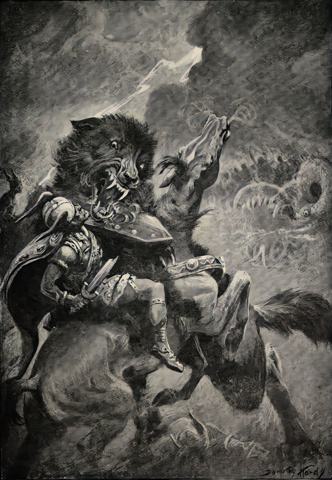
The Bound Wolf. Loki's son, raised among the gods and chained by a trick that cost Tyr his hand — until Ragnarok, when he devours Odin.
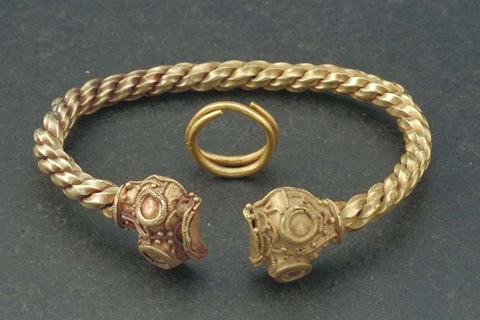
The dripping ring. Odin's gold arm-ring, which sheds eight more of its own weight every ninth night — burned on Baldr's pyre, and sent back from Hel.
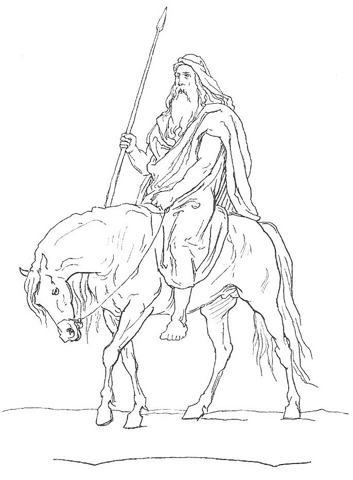
Odin's spear. Dwarf-made, rune-carved, and thrown over an army to hand it to the god of the hanged — the weapon that starts the first war in the world.
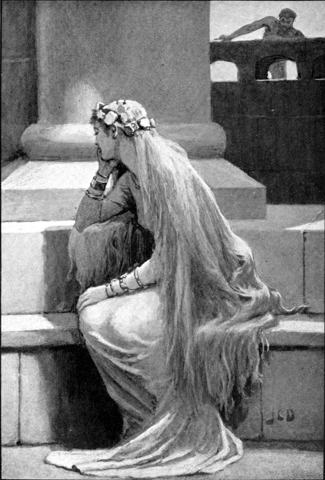
Thor's golden-haired wife, whose shorn hair forced Loki to commission the dwarf-made treasures of the gods, Mjolnir among them.
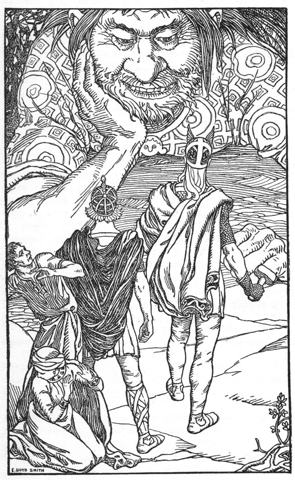
Land of the giants. The wild country east of the fence, older than the gods, holding the wisdom and the brides the AEsir keep going out to take.
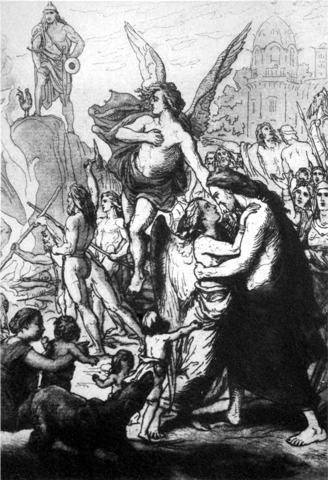
The stronghold of the AEsir. A walled citadel of halls at the top of the world tree, reached by the rainbow bridge and built on a bargain the gods broke.
Sources & Further Reading
- 1.Poetic Edda — Voluspa (Codex Regius, 13th century).
- 2.Snorri Sturluson, Prose Edda — Gylfaginning (c. 1220).
- 3.Snorri Sturluson, Prose Edda — Skaldskaparmal (c. 1220).
- 4.Lindow, John. Norse Mythology — A Guide to the Gods, Heroes, Rituals, and Beliefs. Oxford University Press, 2001.
- 5.Simek, Rudolf. Dictionary of Northern Mythology. Trans. Angela Hall. D.S. Brewer, 1993.
- 6.Clunies Ross, Margaret. Prolonged Echoes — Old Norse Myths in Medieval Northern Society, vol. 1: The Myths. The Viking Collection 7. Odense University Press, 1994.
- 7.Larrington, Carolyne (trans.). The Poetic Edda. Rev. ed., Oxford World's Classics, 2014.
Spot an error or have a source to suggest? Write to info@viseterna.com. We cite primary sources and modern scholarship, and we correct fast.