
Historia Regum Britanniae
Geoffrey of Monmouth's 1136 pseudo-history that invented most of the Arthur legend as we know it, and was believed as literal fact for four centuries.
Merlin and Vortigern, BL Cotton MS Claudius B VII, f.224, c. 1250-1270 · Public domain · source
A Book From an Ancient Source, He Says
Geoffrey of Monmouth, a cleric of Welsh or Breton background working at Oxford, completed the Historia Regum Britanniae around 1136. He opens by claiming to translate it from "a certain very ancient book in the British tongue," supplied to him by Walter, Archdeacon of Oxford, covering the kings of Britain "in a continuous narrative and elegant style" 1. No modern scholar believes this book ever existed in the form Geoffrey describes; it functions as a medieval authenticating device rather than a real citation 4. His actual materials were the real early histories of Britain — Gildas, Bede, the Historia Brittonum attributed to Nennius — stitched together with Welsh genealogical tradition, some borrowed Welsh narrative material including elements later found independently in Culhwch and Olwen, and a great deal that Geoffrey simply composed 4. Surviving copies carry different dedications to different patrons, among them Robert, Earl of Gloucester, and King Stephen, which suggests Geoffrey adjusted the book's political framing more than once before it left his hands 2.
From Troy to the Last King
The Historia tells the story of Britain as one continuous royal line running for nineteen hundred years, opening with the Trojan exile Brutus, who gives the island its name, and closing with Cadwallader, the last king of the Britons, who dies in Rome in the late seventh century 1,4. In between come dozens of invented or barely-attested kings — Lear, Cymbeline, Vortigern — folded into a single dynastic chronicle that reads, deliberately, like a real history rather than a collection of legends 4. It is the earliest surviving text to tell the full story of Lear and his daughters, which reached Shakespeare through later retellings of Geoffrey's version 4.
Arthur's Reign, Written Into Existence
Roughly a fifth of the book is given to King Arthur, and nearly everything most people now think they know about him first appears here. Geoffrey narrates Arthur's conception at Tintagel, where Merlin disguises Uther Pendragon as Ygerna's husband Gorlois; Arthur's sword Caliburnus, forged on the isle of Avalon; a continental campaign that defeats a Roman army; and the final battle against the traitor Mordred, after which the wounded king is carried to Avalon and the narrative pointedly declines to say he died 1. Geoffrey had already given Merlin his own set-piece earlier in the book, the Prophetiae Merlini, delivered to the British king Vortigern as a sequence of cryptic political prophecies that circulated separately and were taken with total seriousness by contemporary readers 1,4.
Two Hundred Manuscripts
The Historia was a medieval bestseller. More than two hundred manuscript copies survive, several dozen of them from the twelfth century alone, an extraordinary rate of copying for a secular Latin text of the period 2,4. The manuscript tradition is not uniform — scholars distinguish a "vulgate" version, a shorter "first variant," and other recensions that rewrite individual episodes — and Michael Reeve and Neil Wright's 2007 edition is built on the Bern manuscript, now judged the best surviving witness to Geoffrey's own text 2.
Believed as History
For roughly four hundred years the Historia was read as a genuine chronicle rather than a literary invention, and it did real political work: English and later Tudor writers used its account of a unified, glorious Britain to justify claims to Wales and Scotland, and Welsh writers used it to assert that the Britons, not the English, were the island's rightful heirs 4. Serious doubt did not become mainstream until the Italian humanist historian Polydore Vergil attacked its reliability in the early sixteenth century, and even then the debate over Arthur's historicity that Geoffrey's book had started took centuries longer to resolve into the modern scholarly consensus that the Historia has essentially no independent value as history 4.
What Scholars Argue About Now
Current debate centres less on whether the Historia is history — it is agreed that it is not — than on how Geoffrey built it: how much of his non-Arthurian material reflects real, lost Welsh tradition rather than his own invention, how the different recensions relate to one another and to his authorship, and how directly his Arthur shaped the vernacular romance tradition that followed, from Wace's Roman de Brut to Malory's Le Morte d'Arthur two and a half centuries later 3,4,6. What is not in dispute is the scale of the achievement: a single Latin book, written to entertain and flatter twelfth-century patrons, supplied nearly the entire narrative skeleton of what would later be called the Matter of Britain, the whole later Arthurian tradition built on Geoffrey's foundation 4,5.
Continue Exploring
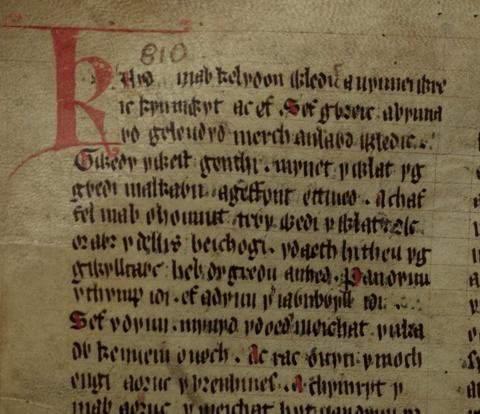
Wales's earliest surviving Arthur story: a cursed suitor, an impossible bride-price, and Arthur's warband of superhuman heroes hunting a giant enchanted boar.

The Cornish clifftop where Geoffrey of Monmouth set Arthur's conception, and where archaeology has since found a real, wealthy post-Roman stronghold.
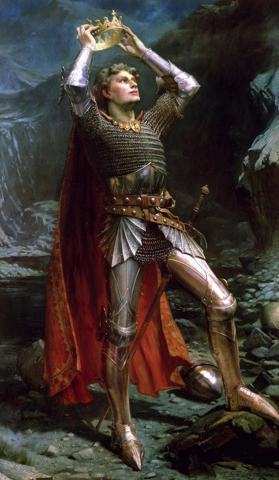
The once and future king: a shadowy British war-leader who medieval writers rebuilt into the emperor of Camelot and the Round Table.
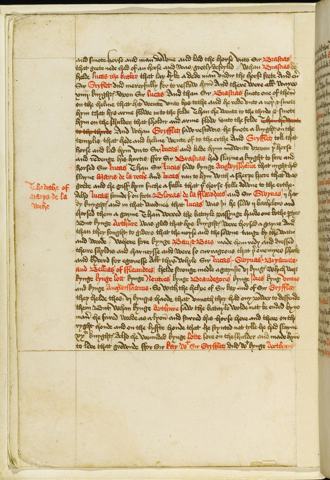
Thomas Malory's 15th-century compilation of the whole Arthurian legend, printed by Caxton in 1485 and rediscovered in a lost manuscript in 1934.
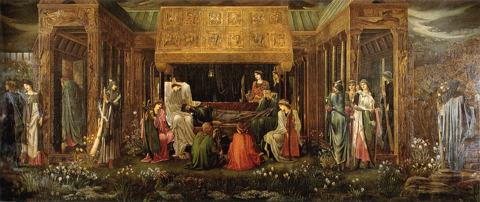
The isle of apples: the healing island where Excalibur was forged and where the wounded Arthur was carried, neither dead nor returned.
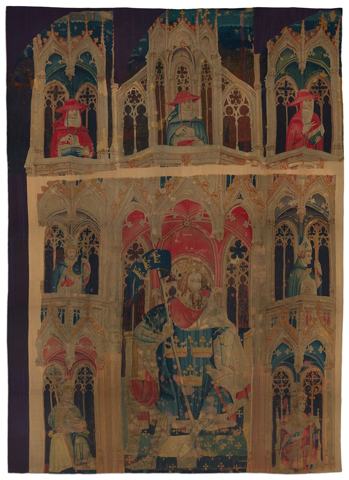
The medieval term for the whole Arthurian tradition, coined around 1200 to separate British legend from the Matter of France and the Matter of Rome.
Sources & Further Reading
- 1.Geoffrey of Monmouth, Historia Regum Britanniae (c. 1136).
- 2.Reeve, Michael D. (ed.), and Neil Wright (trans.). Geoffrey of Monmouth: The History of the Kings of Britain, an Edition and Translation of De gestis Britonum. Woodbridge: Boydell Press, 2007.
- 3.Thorpe, Lewis (trans.). Geoffrey of Monmouth: The History of the Kings of Britain. Harmondsworth: Penguin Classics, 1966.
- 4.Faletra, Michael A. (trans.). The History of the Kings of Britain. Peterborough, Ontario: Broadview Press, 2008.
- 5.Tatlock, J. S. P. The Legendary History of Britain: Geoffrey of Monmouth's Historia Regum Britanniae and Its Early Vernacular Versions. Berkeley: University of California Press, 1950.
- 6.Lacy, Norris J. (ed.). The New Arthurian Encyclopedia. New York: Garland, 1991.
Spot an error or have a source to suggest? Write to info@viseterna.com. We cite primary sources and modern scholarship, and we correct fast.