
The Round Table
The table without a head: invented in 1155 to stop knights fighting over precedence, it became the name of Arthur's whole fellowship.
The Grail appears to the knights of the Round Table, Evrard d'Espinques, c. 1475 (BnF Fr. 116, Bibliotheque nationale de France) · Public domain · source
An Invention of 1155
The Round Table does not appear in Geoffrey of Monmouth. It enters the legend in Wace's Roman de Brut, the Norman French verse adaptation of Geoffrey completed in 1155, in a short passage that turns out to be one of the most productive dozen lines in medieval literature. Wace explains that King Arthur's barons all claimed to be the best, and that none could be seated above another without offence, so the king had a round table made at which every man sat at the head and none at the foot 1,7. Wace adds that the Britons tell many tales about it, which may be true or may be the standard medieval gesture towards an authority that does not exist 8.
The idea is essentially political, and it was invented in a court culture preoccupied with rank and seating. That is why it travelled so well: a table with no head is a picture of a problem every twelfth-century hall actually had.
Layamon's Bloody Origin Story
Around 1200 the English priest Layamon retold Wace in alliterative verse and supplied a violent backstory. At a Christmas feast a quarrel over who is served first turns into a brawl, men are killed with fists, bowls and knives, and Arthur puts down the riot with a savagery that includes mutilating the offenders' kin. Afterwards a Cornish craftsman offers to build him a table that can seat sixteen hundred and more, at which all are equal, and which can be carried wherever the king rides 2. Layamon's table is a piece of crisis management, not a symbol of harmony, and the memory of what it was built to prevent never quite leaves the tradition.
The Third Table
Robert de Boron folded the object into salvation history. In his Merlin, the Round Table is the third of three: after the table of the Last Supper, and after the table Joseph of Arimathea established for the Holy Grail, Merlin makes a third for Uther Pendragon in imitation of the first two 3. This gives the fellowship a sacred lineage and introduces its most famous feature — the empty place. On the Grail table one seat had been left vacant for the traitor Judas; on the Round Table the equivalent seat, the Siege Perilous, destroys any man who sits in it who is not the destined Grail knight 3,8.
The Fellowship and the Siege Perilous
In the thirteenth-century prose cycles and in Malory, the table passes to Arthur as part of Guinevere's dowry from her father Leodegrance, arriving with a hundred knights already sworn to it and room for many more 4,5. Malory sets the complement at a hundred and fifty, and describes how each seat carries its occupant's name in gold letters that appear and vanish as knights die and are replaced — a small, brilliant image of an institution outliving its members.
By this stage "the Round Table" has stopped meaning a piece of furniture at all. It names the fellowship, its oath — to do no outrage, to grant mercy, to give ladies succour, never to fight in a wrongful quarrel — and the standard against which every knight in the legend is measured 5. When Galahad finally sits in the Siege Perilous at the opening of the Grail quest, the fellowship is complete for exactly one day before the quest begins to destroy it 5.
The Table at Winchester
There is a Round Table you can visit. A vast oak disc, roughly five and a half metres across and weighing more than a tonne, hangs in the great hall of Winchester Castle, painted with a green and white Tudor design, the names of twenty-four knights around the rim, and a figure of King Arthur enthroned at the top. In 1976 it was taken down and examined by a team assembled by the archaeologist Martin Biddle, using dendrochronology, radiocarbon dating and structural analysis 6.
The findings are a good lesson in how legend and politics interact. The table is genuinely medieval but not Arthurian: it was made in the reign of Edward I, probably as the centrepiece of a tournament feast, and originally stood on twelve legs. Edward III, who in 1344 vowed to found a Round Table of his own at Windsor and instead created the Order of the Garter, seems to have had it hung on the wall. The paint is later still: it was decorated for Henry VIII in the early sixteenth century, and the Arthur enthroned above the names bears a conspicuous resemblance to Henry himself 6,7.
Why It Endured
Round-table tournaments were held across Europe from the thirteenth century, in which nobles took the names of Arthur's knights and fought under them; the Garter, and later chivalric orders across the continent, drew directly on the idea 6,7. The phrase survives in ordinary English — a round-table discussion, round-table talks — with its original meaning intact: a meeting in which no one is seated above anyone else. Very few invented objects have had a longer or more practical afterlife.
Continue Exploring
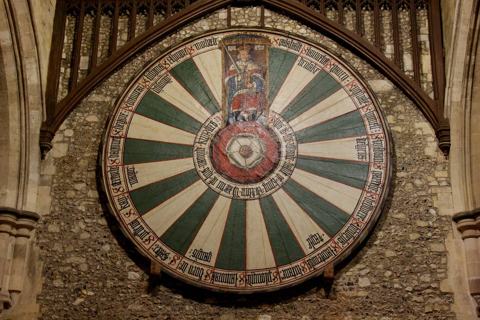
The real oak Round Table hanging in Winchester's Great Hall: tree-ring dated to the reign of Edward I, not Arthur's, and repainted for Henry VIII.
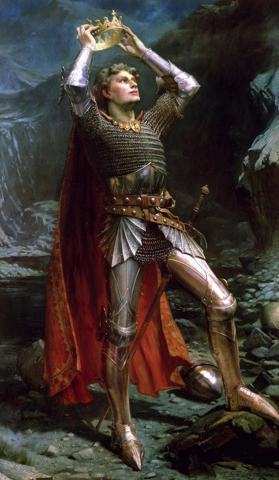
The once and future king: a shadowy British war-leader who medieval writers rebuilt into the emperor of Camelot and the Round Table.
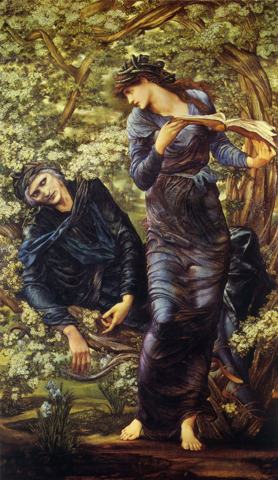
Britain's prophet and enchanter: a mad Welsh seer whom Geoffrey of Monmouth rebuilt as the wizard who made Arthur possible.
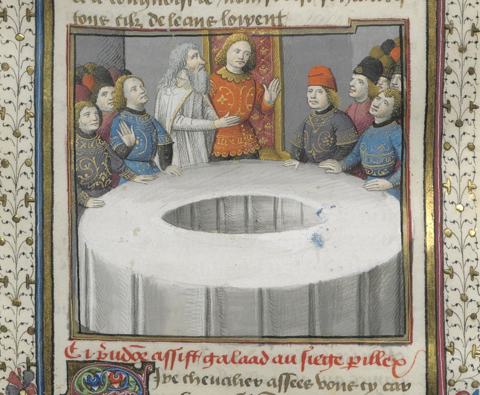
The vacant place at the Round Table that kills any knight who sits in it unworthily, kept for the one who would achieve the Holy Grail.
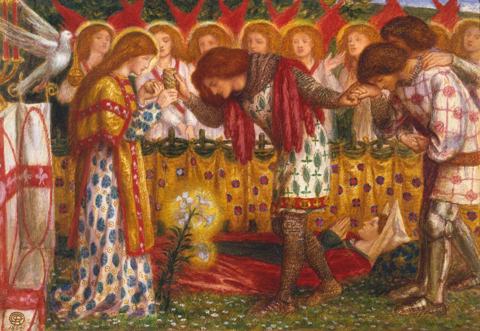
The vessel of the quest: a serving dish in an unfinished French poem that became Christendom's most famous relic and the ruin of the Round Table.
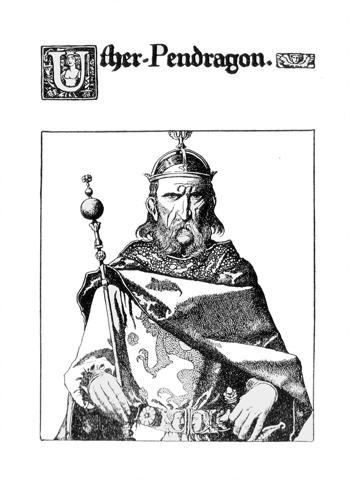
The dragon-star king whose deceit, arranged by Merlin, conceived King Arthur at Tintagel. A thin Welsh figure before Geoffrey of Monmouth gave him a full story.
Also mentioned inCulhwch and OlwenGalahadLe Morte d'ArthurThe Battle of CamlannThe Matter of BritainTristan and Iseult
Sources & Further Reading
- 1.Wace, Roman de Brut (1155).
- 2.Layamon, Brut (c. 1200).
- 3.Robert de Boron, Merlin (c. 1200).
- 4.The Vulgate Cycle: Estoire de Merlin and Lancelot (c. 1215-1235).
- 5.Thomas Malory, Le Morte Darthur (printed by William Caxton, 1485), Books III and XIII.
- 6.Biddle, Martin. King Arthur's Round Table: An Archaeological Investigation. Woodbridge: Boydell Press, 2000.
- 7.Barber, Richard. King Arthur: Hero and Legend. Woodbridge: Boydell Press, 1986.
- 8.Lacy, Norris J. (ed.). The New Arthurian Encyclopedia. New York: Garland, 1991.
Spot an error or have a source to suggest? Write to info@viseterna.com. We cite primary sources and modern scholarship, and we correct fast.