
Sir Bors
Lancelot's cousin and one of three knights who achieve the Holy Grail, and the only one who lives to tell the court what happened at Sarras.
Sir Bors de Ganis, Howard Pyle, 1907 · Public domain · source
The Middle Brother
Bors is the son of King Bors of Gaunes and brother of Lionel, and through their father's brother King Ban of Benoic he is first cousin to Lancelot 1. When Claudas of the Desert Land conquers both kingdoms, the orphaned boys are carried off with their cousin and raised together by the Lady of the Lake, which makes Bors one of a small circle of knights whose whole childhood happens underwater, outside ordinary human society, before they are returned to claim their names at King Arthur's court 1. He grows into one of the best knights of the Round Table, respected as much for conscience as for combat.
A Knight of Two Loyalties
What distinguishes Bors from most of Arthur's court is that his two great loyalties, to family and to God, are allowed to pull against each other rather than sitting comfortably together. He is devoted to Lancelot and follows him into exile and open war against Arthur when the queen's affair is exposed, yet he is also one of the few knights the Grail romances treat as genuinely, if imperfectly, virtuous 2,4,6. That imperfection is specific: unlike the wholly chaste Galahad, Bors fathers a son, Elyan the White, in a single lapse brought about by a trick very like the one played on Lancelot at Corbenic, and the text treats it as a real failing rather than an excuse 1,7.
Temptation on the Road to the Grail
The clearest test of his character comes mid-quest. A devil takes the form of a beautiful woman and offers herself to him on a rock, threatening that twelve gentlewomen in her company will throw themselves from a tower to their deaths if he refuses her 2,5. Bors prays instead of yielding, and the whole scene collapses into shrieking devils and vanishing illusions the instant he makes the sign of the cross 2. It is the nearest Malory's text comes to putting Bors through Galahad's kind of trial, and he passes it, which is part of why he is allowed to go as far into the mystery as he does.
Brother Against Brother
A harder test follows almost immediately. Riding out, Bors comes upon two crises at once: a maiden about to be assaulted, and his own brother Lionel, bound and about to be executed by a rival knight. He chooses to save the stranger, judging her need the more urgent and the more morally clear-cut claim, and returns to find Lionel alive but murderously angry at having been left 2. Lionel attacks him outright, and Bors is saved only by a hermit's intervention, understood in the text as a mark of divine favor toward the choice he made 2. Few episodes in the Grail romances state as starkly that the quest can require setting kinship itself aside.
Sole Witness at Sarras
Bors, Galahad, and Percival are the three knights who together achieve the Holy Grail, and Bors is the one who survives to bring the story home. After Galahad's death and the Grail's ascent from the holy city of Sarras, Bors alone returns to Camelot and recounts everything that happened on the quest before the assembled court, where, in the fiction the romances maintain, his account becomes the written record the reader has just finished 2,4. He is, structurally, the source of his own story.
The Last Loyal Knight
When the affair between Lancelot and Guinevere is exposed, Bors stands by his cousin through the civil war that follows, fighting on his side against Gawain's kin and going into exile with him rather than staying loyal to Arthur 3,4. After Arthur's death at Camlann and Lancelot's own death as a penitent hermit, Malory's closing chapter sends Bors and a handful of the surviving knights to the Holy Land, where they fight and, within a few years, die on campaign — a quiet, almost anticlimactic end for a man who had already seen the one true miracle of the story at Sarras 4.
Continue Exploring
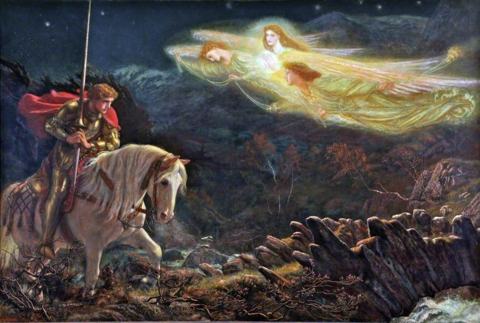
Lancelot's son, invented to succeed where his father failed. The spotless knight who filled the Siege Perilous and achieved the Holy Grail.
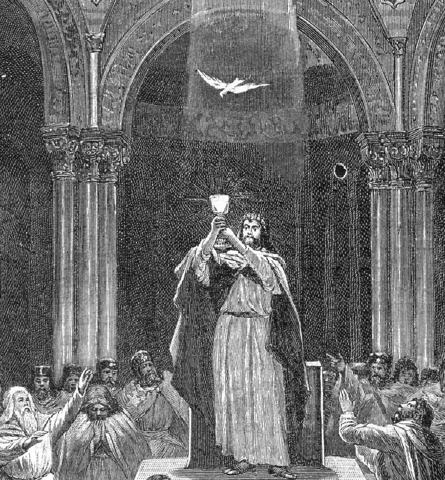
The forest-raised innocent who found the Grail castle and failed to ask the one question that mattered. Arthurian romance's first Grail knight.
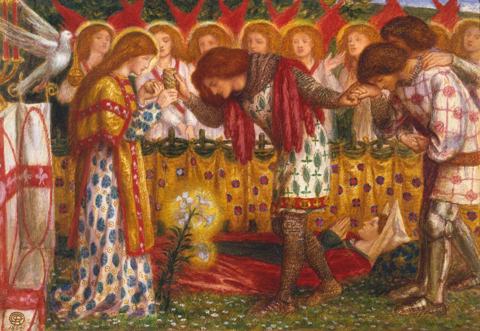
The vessel of the quest: a serving dish in an unfinished French poem that became Christendom's most famous relic and the ruin of the Round Table.
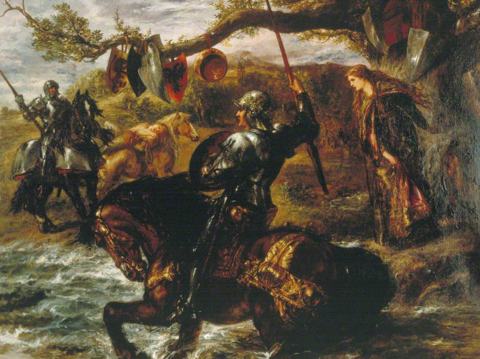
First knight of the Round Table: a French invention raised by a lake fay, whose love for the queen makes him the best knight and ruins the kingdom.
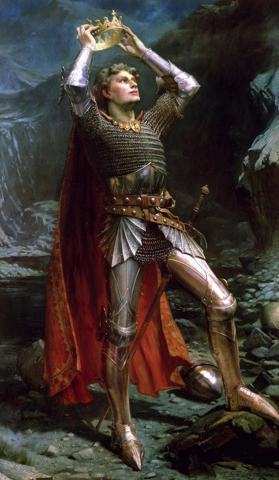
The once and future king: a shadowy British war-leader who medieval writers rebuilt into the emperor of Camelot and the Round Table.
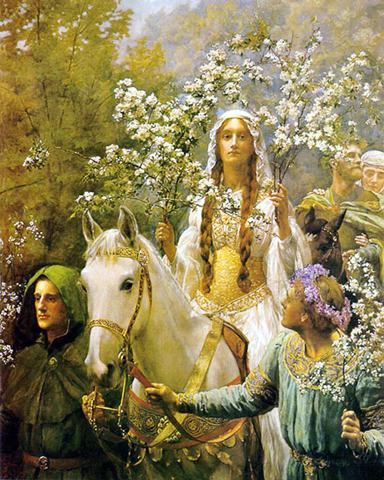
Queen of Britain and Arthur's wife: a figure repeatedly stolen, blamed and reinvented, whose love for Lancelot brings the Round Table down.
Sources & Further Reading
- 1.The Vulgate Cycle: Lancelot (c. 1215-1220).
- 2.La Queste del Saint Graal, in the Vulgate (Lancelot-Grail) Cycle (c. 1215-1235).
- 3.La Mort le Roi Artu, in the Vulgate Cycle (c. 1215-1235).
- 4.Thomas Malory, Le Morte Darthur (printed by William Caxton, 1485), Books XI-XVII and XX-XXI.
- 5.Matarasso, Pauline (trans. and intro.). The Quest of the Holy Grail. Penguin Classics, 1969.
- 6.Kibler, William W. (ed.). The Lancelot-Grail Cycle: Text and Transformations. Austin: University of Texas Press, 1994.
- 7.Lacy, Norris J. (ed.). The New Arthurian Encyclopedia. New York: Garland, 1991.
Spot an error or have a source to suggest? Write to info@viseterna.com. We cite primary sources and modern scholarship, and we correct fast.