
Sir Kay
Arthur's foster-brother and seneschal. A magic-gifted warrior in Welsh tradition who became the sharp-tongued butt of French romance.
Sir Kay showeth the mystic sword unto Sir Ector, Howard Pyle, 1903 (The Story of King Arthur and His Knights) · Public domain · source
Cai in the Welsh Tradition
Long before he became a figure of fun, Kay was one of the most formidable men in Arthur's warband. The Welsh tale Culhwch and Olwen introduces him as Cai fab Cynyr and immediately lists his gifts, which are frankly supernatural: he can hold his breath underwater for nine days and nine nights, no physician can heal a wound from his sword, he can make himself as tall as the tallest tree in the forest, and his natural heat is so great that in rain his burden stays dry and in the cold his companions kindle their fire from him 1,6. He is the first man Culhwch asks for, and he leads the party that hunts down the giant Ysbaddaden's impossible demands 1.
The early poem Pa gur yv y porthaur? is even more emphatic. In its catalogue of Arthur's men, Cai is the one who fights lions, kills nine witches on the uplands of Ystafngwn, and goes against Palug's Cat on Anglesey; the poem gives him more lines than Arthur 2,6. Whatever Kay later became, in the oldest surviving material he is a champion of the first rank 6,7.
He is also, already, difficult. In Culhwch he takes lasting offence at a mocking verse Arthur composes at his expense and withdraws from the king's service, refusing to help even in extremity — a sulk the narrator records without excusing 1,7. Scholars have therefore been cautious about treating his later boorishness as purely a French invention; the prickliness looks native, even if the incompetence does not 6,7,8.
Foster-Brother to the King
The relationship that defines Kay in the later tradition is family. He is the son of Sir Ector, into whose household the infant Arthur is given to be raised in secret, which makes Kay Arthur's elder foster-brother and, in some versions, his milk-brother 5,8. Malory turns this into the hinge of the whole accession story: Kay is newly knighted, rides to the tournament in London on New Year's Day, and finds he has left his sword behind. Arthur, serving as his squire, goes looking for a replacement and pulls the sword from the stone in the churchyard instead 5.
Kay's first instinct is to claim the sword as his own. His father makes him swear on a book how he came by it, and Kay confesses. It is a small, human failure, and Malory neither forgives nor condemns it — but he does make Arthur's first act as king the appointment of Kay as seneschal of Britain for life, an office Kay holds without interruption to the end of the reign 5,7.
Geoffrey's Seneschal
Geoffrey of Monmouth, writing about 1136, is the first to give Kay that office formally. In the Historia Regum Britanniae he is Caius, Arthur's steward or dapifer, granted the province of Anjou after the conquest of Gaul and serving at the great crown-wearing at Caerleon among the highest of the king's men 3. He is present with Bedivere at the killing of the giant of Mont-Saint-Michel, and in the Roman war he is mortally wounded in the fighting and carried to Chinon, the town Geoffrey says he had himself built, and buried there 3,8.
That version of Kay is unambiguously heroic. Welsh tradition offers a different death, in which Cai is slain by one Gwyddawg, whom Arthur then kills in vengeance; the two accounts have never been reconciled and probably descend from separate stories 6,7.
The Sharp Tongue of French Romance
Chretien de Troyes fixed the character most readers now recognise. In his romances Kay is the seneschal who insults arriving strangers, demands rash boons, mocks better knights and is regularly unhorsed for it 4,7. In Le Chevalier de la Charrette he extracts from Arthur the right to escort Guinevere and promptly loses her to Meleagant, leaving Lancelot to make the rescue. In Erec and Yvain he is the first to speak and the first to fall 4.
The literary function is clear enough. A court needs a voice of ordinary malice for the hero to overcome, and a king surrounded only by flatterers is dull; Kay supplies the friction 7,8. Some scholars have suggested the seneschal's office itself invited the caricature, since a household steward controls access, food and precedence, and is therefore the natural target of everyone's resentment 7,8. Notably, the romances almost never make him a coward or a traitor. He is rude, hasty and outmatched, but he stays.
Malory and After
Malory inherits the French Kay and softens him. He is still mocking — it is Kay who saddles Gawain's young brother Gareth with the kitchen-boy nickname Beaumains and is unhorsed by him for it — but he is also steady, loyal to Arthur through the civil war with Lancelot, and dies in the king's service 5. The comic seneschal and the Welsh champion coexist uneasily in the same book, which is a fair description of the character's whole history 7,8.
Modern retellings have tended to pick one side or the other: T. H. White's jealous, insecure Kay, the blustering comic of film and television, or occasionally a rehabilitated Cai closer to the Welsh original. All of them are, in some sense, textually defensible 7,8.
Continue Exploring
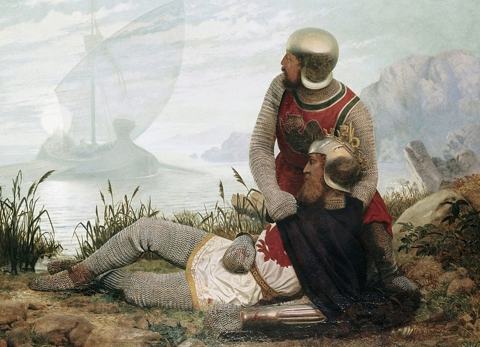
The one-handed spearman of Welsh tradition who became the knight who returned Excalibur to the lake and carried Arthur to the barge.
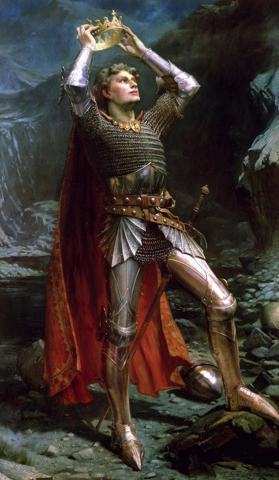
The once and future king: a shadowy British war-leader who medieval writers rebuilt into the emperor of Camelot and the Round Table.
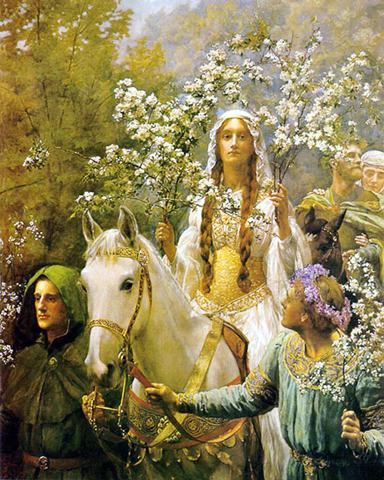
Queen of Britain and Arthur's wife: a figure repeatedly stolen, blamed and reinvented, whose love for Lancelot brings the Round Table down.
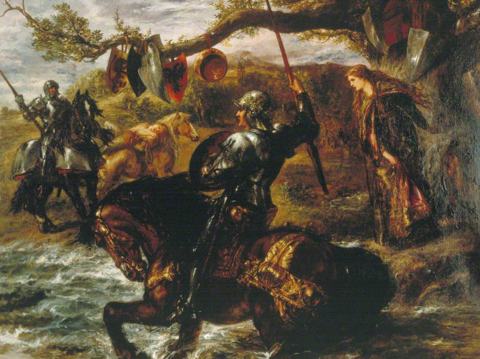
First knight of the Round Table: a French invention raised by a lake fay, whose love for the queen makes him the best knight and ruins the kingdom.
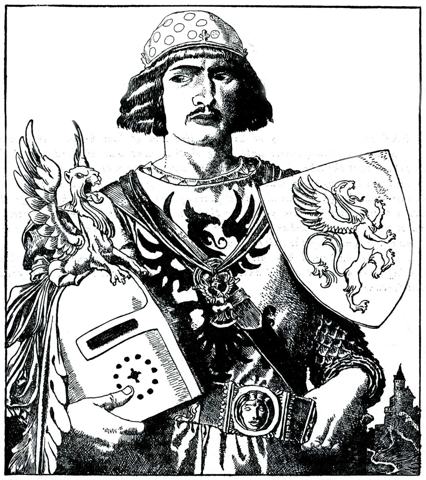
The courteous knight and Arthur's nephew: England's favourite of the Round Table, demoted by French romance and redeemed by an English poet.
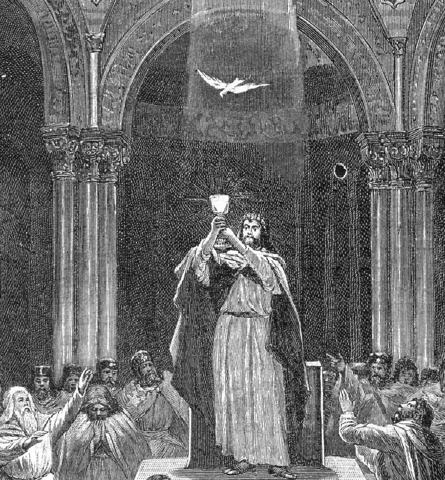
The forest-raised innocent who found the Grail castle and failed to ask the one question that mattered. Arthurian romance's first Grail knight.
Also mentioned inCulhwch and Olwen
Sources & Further Reading
- 1.Culhwch and Olwen, in the Mabinogion (Welsh prose, perhaps c. 1100; surviving in 14th-century manuscripts).
- 2.Pa gur yv y porthaur? ("What man is the gatekeeper?"), Black Book of Carmarthen (13th century).
- 3.Geoffrey of Monmouth, Historia Regum Britanniae (c. 1136).
- 4.Chretien de Troyes, Erec et Enide, Le Chevalier de la Charrette and Yvain (c. 1170-1180).
- 5.Thomas Malory, Le Morte d'Arthur (completed c. 1469-70; printed by William Caxton, 1485).
- 6.Bromwich, Rachel. Trioedd Ynys Prydein - The Triads of the Island of Britain. 4th ed., University of Wales Press, 2014.
- 7."Kay", The Camelot Project, Robbins Library Digital Projects, University of Rochester.
- 8.Lacy, Norris J. (ed.). The New Arthurian Encyclopedia. Garland, 1991.
Spot an error or have a source to suggest? Write to info@viseterna.com. We cite primary sources and modern scholarship, and we correct fast.