
Glastonbury (Isle of Avalon)
The Somerset abbey that announced Arthur's grave in 1191, almost certainly a fundraising fiction, and became identified with Avalon ever after.
Former grave site of King Arthur, Glastonbury Abbey, photograph by Tom Ordelman, 1984 · CC BY-SA 3.0 · source
An Island Before the Drains
Glastonbury sits on a low rise in the Somerset Levels that, before large-scale medieval and early modern drainage, really was close to an island, ringed by marsh and seasonal flood 3,6. Its Welsh name, Ynys Witrin, "the isle of glass," is recorded from an early date and gave later writers an obvious hook for identifying the place with the legendary otherworld island of Avalon, to which the mortally wounded King Arthur is carried after the Battle of Camlann that ends his reign 3. The identification is a medieval interpretation layered onto a real, and genuinely striking, piece of local geography rather than something the earliest Arthurian texts state outright 6.
Joseph, the Grail, and a Thorn
Glastonbury's other great legend predates the Arthur connection and eventually merged with it. William of Malmesbury's early history of the abbey, written around 1129, already promotes Glastonbury as an exceptionally ancient foundation; later interpolations, added to his text and to the wider tradition across the thirteenth century, elaborated this into a claim that Joseph of Arimathea himself founded a church there in the first century, carrying with him relics connected to the Holy Grail 2,3. Attached to this story is the Glastonbury Thorn, a hawthorn traditionally said to have sprung from Joseph's staff when he planted it on Wearyall Hill; the specific double-flowering cultivar associated with the legend is attested from the sixteenth century, was cut down as a royalist symbol during the Civil War, and survived only because cuttings had already been grafted onto other trees in and around the town, including one grown as part of a hedge, from which the abbey's own tree and its royal Christmas-branch tradition descend 3. Carley's history of the abbey treats both the Joseph legend and the Thorn as part of the same long promotional tradition that later produced the Arthur grave 3.
The Grave of 1191
In 1191 monks digging in the abbey cemetery, prompted by what Gerald of Wales says was information from an aged Welsh bard, uncovered a hollowed oak trunk some sixteen feet down between two ancient stone pyramids 1. Gerald, who visited soon after and spoke to those involved, describes bones of remarkable size, a skull marked by ten old wounds, a woman's plait of golden hair that crumbled to dust when touched, and, laid above the coffin, a lead cross inscribed to the effect that here lay the renowned King Arthur, buried in the isle of Avalon, with Guinevere his second wife 1.
A Fire and a Convenient Discovery
Glastonbury Abbey had burned catastrophically in 1184, and the community faced a huge and expensive rebuilding programme without its usual pilgrim income 3. The discovery, seven years later, of the most famous grave in Britain was, to virtually every modern historian, too well timed to be coincidence: it gave the abbey a spectacular new relic to draw pilgrims and money, and it suited the Angevin crown, which had reason to want the Britons' hoped-for once-and-future king declared safely and permanently dead rather than a live rallying point for Welsh and Breton resistance 3,6. The lead cross itself, which survived long enough to be sketched by the antiquarian William Camden in the early seventeenth century, is lettered in a script that later palaeographers judge inconsistent with a genuine sixth-century original 3. The bones, real or invented, were reburied with great ceremony before the high altar in 1278 in the presence of Edward I and Queen Eleanor 1,3.
Digging Again
Twentieth-century archaeology did not settle the question so much as complicate it further. Excavations directed by C. A. Ralegh Radford in the 1950s and 1960s identified what he described as an early, isolated burial pit south of the Lady Chapel, roughly where the medieval monks claimed to have dug, and Radford argued this supported the story's basic outline even while doubting the specific identification with Arthur 4. A full reassessment of Radford's excavation archive, published by Roberta Gilchrist and Cheryl Green for the Society of Antiquaries in 2015, found that his own records do not clearly support an early date or a special status for that pit at all, and that the evidence is at least as consistent with a much more mundane later medieval feature 4. Independently, the same programme of re-analysis confirmed genuine Roman and Saxon activity on the site, underlining that Glastonbury was a real and long-occupied religious centre quite apart from the Arthur story grafted onto it 4,5.
Present Status
Henry VIII's dissolution reached Glastonbury in 1539; its last abbot, Richard Whiting, was executed on the Tor for resisting surrender, and the abbey has stood in ruins ever since 3. Today the site is a Grade I listed scheduled monument and a major visitor attraction drawing over 100,000 people a year, with the traditional grave location still marked by a sign on the abbey lawn, a monument to a story that scholars are confident is fiction and that the public has never quite been willing to let go 3,6.
Continue Exploring
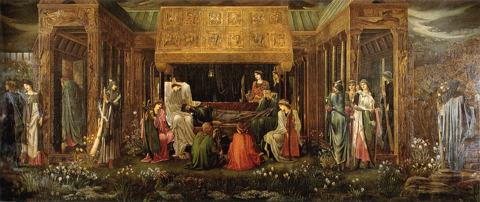
The isle of apples: the healing island where Excalibur was forged and where the wounded Arthur was carried, neither dead nor returned.
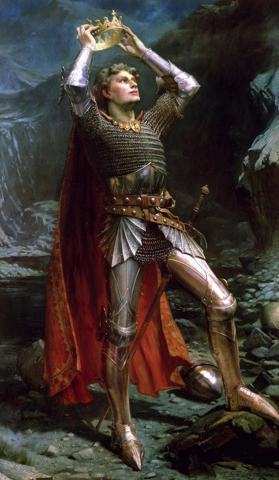
The once and future king: a shadowy British war-leader who medieval writers rebuilt into the emperor of Camelot and the Round Table.
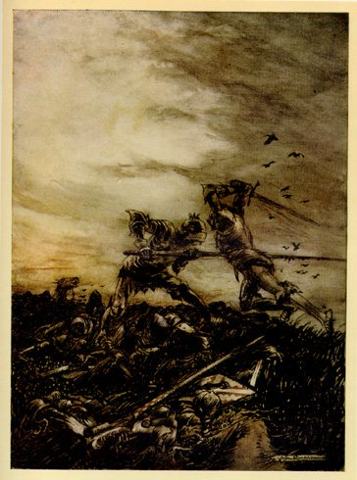
The battle that ended Arthur's reign: a single line in a medieval annal grew, over nine centuries, into the mutual destruction of Arthur and Mordred.
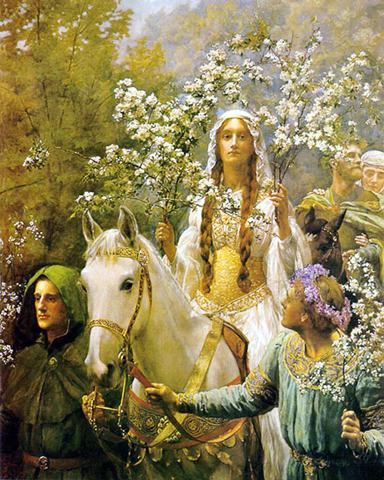
Queen of Britain and Arthur's wife: a figure repeatedly stolen, blamed and reinvented, whose love for Lancelot brings the Round Table down.
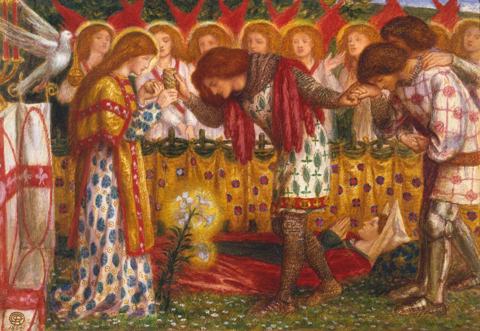
The vessel of the quest: a serving dish in an unfinished French poem that became Christendom's most famous relic and the ruin of the Round Table.
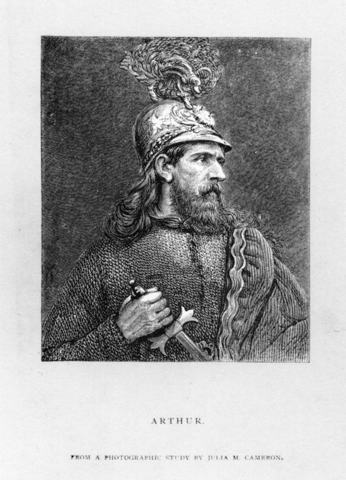
Tennyson's Victorian retelling of the Arthur story in blank verse, published across 26 years — the most influential English version of the legend after Malory.
Sources & Further Reading
- 1.Gerald of Wales (Giraldus Cambrensis). De Principis Instructione (c. 1193) and Speculum Ecclesiae (c. 1216), on the Glastonbury exhumation.
- 2.William of Malmesbury, De Antiquitate Glastoniensis Ecclesiae (c. 1129, with later interpolations).
- 3.Carley, James P. Glastonbury Abbey: The Holy House at the Head of the Moors Adventurous. New York: St. Martin's Press, 1988.
- 4.Gilchrist, Roberta, and Cheryl Green. Glastonbury Abbey: Archaeological Investigations 1904-79. London: Society of Antiquaries of London, 2015.
- 5.Rahtz, Philip, and Lorna Watts. Glastonbury: Myth and Archaeology. Stroud: Tempus, 2003.
- 6.Higham, N. J. King Arthur: Myth-Making and History. London: Routledge, 2002.
Spot an error or have a source to suggest? Write to info@viseterna.com. We cite primary sources and modern scholarship, and we correct fast.