
Culhwch and Olwen
Wales's earliest surviving Arthur story: a cursed suitor, an impossible bride-price, and Arthur's warband of superhuman heroes hunting a giant enchanted boar.
Red Book of Hergest (Jesus College MS 111), f.200v, c. 1382-1410 · CC BY 4.0 · source
The Oldest Tale
Culhwch and Olwen survives complete in the Red Book of Hergest, copied around 1382-1410, and in fragmentary form in the earlier White Book of Rhydderch, copied around 1350 1,4. Its composition is older still. Scholars long dated it to the eleventh century on grounds of language and style, which would make it the earliest substantial piece of Arthurian prose fiction in any language; a 2005 reassessment by Simon Rodway pushed the likely date later, into the second half of the twelfth century, on the basis of verb forms and other linguistic evidence, and the question remains open 5. The tale belongs to the collection later named the Mabinogion, a title coined by its first English translator, Lady Charlotte Guest, in the 1830s and 1840s and now used conventionally for the whole group of medieval Welsh prose tales even though the word itself is a scribal error in the original manuscripts 2,6.
A Curse and a Quest
Culhwch's dying mother makes his father swear not to remarry until a two-headed briar grows over her grave; when the father remarries anyway, the new stepmother curses Culhwch to marry no one but Olwen, daughter of the giant Ysbaddaden Bencawr, a woman he has never seen 1,3. Instead of despairing, Culhwch invokes his kinship with King Arthur — the tale makes them first cousins — and rides to Arthur's court to claim help as a boon, cutting his hair as a formal gesture of kinship before he asks 1,4.
Arthur's Court in the Old Style
What follows is one of the tale's most striking features: an enormous roll call of Arthur's warriors, more than two hundred names long, each briefly credited with an impossible or grotesque ability — men who can hear an ant fifty miles off, drink the sea dry, or track anything living 1,4. This is an older, wilder image of Arthur's fellowship than the courtly society of later romance, closer to a war-band of folkloric champions than to the chivalric order that produces the Round Table. Among the names are early appearances of figures who endure into the later tradition, including Kay and Bedwyr, the Welsh original of Bedivere, already established as Arthur's foremost companions 1,3.
Forty Impossible Tasks
Ysbaddaden, who is fated to die the day his daughter marries, sets Culhwch a list of daunting conditions before he will consent, the anoethau, of which some forty are actually carried out in the surviving text 1,4. Central among them is the hunt for Twrch Trwyth, an enormous enchanted boar that must be stripped of a comb, razor, and shears hidden between its ears, a chase that runs from Ireland across South Wales and finally into the sea off Cornwall 1,3. Another requires freeing the imprisoned Mabon son of Modron, found through a chain of ever-older animal informants — an ousel, a stag, an owl, an eagle, and finally the salmon of Llyn Llyw, who carries two of Arthur's men to the prison walls on its back 1,2. Arthur himself lends his own sword, here called Caledfwlch, to the warrior Llenlleawg for one of the tale's battles — the earliest form of the weapon later Frenchified into Excalibur 1.
Giants and Older Gods
Beneath the tale's comic excess and list-making lies older material. Mabon son of Modron corresponds closely to the Romano-British god Maponos, and the "oldest animals" sequence is a recognised folk-tale pattern found elsewhere in Celtic tradition, evidence that the author was drawing on a deep existing stock of story and, in places, of half-remembered myth rather than inventing from nothing 3,4. Rachel Bromwich's study of the Welsh Triads shows many of the tale's minor characters recurring in that separate, older mnemonic tradition, which suggests Culhwch and Olwen's author had a large body of native narrative to draw on and select from, not a blank page 4,7.
Why It Matters
Culhwch and Olwen gives the clearest surviving picture of an Arthur who belonged to native Welsh storytelling before Geoffrey of Monmouth turned him into pseudo-history and the French romances turned him into a courtly monarch. Its Arthur is a war-leader with a retinue of monstrous, gifted followers, its Caledfwlch is a hero's blade rather than a symbol of kingship, and its plot runs on folk-tale logic — the impossible task, the animal helper, the doomed father — rather than on chivalric ideals 1,3,4. Modern editors treat it as an essential control on how much of the "medieval" Arthurian tradition was in fact considerably older.
Continue Exploring
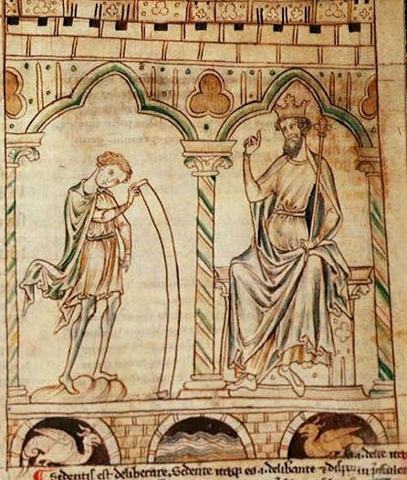
Geoffrey of Monmouth's 1136 pseudo-history that invented most of the Arthur legend as we know it, and was believed as literal fact for four centuries.
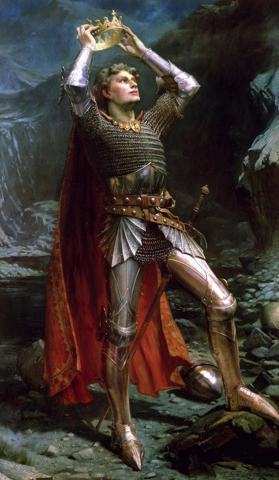
The once and future king: a shadowy British war-leader who medieval writers rebuilt into the emperor of Camelot and the Round Table.
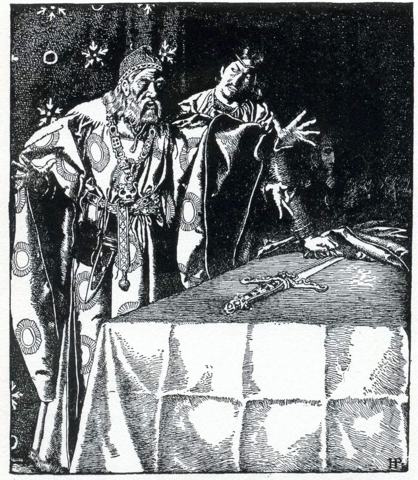
Arthur's foster-brother and seneschal. A magic-gifted warrior in Welsh tradition who became the sharp-tongued butt of French romance.
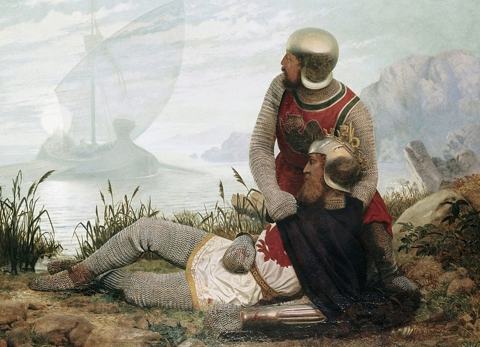
The one-handed spearman of Welsh tradition who became the knight who returned Excalibur to the lake and carried Arthur to the barge.
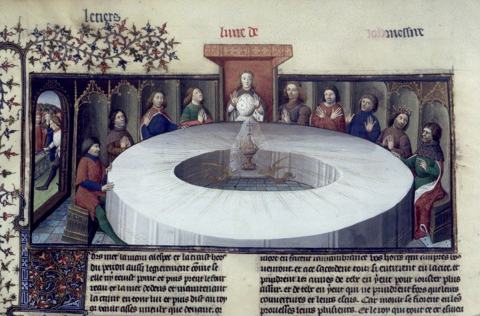
The table without a head: invented in 1155 to stop knights fighting over precedence, it became the name of Arthur's whole fellowship.
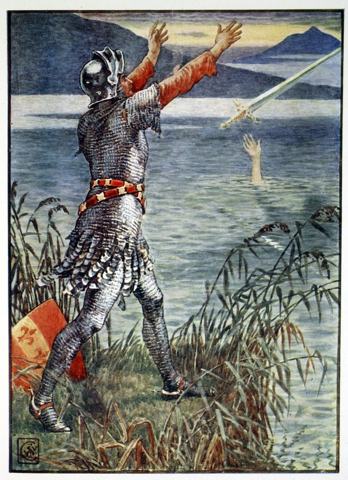
The sword of King Arthur: a Welsh blade called Caledfwlch that became the weapon drawn from a stone, given by a lake, and returned to the water.
Sources & Further Reading
- 1.Culhwch and Olwen (composed 11th-12th century), in the White Book of Rhydderch (c. 1350) and Red Book of Hergest (c. 1382-1410).
- 2.Davies, Sioned (trans.). The Mabinogion. Oxford: Oxford University Press (World's Classics), 2007.
- 3.Ford, Patrick K. (trans.). The Mabinogion and Other Medieval Welsh Tales. Berkeley: University of California Press, 1977.
- 4.Bromwich, Rachel, and D. Simon Evans (eds.). Culhwch and Olwen: An Edition and Study of the Oldest Arthurian Tale. Cardiff: University of Wales Press, 1992.
- 5.Rodway, Simon. 'The Date and Authorship of Culhwch ac Olwen: A Reassessment.' Cambrian Medieval Celtic Studies 49 (2005): 21-44.
- 6.Lady Charlotte Guest (trans.), The Mabinogion (London, 1838-1845), the first complete English translation.
- 7.Bromwich, Rachel (ed. and trans.). Trioedd Ynys Prydein: The Triads of the Island of Britain. Cardiff: University of Wales Press, 1961.
Spot an error or have a source to suggest? Write to info@viseterna.com. We cite primary sources and modern scholarship, and we correct fast.