
Galahad
Lancelot's son, invented to succeed where his father failed. The spotless knight who filled the Siege Perilous and achieved the Holy Grail.
Sir Galahad - The Quest for the Holy Grail, Arthur Hughes, 1870 (Walker Art Gallery, Liverpool) · Public domain · source
A Knight Made to Order
Galahad is the youngest of the great Arthurian figures and the only one whose purpose is entirely transparent: he exists because the writers of the thirteenth-century Vulgate Cycle needed someone Percival could not be and Lancelot must not be 1,8. Percival had been the Grail hero of Chretien de Troyes, but he was a comic innocent, and Lancelot, the finest knight in the world by every worldly measure, was disqualified by his love for Guinevere. The solution was to give Lancelot a son who inherited his prowess without his sin 1,7.
He appears in no text before the Queste del Saint Graal, and everything about him is designed. He is a virgin; he is descended on his mother's side from Joseph of Arimathea and thus from the Grail's own lineage; he arrives at Camelot at fifteen and dies within roughly a year and a half of the story's action 1,5. Scholars have generally traced his name to Galaad, the Vulgate Bible's form of Gilead, a place-name the Song of Songs uses in imagery of purity — though the derivation is a reasonable inference rather than a statement in the texts themselves 5,8.
Conceived at Corbenic
The circumstances of his birth are deliberately compromised. King Pelles of Corbenic, keeper of the Grail, knows by prophecy that his daughter Elaine must bear Lancelot's child, and arranges by enchantment for Lancelot to lie with her believing she is Guinevere 2,3. Lancelot's greatest act of fidelity thus produces his replacement, and he is furious when he learns of it. The child is taken to a nunnery and raised by his great-aunt, an abbess, out of the world entirely 2,3.
Fifteen years later a white-robed old man brings a young knight to Arthur's court on the vigil of Pentecost. Lancelot has knighted him that same morning without knowing who he is 1,3.
The Seat and the Sword
Two proofs establish him within a single day. The first is the Siege Perilous, the empty place at the Round Table that has killed every presumptuous knight who tried it; gold letters have appeared on it that morning naming the day it will be filled, and when the cloth is lifted Galahad's name stands there 1,3. He sits, and nothing happens, which is the point.
The second is a sword fixed in a block of red marble floating in the river outside Camelot, inscribed to say that only the world's best knight may draw it. Lancelot declines to try; Gawain tries under orders and is later wounded by that same sword; Galahad draws it without effort, because he arrived at court without a sword at all and the whole tableau was waiting for him 1,3. He is afterwards given a white shield bearing a red cross, said to have been marked in blood by Josephus, son of Joseph of Arimathea, and kept for him for four centuries 1,3.
The Quest and the End at Sarras
The Grail appears at that evening's feast under a cover of white samite, feeding every knight with the food he most desires, and the entire fellowship swears to seek it — an oath King Arthur hears with open grief, knowing it will empty his hall 1,3. Most fail. Gawain rides for months and meets no adventure at all. Lancelot reaches Corbenic and is struck senseless at the chamber door for daring to come nearer than his life allows 1,3.
Galahad's road is a sequence of allegories rather than trials: he frees the Castle of Maidens, ends a long feud, heals the Maimed King with blood from the bleeding lance, and is joined at last by Percival and Bors and by Percival's sister, who dies giving her blood to cure a leprous lady 1,3. The three men carry the Grail by ship to the eastern city of Sarras, where Galahad is made king. After a year he asks to be released from the world, sees into the vessel, and dies in the act of looking; a hand comes down from heaven and takes the Grail and the lance away, and no one has claimed to see them since 1,3,7.
Theology in Armour
Modern criticism reads the Queste as a religious treatise wearing romance clothes. Etienne Gilson argued in 1925 that its governing idea is the Cistercian theology of grace, in which the Grail stands for divine grace itself and the knights are graded by their capacity to receive it; Pauline Matarasso's influential translation and introduction developed the case that the work is close in spirit, and possibly in authorship, to the Cistercian milieu of Saint Bernard 5,6. Not everyone accepts a specifically Cistercian origin — some scholars argue for a broader monastic or clerical background — but there is wide agreement that the text is doctrinal in intention rather than merely adventurous 5,6,7.
That design explains Galahad's flatness. He has no inner conflict because he is not built to have one: he is the standard against which Lancelot's magnificent, doomed divided heart is measured 6,7.
Victorian Revival
Malory carried Galahad into English, and Tennyson made him a Victorian icon. The 1842 lyric "Sir Galahad" gave the age one of its most quoted lines about strength through purity, and Pre-Raphaelite painters — Rossetti, Arthur Hughes, Burne-Jones, Watts — returned to him repeatedly, usually kneeling, usually in a wood, usually alone 4,8. The result is that a character invented as an argument about grace became, seven centuries later, a byword for chivalric idealism in the ordinary sense: the man who is simply and unglamorously good 4,7.
Continue Exploring
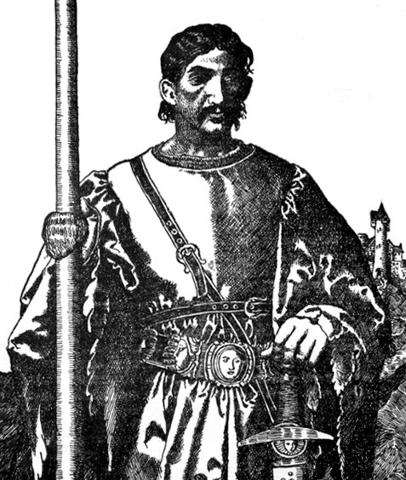
Lancelot's cousin and one of three knights who achieve the Holy Grail, and the only one who lives to tell the court what happened at Sarras.
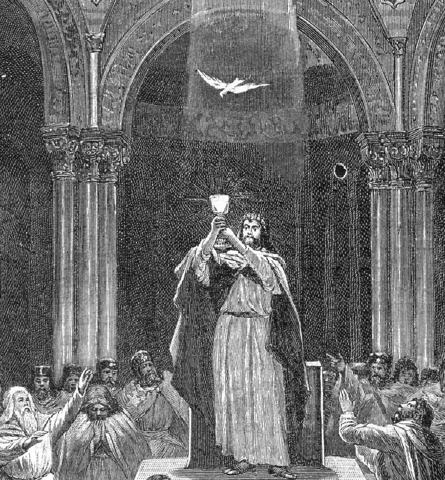
The forest-raised innocent who found the Grail castle and failed to ask the one question that mattered. Arthurian romance's first Grail knight.
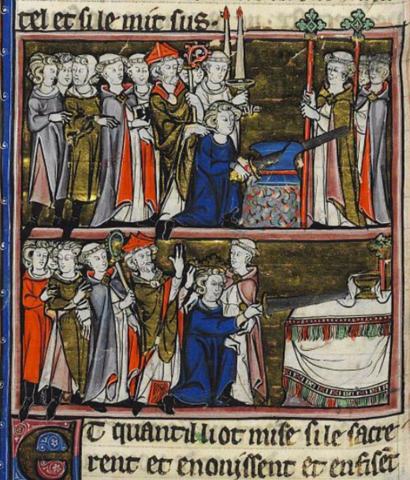
A sword fixed in a churchyard stone, drawable only by Britain's rightful king. Robert de Boron's invention, distinct from Excalibur in most versions.
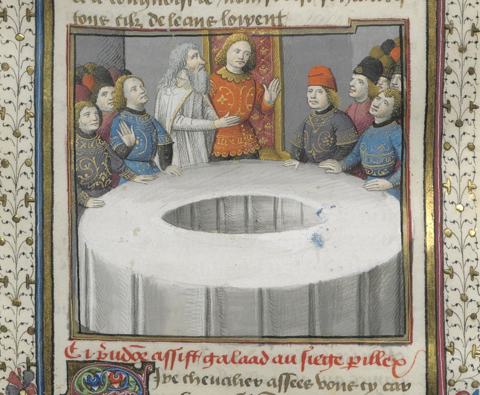
The vacant place at the Round Table that kills any knight who sits in it unworthily, kept for the one who would achieve the Holy Grail.
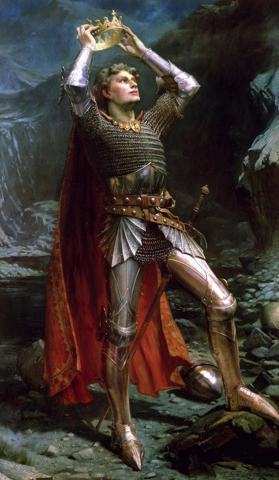
The once and future king: a shadowy British war-leader who medieval writers rebuilt into the emperor of Camelot and the Round Table.
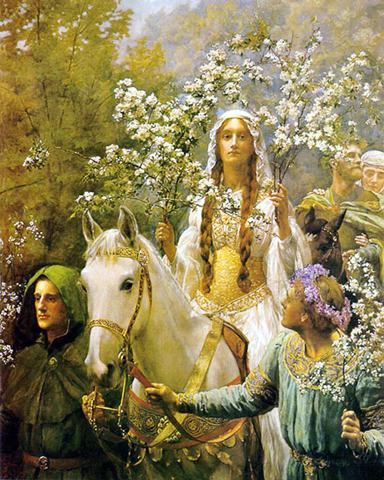
Queen of Britain and Arthur's wife: a figure repeatedly stolen, blamed and reinvented, whose love for Lancelot brings the Round Table down.
Also mentioned inElaine of Astolat (the Lady of Shalott)The Fisher King
Sources & Further Reading
- 1.La Queste del Saint Graal, in the Vulgate (Lancelot-Grail) Cycle (Old French, c. 1215-1235).
- 2.The Lancelot proper and the Estoire del Saint Graal, in the Vulgate Cycle (c. 1215-1235).
- 3.Thomas Malory, Le Morte d'Arthur, Books XI-XVII (completed c. 1469-70; printed by William Caxton, 1485).
- 4.Alfred, Lord Tennyson, "Sir Galahad" (1842) and "The Holy Grail", Idylls of the King (1869).
- 5.Matarasso, Pauline (trans. and intro.). The Quest of the Holy Grail. Penguin Classics, 1969.
- 6.Gilson, Etienne. "La mystique de la grace dans la Queste del Saint Graal." Romania 51 (1925), 321-347.
- 7.Barber, Richard. The Holy Grail - Imagination and Belief. Harvard University Press, 2004.
- 8.Lacy, Norris J. (ed.). The New Arthurian Encyclopedia. Garland, 1991.
Spot an error or have a source to suggest? Write to info@viseterna.com. We cite primary sources and modern scholarship, and we correct fast.