
Lancelot
First knight of the Round Table: a French invention raised by a lake fay, whose love for the queen makes him the best knight and ruins the kingdom.
Lancelot du Lac, John Gilbert, 1886 (Guildhall Art Gallery, London) · Public domain · source
A Knight Invented in France
Lancelot is the great latecomer. He has no Welsh antecedent, appears in no chronicle, and is absent from Geoffrey of Monmouth entirely. His first surviving mention is a name in a list of knights in Chretien de Troyes' Erec et Enide, around 1170, ranked third after Gawain and Erec; within a decade Chretien had made him the protagonist of his own romance, and within fifty years he had displaced everyone else at the centre of the legend 1,7. Attempts to find a Celtic original for the name — proposals have included Welsh figures such as Llwch Llenlleawc — have never commanded agreement, and the safest description is that Lancelot is a twelfth-century French literary creation grafted onto older British material 7,8.
The reason he took over is not mysterious. The chronicle Arthur was a conqueror, and conquest stories end. Lancelot brought a subject that does not end: an impossible love inside a loyal service, which can generate episodes indefinitely and eventually detonate the whole court.
The Knight of the Cart
Chretien's Chevalier de la Charrette is the founding text. Queen Guinevere is carried off by Meleagant to a land from which no stranger returns, and Lancelot pursues her past a sequence of ordeals, the sharpest of which is not physical. Offered a ride in a cart used to carry criminals to execution — the medieval equivalent of a public pillory — he hesitates for two steps before climbing in. He rescues her; she refuses to speak to him, and the reason, revealed later, is those two steps 1. Chretien says in his prologue that both the matter and the meaning were given to him by Marie de Champagne, and the poem behaves like an assignment: it is a rigorous, half-ironic demonstration of what absolute obedience in love actually requires.
Raised Beneath the Water
The other twelfth-century strand comes through German. Ulrich von Zatzikhoven's Lanzelet, based on an Anglo-Norman book he says came to Germany with a hostage, tells a completely different story: the infant is stolen by a water fairy and raised in a land of women where he learns courtesy and arms but not his own name, then wins his way through a series of adventures to a wife and a kingdom 2. There is no affair with the queen anywhere in it.
The French prose tradition fused the two. Lancelot becomes the son of King Ban of Benoic, orphaned when his father's kingdom falls, snatched from the lakeside and raised by the Lady of the Lake, who returns him to Arthur's court as an unnamed youth of unmatched promise — which is where "du Lac" comes from 4,6,7.
The Prose Lancelot and the Grail
The enormous prose Lancelot of the early thirteenth century is one of the longest works of medieval fiction, and Elspeth Kennedy's textual work established that an earlier, shorter, non-cyclic version existed before the Grail material was attached, with a noticeably different sense of what Lancelot's love means 3,6. In the expanded cyclic version the affair is set on a collision course with sanctity. Deceived into believing he is with Guinevere, Lancelot fathers Galahad on Elaine, daughter of King Pelles; Galahad grows up to be the flawless knight his father could not be 4.
The Queste del Saint Graal is built to humiliate him. The best knight in the world rides out after the Holy Grail and is turned back at every gate, permitted at last only a partial vision through a doorway before being struck senseless for twenty-four days. He confesses, repents and reverts. The Cistercian-flavoured moral is explicit: earthly chivalry, however perfect, cannot reach the Grail 4,8.
Best Knight of a Sinful World
La Mort le Roi Artu and Malory after it carry the consequences through. The affair is exposed by Agravain and Mordred; Guinevere is condemned to the fire; Lancelot's rescue kills Gareth and Gaheris, unarmed men who loved him, and Gawain's grief converts a scandal into a war that empties Britain of its army and opens the door to Mordred 4,5.
Malory's Lancelot is the character he cared most about, and his ending is the book's finest writing. After the last battle Lancelot becomes a hermit and a priest, dies in penance, and is mourned by his brother Ector in a speech that names him the courtliest knight ever to bear a shield and the truest lover of a sinful man 5. The phrase that clings to him — the best knight of a sinful world — captures the paradox exactly: his excellence and his sin are the same devotion, pointed at a person rather than at God.
In Popular Culture
Lancelot's modern reputation swings with attitudes to romantic love. Tennyson blames him; T. H. White gives him a famous reinvention as an ugly, self-loathing man who becomes the greatest knight out of shame; the musical Camelot (1960) plays him for charm, and Excalibur (1981) and First Knight (1995) for tragedy. In games and comics he is usually cast as the peerless duellist and the tarnished paragon, and the shape of that character — supremely capable, morally compromised, doomed by a loyalty he cannot keep — has become one of the standard templates of heroic fiction well outside Arthurian material.
Continue Exploring
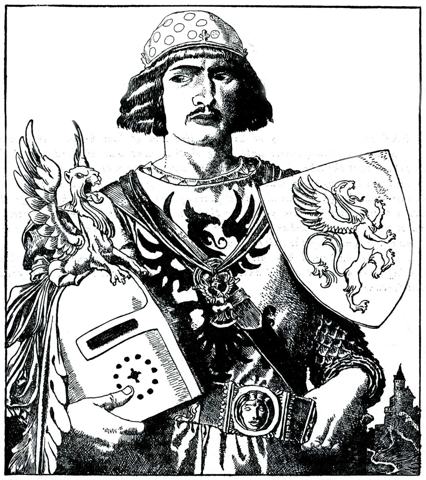
The courteous knight and Arthur's nephew: England's favourite of the Round Table, demoted by French romance and redeemed by an English poet.
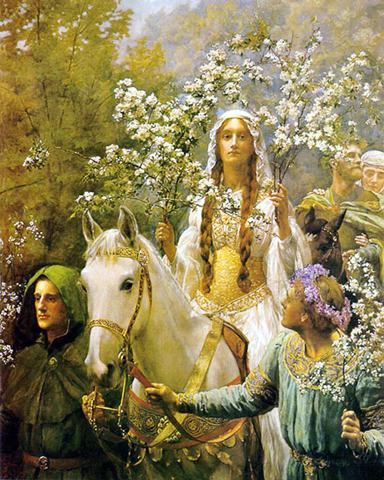
Queen of Britain and Arthur's wife: a figure repeatedly stolen, blamed and reinvented, whose love for Lancelot brings the Round Table down.
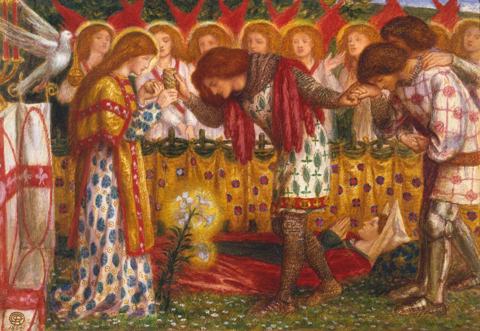
The vessel of the quest: a serving dish in an unfinished French poem that became Christendom's most famous relic and the ruin of the Round Table.
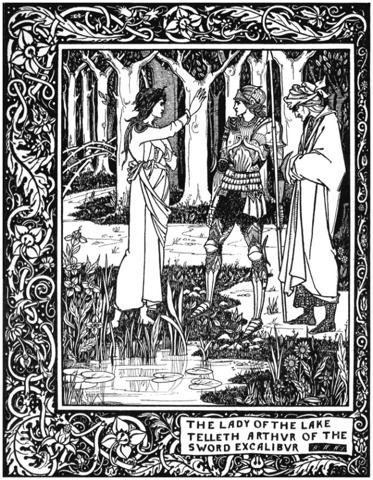
The fay of the lake: the water-dwelling enchantress who gave Arthur Excalibur, raised Lancelot, and sealed Merlin in his prison.
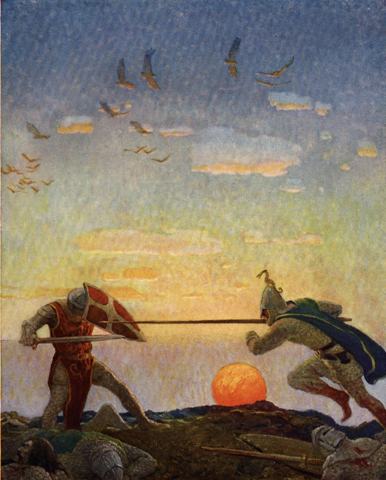
The traitor of Camlann: Arthur's nephew and, in later tradition, his incestuous son, who seizes the crown and destroys the Round Table.
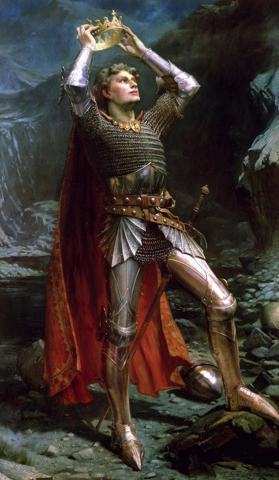
The once and future king: a shadowy British war-leader who medieval writers rebuilt into the emperor of Camelot and the Round Table.
Also mentioned inElaine of Astolat (the Lady of Shalott)GalahadIdylls of the KingLe Morte d'ArthurMorgan le FaySir BorsSir KayThe Matter of BritainThe Siege PerilousTristan and Iseult
Sources & Further Reading
- 1.Chretien de Troyes, Erec et Enide (c. 1170) and Lancelot, ou le Chevalier de la Charrette (c. 1177-1181).
- 2.Ulrich von Zatzikhoven, Lanzelet (c. 1200).
- 3.The non-cyclic Prose Lancelot (c. 1215-1220).
- 4.The Vulgate Cycle: Lancelot, La Queste del Saint Graal and La Mort le Roi Artu (c. 1215-1235).
- 5.Thomas Malory, Le Morte Darthur (printed by William Caxton, 1485), esp. Books VI, XI and XVII-XXI.
- 6.Kennedy, Elspeth. Lancelot and the Grail: A Study of the Prose Lancelot. Oxford: Clarendon Press, 1986.
- 7.Lacy, Norris J. (ed.). The New Arthurian Encyclopedia. New York: Garland, 1991.
- 8.Archibald, Elizabeth and Ad Putter (eds.). The Cambridge Companion to the Arthurian Legend. Cambridge University Press, 2009.
Spot an error or have a source to suggest? Write to info@viseterna.com. We cite primary sources and modern scholarship, and we correct fast.