
Le Morte d'Arthur
Thomas Malory's 15th-century compilation of the whole Arthurian legend, printed by Caxton in 1485 and rediscovered in a lost manuscript in 1934.
Winchester Manuscript (BL Add MS 59678), f.12v, Sir Thomas Malory, c. 1471-1483 · Public domain · source
A Knight Prisoner's Book
Every printed text of Le Morte Darthur ends with a colophon in which the author names himself: "Syr Thomas Maleore, knyght," who finished the work "the ninth yere of the reygne of kyng edward the fourth," meaning 1469 or 1470 1,3. Beyond that signature, his identity is contested. The strongest candidate is Thomas Malory of Newbold Revel in Warwickshire, a knight and one-time member of parliament with a startling criminal record — theft, ambush, extortion, and at least one charge of rape — who was imprisoned repeatedly between 1451 and 1470 and escaped at least twice, once by swimming a moat 5,6. Other candidates from Yorkshire and Cambridgeshire have been proposed, and P. J. C. Field's biography, the most thorough attempt to pin the man down, concedes that parts of the case remain circumstantial 5. Whoever he was, several colophons describe him as a "knyght presoner," and the book reads, in places, like the work of a man with unusual leisure to write 3,5.
Building One Book From Many
Malory did not invent his story; he compressed it. His main source was the great thirteenth-century French Vulgate and Post-Vulgate prose cycles, supplemented by two Middle English poems, the alliterative Morte Arthure and the stanzaic Le Morte Arthur, and by shorter French romances such as Erec et Enide 3,6. He calls his source simply "the Freynshe booke," a phrase that functions as much as a rhetorical signature as a citation 6. What he produced was, in Eugene Vinaver's phrase, not one continuous narrative but a sequence of self-contained tales — the founding of the fellowship, the tale of Lancelot, the tale of Tristan and Iseult, the Holy Grail quest, and the fellowship's ruin through Mordred's treachery — stitched into a single continuous English prose for the first time 3.
Caxton's Book of 1485
William Caxton printed the text in 1485 at Westminster, one of the first substantial works of prose fiction ever printed in England. He divided Malory's material into twenty-one books and roughly five hundred chapters, added chapter headings and a table of contents, and wrote a preface that argues, at some length, for Arthur's historical reality against sceptics who doubted a king could have existed with so little surviving physical evidence 3,6. Only two copies of Caxton's edition survive today, at the Morgan Library and the John Rylands Library, and until the twentieth century his text was the only version of Malory anyone could read 6.
The Winchester Manuscript
In June 1934, Walter Oakeshott, then an assistant master cataloguing the library at Winchester College, found an unrecorded manuscript of Malory's work bound among other volumes 4,6. It had been copied by two scribes, probably from the West Midlands, some years before Caxton printed his edition, and microscopic study later showed ink smudges consistent with the manuscript having sat in Caxton's own print shop 4. Comparison revealed that Caxton had silently rewritten passages, invented the book and chapter divisions that generations of readers had taken for Malory's own structure, and in places altered the sense of what Malory wrote 4,6. The manuscript, now British Library Additional MS 59678, is the closest surviving witness to what Malory actually set down, and Helen Cooper's edition is built directly on it rather than on Caxton 2,4.
One Book or Eight
Eugene Vinaver's 1947 edition, prepared in the years after Oakeshott's discovery, printed the Winchester text under the title The Works of Sir Thomas Malory rather than Le Morte Darthur, and argued in his commentary that Malory had written eight separate romances rather than one unified book 3. William Matthews and later critics pushed back, pointing to the way later tales openly refer back to earlier ones — Guinevere's trial, Excalibur's scabbard, the fellowship's oath sworn at the founding of the Round Table — as evidence that Malory intended a single continuous history even while working tale by tale 6,7. The argument has never fully settled, and modern editions increasingly split the difference, printing Malory as one book made of clearly marked parts.
Afterlife
Malory's version became the English-language Arthur by default: Tennyson drew on it for the Idylls of the King, T. H. White reworked it into The Once and Future King, and the plain declarative cadence of "the once and future king" and "many men said that there was written upon the tomb this verse" has been rewritten in film, television, and games ever since 6. Almost every modern English retelling of King Arthur's court, from Merlin's counsel to the sword given by the Lady of the Lake, ultimately passes through Malory's sentences, whether or not the retelling knows it 8.
Continue Exploring
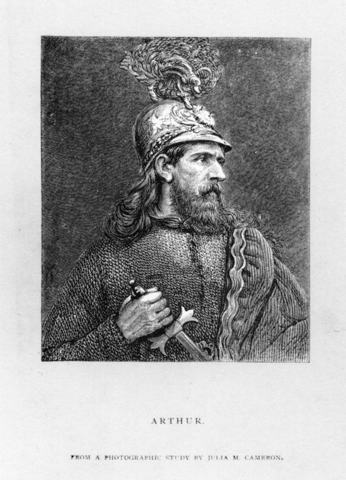
Tennyson's Victorian retelling of the Arthur story in blank verse, published across 26 years — the most influential English version of the legend after Malory.
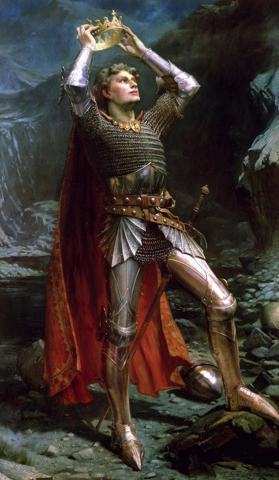
The once and future king: a shadowy British war-leader who medieval writers rebuilt into the emperor of Camelot and the Round Table.
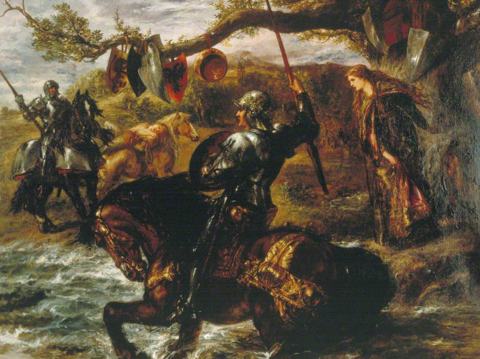
First knight of the Round Table: a French invention raised by a lake fay, whose love for the queen makes him the best knight and ruins the kingdom.
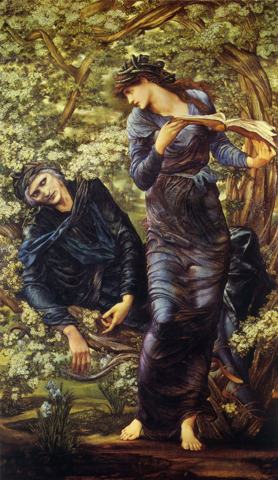
Britain's prophet and enchanter: a mad Welsh seer whom Geoffrey of Monmouth rebuilt as the wizard who made Arthur possible.
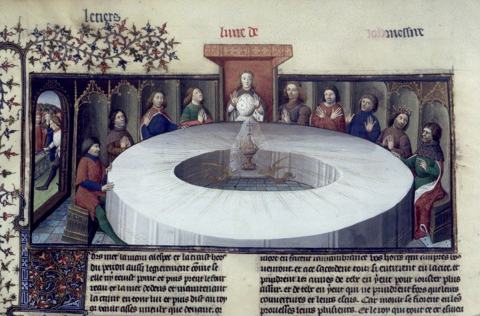
The table without a head: invented in 1155 to stop knights fighting over precedence, it became the name of Arthur's whole fellowship.
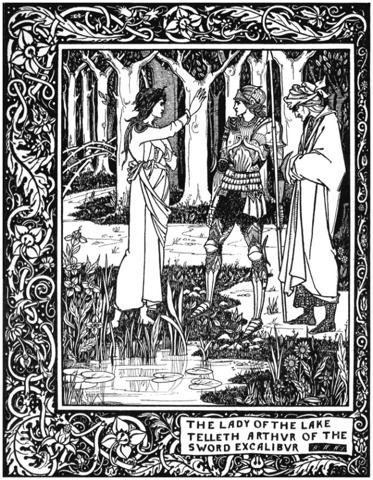
The fay of the lake: the water-dwelling enchantress who gave Arthur Excalibur, raised Lancelot, and sealed Merlin in his prison.
Also mentioned inHistoria Regum Britanniae
Sources & Further Reading
- 1.Thomas Malory, Le Morte Darthur, printed by William Caxton (1485).
- 2.The Winchester Manuscript, British Library, Additional MS 59678, c. 1471-1483.
- 3.Vinaver, Eugene (ed.). The Works of Sir Thomas Malory. Oxford: Clarendon Press, 1947.
- 4.Cooper, Helen (ed.). Le Morte Darthur: The Winchester Manuscript. Oxford: Oxford University Press (World's Classics), 1998.
- 5.Field, P. J. C. The Life and Times of Sir Thomas Malory. Cambridge: D. S. Brewer, 1993.
- 6.Oakeshott, Walter F. 'The Finding of the Manuscript.' In Essays on Malory, edited by J. A. W. Bennett. Oxford: Clarendon Press, 1963.
- 7.Matthews, William. The Ill-Framed Knight: A Skeptical Inquiry into the Identity of Sir Thomas Malory. Berkeley: University of California Press, 1966.
- 8.Lacy, Norris J. (ed.). The New Arthurian Encyclopedia. New York: Garland, 1991.
Spot an error or have a source to suggest? Write to info@viseterna.com. We cite primary sources and modern scholarship, and we correct fast.