
The Matter of Britain
The medieval term for the whole Arthurian tradition, coined around 1200 to separate British legend from the Matter of France and the Matter of Rome.
King Arthur, from the Nine Heroes Tapestries, South Netherlandish, c. 1400 (The Cloisters, Met Museum) · CC0 · source
A Poet's Filing System
"The Matter of Britain" is not a myth, a text, or a character — it is a label medieval writers used to sort their own material, and it has stuck for over eight hundred years. It comes from the prologue to La Chanson des Saisnes (The Song of the Saxons), an epic about Charlemagne's wars written around 1200 by the Arras poet Jean Bodel. Bodel opens by telling his audience that a storyteller has only three sources to draw on: "Ne sont que III matières à nul homme atandant: / De France et de Bretaigne et de Rome la grant" — "There are only three subject matters for any discerning man: that of France, that of Britain, and that of great Rome" 1. Everything a poet of his generation might tell a story about, in other words, fell into one of exactly three baskets.
What "Matter" Meant
Matiere in Old French did not mean "topic" in the loose modern sense; it meant the raw legendary and historical material available for a poet to shape into verse, prior to any particular telling of it 4,5. The Matter of Rome covered the ancient world — Alexander, the Trojan War, Aeneas — material medieval writers reached through Latin epitomes and romances rather than through Homer or Virgil directly. The Matter of France was the Charlemagne cycle: the chansons de geste about Roland, Oliver and the Frankish wars against the Saracens, the genre Bodel's own poem belonged to. The Matter of Britain was everything else — the legendary history and folklore of the Britons, and above all the figure who came to dominate it almost entirely: King Arthur 4,6.
What the Matter of Britain Actually Contains
By Bodel's time the category had already absorbed an enormous amount of material. Its backbone is Geoffrey of Monmouth's Historia Regum Britanniae (c. 1136), which turned a scattering of Welsh legend and Latin chronicle into a continuous royal history running from the fall of Troy through Arthur's reign, giving later writers Merlin, the Round Table and the frame story every subsequent romance would work within 2. Chretien de Troyes, writing in French a generation later, poured his own courtly romances into that frame — Grail material, Lancelot's adultery, individual knight-errantry — and effectively founded the branch of the tradition Bodel and his contemporaries had in mind 3,4. From there the Matter of Britain kept absorbing outside material: the Cornish and Breton legend of Tristan and Iseult, for instance, began as an independent story and was folded into the Arthurian world only after the fact, becoming Arthurian largely because there was nowhere else in the medieval "three matters" scheme for it to go 4,6.
Not Just England, and Not Just History
The name is slightly misleading to modern ears, because Bretaigne in Bodel's French covers both the island of Britain and Brittany on the continent — the same Breton-speaking cultural zone that had been exporting Arthurian storytelling, through professional Breton conteurs, into French-speaking courts for at least a generation before Bodel wrote 4,6. The category was never bound by a single nation's borders or a single language: it moved fluidly through Welsh, Latin, French, German and English texts across four centuries, absorbing whatever fit its central cast without much regard for where the story had started out 5,6.
Ranked Behind France and Rome
Bodel did not consider the three matters equal, and where he places the Matter of Britain is itself part of what the term has come to mean in scholarship. He treats the Matter of France as the one grounded in verifiable, still-visible history — the Frankish past his own audience could point to — while he characterizes the Matter of Britain as essentially entertainment: vivid and pleasing, but not something a serious audience should mistake for documented fact 1,5. That distinction, made by a poet working squarely inside the French epic tradition rather than the Arthurian one, is one of the earliest pieces of evidence that medieval readers themselves understood Arthurian material as legend rather than as history — a caution modern historians revisiting the Battle of Badon and the Battle of Camlann still have to take seriously 1,5.
Why the Label Still Works
Modern medievalists have kept Bodel's three-matter scheme because nothing better has replaced it as shorthand for grouping medieval European narrative traditions, even though scholars now treat "Matter of Britain" as covering everything from ninth-century Welsh annals through Chretien's romances, Malory's English prose, and on into Idylls of the King and the present day 4,5,6. Used carefully, it is less a claim about where a story came from than an acknowledgment of the company it keeps — which is, in the end, close to what Bodel meant by it in the first place.
Continue Exploring
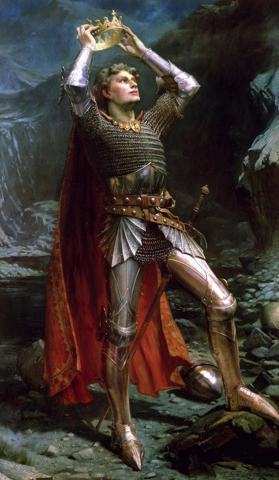
The once and future king: a shadowy British war-leader who medieval writers rebuilt into the emperor of Camelot and the Round Table.
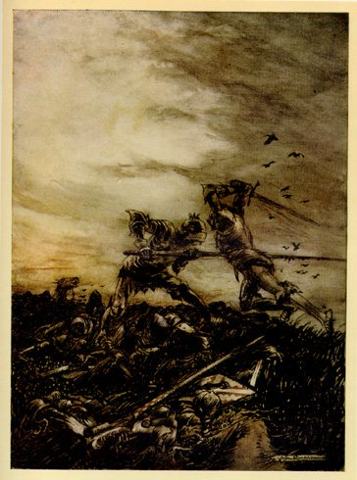
The battle that ended Arthur's reign: a single line in a medieval annal grew, over nine centuries, into the mutual destruction of Arthur and Mordred.
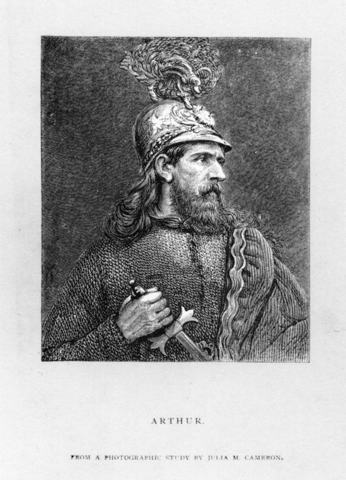
Tennyson's Victorian retelling of the Arthur story in blank verse, published across 26 years — the most influential English version of the legend after Malory.
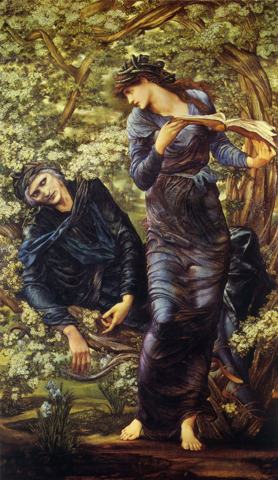
Britain's prophet and enchanter: a mad Welsh seer whom Geoffrey of Monmouth rebuilt as the wizard who made Arthur possible.
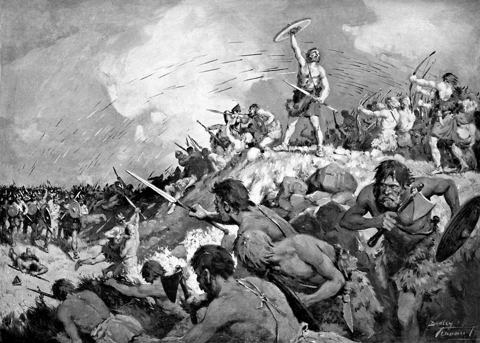
A single line in a 6th-century sermon became the British win historians can't agree on the date or site of — and the victory later tradition gave to Arthur.
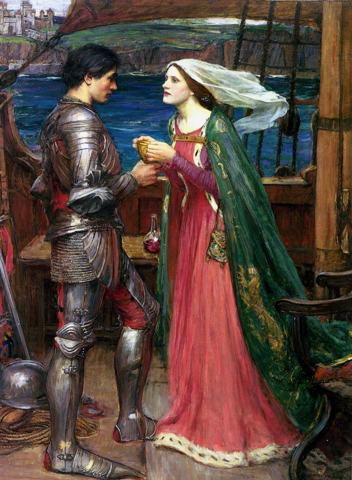
Tristan and Iseult (Isolde) drank a love potion meant for another and could not stop. Europe's oldest great romance of adultery and doom.
Also mentioned inHistoria Regum BritanniaeThe Lady of the Lake
Sources & Further Reading
- 1.Jean Bodel, La Chanson des Saisnes (c. 1200), prologue; ed. Annette Brasseur. 2 vols. Droz, 1989.
- 2.Geoffrey of Monmouth, Historia Regum Britanniae (c. 1136).
- 3.Chretien de Troyes, Arthurian Romances (c. 1170-1190).
- 4.Loomis, Roger Sherman, ed. Arthurian Literature in the Middle Ages: A Collaborative History. Clarendon Press, 1959.
- 5.Archibald, Elizabeth and Ad Putter, eds. The Cambridge Companion to the Arthurian Legend. Cambridge University Press, 2009.
- 6.Barron, W. R. J., ed. The Arthur of the English: The Arthurian Legend in Medieval English Life and Literature. University of Wales Press, 1999.
Spot an error or have a source to suggest? Write to info@viseterna.com. We cite primary sources and modern scholarship, and we correct fast.