
Mordred
The traitor of Camlann: Arthur's nephew and, in later tradition, his incestuous son, who seizes the crown and destroys the Round Table.
The Death of Arthur and Mordred, from The Boy's King Arthur, N. C. Wyeth, 1922 · Public domain · source
The Traitor at the End of the Story
Mordred is the name attached to the collapse. In every developed version of the legend he is the reason the Round Table ends in a field of corpses, and in most of them he is a member of King Arthur's own family — which is the point. The kingdom is not overthrown from outside. It is undone by something it produced. He is a figure of medieval legend, not of any religion, and his character was assembled over roughly four hundred years, growing steadily worse as the tradition needed a heavier cause for a heavier fall 8.
Medraut in the Earliest Sources
The oldest reference is a single line. The tenth-century Annales Cambriae record, under the year 537, "the strife of Camlann, in which Arthur and Medraut fell" 1. It says they died in the same battle. It does not say they fought each other, and it does not call either of them a traitor. Everything else is later construction.
The Welsh material is similarly sparse and not uniformly hostile. The Triads record Medrawd's raid on Arthur's court at Celliwig, in which he consumes the whole feast and drags Guinevere from her chair and strikes her, but they also preserve a strand in which Medrawd's courtesy and valour are proverbial 2,8. Peter Korrel's study of the three central figures traces this drift closely: what begins as a colourless name in an annal becomes, under Geoffrey's pen, a defined political villain, and only afterwards a moral monster 8.
Geoffrey Makes Him a Usurper
Geoffrey of Monmouth's Historia fixes the plot everyone inherits. Modredus is Arthur's nephew, son of the king's sister Anna and of King Lot, and he is left as regent of Britain with the queen when Arthur crosses to Gaul to fight Rome. He crowns himself, takes Guinevere, and allies with Saxons, Picts, Scots and Irish against the returning king. Arthur lands at Richborough, at the cost of Gawain's life, and the two forces meet at last by the river Camblan, where Mordred is killed and Arthur mortally wounded 3. Wace and Layamon retell this with mounting horror, Layamon in particular making Mordred's treachery a personal betrayal that Arthur dreams of before he hears it 4.
Arthur's Son
The thirteenth-century French prose cycles added the detail that made Mordred more than a rebel. Arthur, not yet knowing that the wife of King Lot is his own half-sister, sleeps with her, and Mordred is the child; the sin is unwitting on both sides, but it is still incest, and the destroyer of the kingdom is the king's own son 5. Malory dramatises the consequence with a scene of appalling coldness: warned by Merlin that a child born on May Day will destroy him, Arthur has every noble infant born that day put to sea in a ship. All drown but Mordred, who is cast ashore and raised by a good man 7. The Herod echo is deliberate, and it costs Arthur the moral high ground before the story has properly begun.
This is the point at which Mordred becomes a theological figure as well as a political one. The fall of Camelot is no longer bad luck or bad character; it is a sin coming home.
Camlann
The end is narrated with more care than almost anything else in the tradition. In Malory a truce is agreed between the two armies, on the understanding that any drawn sword breaks it. A knight is bitten by an adder in the heath and draws his blade to kill it. Both hosts see the flash of steel and charge 7. When the fighting is done, Arthur finds Mordred leaning on his sword among the dead, runs him through with a spear, and Mordred drives himself further up the shaft to bring himself within reach and strike his father through the helm 7. It is one of the great images in English narrative, and it makes the mutual destruction literal.
The alliterative Morte Arthure, meanwhile, offers a more complicated Mordred: he weeps for Gawain, whom he has killed, and speaks of him as the finest knight who ever lived, which suggests at least some English writers found the pure traitor unsatisfying 6.
Reading Mordred Now
Modern retellings have gone further in that direction. Twentieth- and twenty-first-century fiction frequently gives Mordred the sympathetic reading the medieval texts withhold: a son denied by his father, raised in the knowledge of a prophecy about himself, punished before he has done anything. The video game King Arthur: Knight's Tale goes as far as making him the player character. The shift is not a distortion so much as a return, since the earliest source made no accusation at all — it simply recorded two men falling in the same battle, and left the rest for later ages to supply.
Continue Exploring
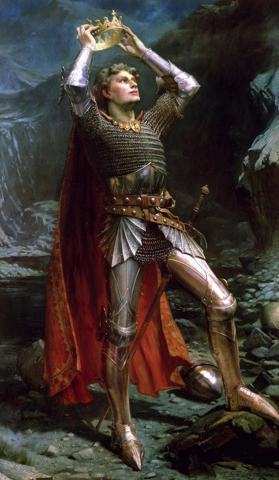
The once and future king: a shadowy British war-leader who medieval writers rebuilt into the emperor of Camelot and the Round Table.
Queen of Britain and Arthur's wife: a figure repeatedly stolen, blamed and reinvented, whose love for Lancelot brings the Round Table down.
Britain's prophet and enchanter: a mad Welsh seer whom Geoffrey of Monmouth rebuilt as the wizard who made Arthur possible.
The courteous knight and Arthur's nephew: England's favourite of the Round Table, demoted by French romance and redeemed by an English poet.
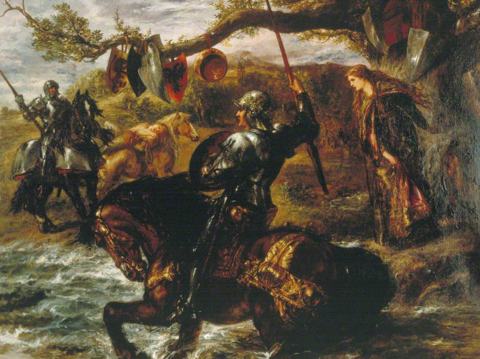
First knight of the Round Table: a French invention raised by a lake fay, whose love for the queen makes him the best knight and ruins the kingdom.
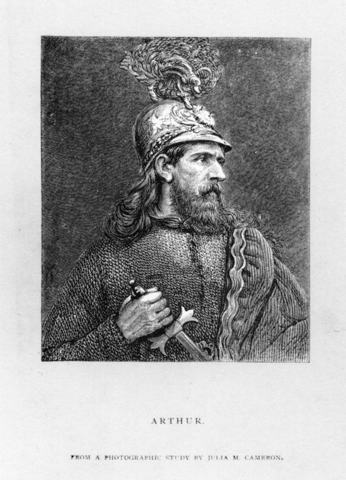
Tennyson's Victorian retelling of the Arthur story in blank verse, published across 26 years — the most influential English version of the legend after Malory.
Also mentioned inLe Morte d'ArthurThe Battle of CamlannThe Questing Beast
Sources & Further Reading
- 1.Annales Cambriae (10th century), entry for the year 537 - the strife of Camlann.
- 2.Trioedd Ynys Prydein (the Welsh Triads), on Medrawd's raid at Celliwig.
- 3.Geoffrey of Monmouth, Historia Regum Britanniae (c. 1136), Books X-XI.
- 4.Wace, Roman de Brut (1155); Layamon, Brut (c. 1200).
- 5.The Vulgate La Mort le Roi Artu and the Post-Vulgate Suite du Merlin (13th century).
- 6.The alliterative Morte Arthure (c. 1400).
- 7.Thomas Malory, Le Morte Darthur (printed by William Caxton, 1485), Books I and XXI.
- 8.Korrel, Peter. An Arthurian Triangle: A Study of the Origin, Development and Characterization of Arthur, Guinevere and Modred. Leiden: E. J. Brill, 1984.
Spot an error or have a source to suggest? Write to info@viseterna.com. We cite primary sources and modern scholarship, and we correct fast.