
The Winchester Round Table
The real oak Round Table hanging in Winchester's Great Hall: tree-ring dated to the reign of Edward I, not Arthur's, and repainted for Henry VIII.
The Winchester Round Table, Great Hall, Winchester Castle, photograph by Mike Peel, 2012 · CC BY-SA 4.0 · source
A Table on a Wall
Fixed high on the end wall of the Great Hall of Winchester Castle — the one part of the medieval castle still standing — is a huge disc of oak, five and a half metres across and weighing over a tonne, painted in green and white segments with a Tudor rose at its centre and the names of twenty-four knights lettered around the rim beneath a crowned portrait of King Arthur 1. It is, without qualification, a real medieval object, and it is the single physical artefact most visitors associate with the Round Table of legend — an idea first put into words over a century earlier, in Wace's 1155 Roman de Brut — even though the Winchester table's own history turns out to have almost nothing to do with any historical Arthur 1,5,6.
Biddle's Investigation
In 1976 the table was taken down from the wall and subjected to the most thorough scientific study any piece of Arthurian material culture has ever received, led by the archaeologist Martin Biddle. His team combined dendrochronology — dating the wood by matching its tree-ring pattern against known regional sequences — with radiocarbon dating, paint and pigment analysis, and close structural examination of the tabletop's joinery and later repairs 1. The results, published in full in 2000, are treated as the definitive account of the object 1.
Made for Edward I
The tree-ring evidence dates the table's construction to the second half of the thirteenth century, within the reign of Edward I, whose enthusiasm for Arthurian display was well documented in his own lifetime: chronicles record him attending or hosting several "Round Table" tournament festivities, in which nobles took the names of Arthur's knights and jousted under them 1,2. Biddle's best reconstruction connects the table's manufacture to a specific court occasion at or near Winchester around 1290, quite possibly a tournament marking a royal marriage 1. In its original form the table was not a wall ornament but a genuine freestanding piece of furniture, resting on twelve legs rather than hanging flat, built to be gathered around rather than looked up at 1.
Edward III's Failed Revival
Arthurian display of this kind had a second royal moment half a century later. In January 1344, after a tournament at Windsor, Edward III publicly swore an oath to found a new fellowship of the Round Table and began construction of a great circular building to house it; the project was abandoned within a couple of years in favour of a smaller, more practical chivalric order, the Garter, and Christopher Berard's study of the episode treats it as a serious but ultimately unworkable attempt to revive Arthurian kingship as living political theatre rather than as pageantry alone 4. The Winchester table, already half a century old by then, seems to have continued its separate existence as a hall fixture through this period without being drawn directly into Edward III's scheme 1.
Painted for Henry VIII
The table's decoration is later than its timber by more than two centuries. Paint analysis confirms that the scheme visible today — the Tudor rose, the roundel portrait of a crowned and enthroned Arthur, and the ring of knights' names in Tudor-period lettering — was applied under Henry VIII, whose own facial features the Arthur figure is widely thought to echo, a piece of dynastic self-flattery consistent with Henry's broader use of Arthurian imagery to bolster Tudor claims to ancient British kingship 1,2. By the time the antiquary John Leland toured England in Henry's reign, the table was already accepted locally as authentic Arthurian furniture without question 3.
What the Investigation Settled
Biddle's study leaves little room for romantic ambiguity: the table is a genuine and rare survival of high medieval royal furniture, built roughly seven and a half centuries after any figure Arthur might have been based on could have sat at it, commissioned to stage a king's chivalric image rather than to record one 1. That does not make it a fake in any ordinary sense — no one at the time claimed it was Arthur's own table, only that it represented the fellowship he was imagined to have kept — and its two royal makeovers, Edward I's construction and Henry VIII's repainting, are themselves a small history of English monarchs reaching for King Arthur's authority across three hundred years 1,5. It remains on public display in the Great Hall today, the most-visited single object connected to the Arthurian legend anywhere in Britain.
Continue Exploring
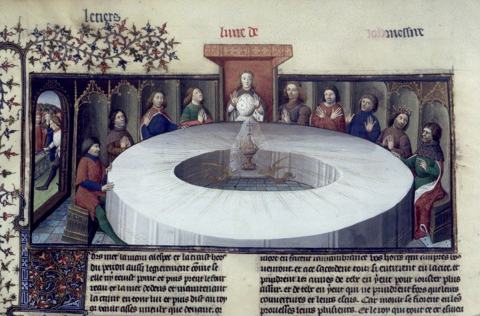
The table without a head: invented in 1155 to stop knights fighting over precedence, it became the name of Arthur's whole fellowship.
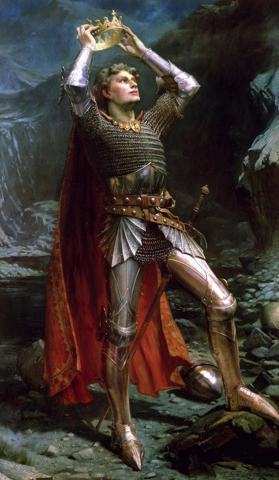
The once and future king: a shadowy British war-leader who medieval writers rebuilt into the emperor of Camelot and the Round Table.
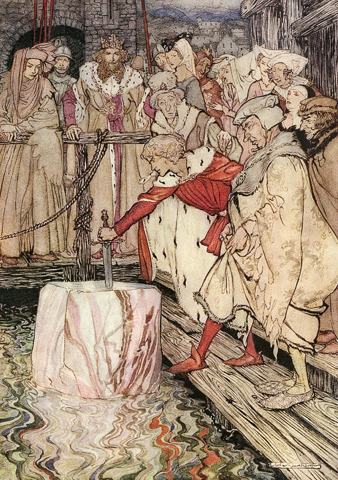
Arthur's chief court: a place named almost by accident in one French poem, which grew into the most famous city that never existed.
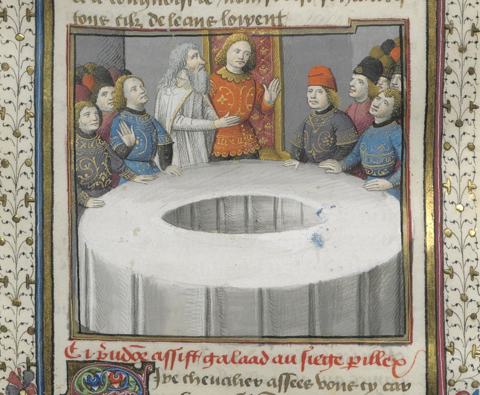
The vacant place at the Round Table that kills any knight who sits in it unworthily, kept for the one who would achieve the Holy Grail.
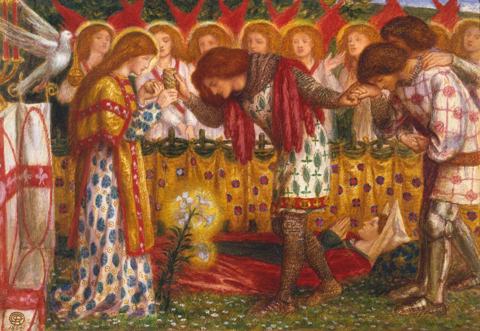
The vessel of the quest: a serving dish in an unfinished French poem that became Christendom's most famous relic and the ruin of the Round Table.
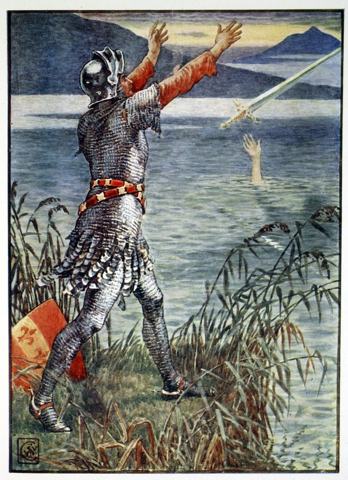
The sword of King Arthur: a Welsh blade called Caledfwlch that became the weapon drawn from a stone, given by a lake, and returned to the water.
Sources & Further Reading
- 1.Biddle, Martin (ed.). King Arthur's Round Table: An Archaeological Investigation. Woodbridge: Boydell Press, 2000.
- 2.Barber, Richard. King Arthur: Hero and Legend. Woodbridge: Boydell Press, 1986.
- 3.Leland, John, The Itinerary (c. 1535-1543).
- 4.Berard, Christopher. 'Edward III's Abandoned Order of the Round Table.' Arthurian Literature 29 (2012): 1-40.
- 5.Lacy, Norris J. (ed.). The New Arthurian Encyclopedia. New York: Garland, 1991.
- 6.Wace, Roman de Brut (1155).
Spot an error or have a source to suggest? Write to info@viseterna.com. We cite primary sources and modern scholarship, and we correct fast.