
Idylls of the King
Tennyson's Victorian retelling of the Arthur story in blank verse, published across 26 years — the most influential English version of the legend after Malory.
King Arthur, frontispiece from Idylls of the King, after Julia Margaret Cameron, 1874 · Public domain · source
What Idylls of the King Is
Idylls of the King is Alfred, Lord Tennyson's cycle of twelve narrative poems retelling the reign and fall of King Arthur in blank verse. It is not a medieval text — Tennyson was Victoria's Poet Laureate, and the work was composed and published across the middle decades of the nineteenth century — but it belongs in the Codex for the same reason Malory does: after Sir Thomas Malory's fifteenth-century prose, it is the single most influential retelling the legend has had in English, the version that fed nearly every twentieth-century film, novel and illustration that followed it 1,6. Tennyson called the individual poems "idylls," a term borrowed from the short, vivid Greek pastoral form, and used it to mean something closer to "episodes" — self-contained scenes that only add up to a single continuous story when read in sequence 1.
Twenty-Six Years in the Making
Tennyson worked on the cycle for most of his adult writing life. A first quartet — "Enid," "Vivien," "Elaine" and "Guinevere" — appeared in 1859 and sold extraordinarily well; further idylls followed piecemeal over the next quarter-century, with "The Holy Grail and Other Poems" in 1869, "Gareth and Lynette" in 1872, "The Last Tournament" serialized in 1871, and "Balin and Balan," the last piece written, not published until 1885 1,6. Tennyson kept revising and reordering the whole sequence as he added to it, so that the finished twelve idylls read as a single architecture only in hindsight; the dedication to the recently deceased Prince Albert, added in 1862, cast the entire cycle retrospectively as a memorial and gave Arthur's court a Victorian moral weight it had not obviously carried before 1,6,7.
Built on Malory and the Mabinogion
Tennyson's main source was Malory's Le Morte Darthur, which supplied the overall shape of the story — the rise of the court, the love triangle, the quest, the fall — along with most of the major names: Guinevere, Lancelot, Merlin, Mordred 2,6. For some idylls, particularly "Geraint and Enid," he turned instead to Lady Charlotte Guest's recent English translation of the Mabinogion, the medieval Welsh prose tales, reworking the Welsh story of Geraint son of Erbin into English blank verse 3,6. Tennyson also felt free to invent and rearrange: he gives Arthur a mysteriously divine arrival and departure that Malory does not emphasize, softens or hardens individual characters to fit a moral scheme, and turns the fellowship's decay into an allegory of "Sense at war with Soul," in his own later description of the poem's intent 6,7.
The Shape of the Cycle
The finished sequence runs from "The Coming of Arthur" through the marriages and quests of "Gareth and Lynette," "The Marriage of Geraint," "Balin and Balan," "Merlin and Vivien" and "Lancelot and Elaine," into the darker turn of "The Holy Grail," "Pelleas and Ettarre" and "The Last Tournament," and closes with "Guinevere" and "The Passing of Arthur" 1. Read start to finish, the poems trace an entire moral rise and collapse: an ideal kingdom built on a vow of purity is undone from within by the very desires — Lancelot's for Guinevere, Vivien's for power over Merlin, the court's own appetite for tournament and spectacle — that its founding could not fully suppress. The Battle of Camlann itself appears only obliquely, referred to in earlier idylls (a knight recalls fighting "on the mount of Badon" under Arthur, pointing back to the Battle of Badon rather than forward to Camlann) before "The Passing of Arthur" finally stages the last battle as elegy, ending with the king borne toward Avalon rather than confirmed dead 1,6.
Illustrated Editions
The poem's popularity produced some of the best-known Arthurian imagery of the century. Gustave Doré illustrated an 1868 edition with dramatic engravings; George Wooliscroft Rhead and Louis Rhead produced a fully illustrated 1898 edition; and in 1874 the pioneering photographer Julia Margaret Cameron, working on the Isle of Wight, spent three months staging and photographing friends and servants as Arthur, Guinevere, Elaine and the rest for a deluxe photographically illustrated Idylls, published the following year 4,5. Cameron's images, soft-focus and theatrical, are now considered among the peak achievements of her career and a significant document of Victorian art photography in their own right, independent of the poem they were made to accompany 5.
Reading Idylls of the King Now
Modern scholarship treats the Idylls less as a straightforward medieval throwback than as a document of its own moment. David Staines traces in detail how selectively and purposefully Tennyson reshaped Malory and the Welsh material to fit a Victorian narrative of moral decline, rather than simply modernizing what he found 6. Debra Mancoff and other historians of Victorian visual culture read the poem's enormous popularity, and the wave of Arthurian painting and photography it triggered, as bound up with anxieties about empire, gender roles and religious doubt that had very little to do with sixth-century Britain 7. The idylls remain, by that reading, less a window onto the medieval sources of the Matter of Britain than a mirror held up to the age that produced them — which has not stopped them from shaping, more than almost any other single text, what most English-language readers still picture when they picture Camelot.
Continue Exploring
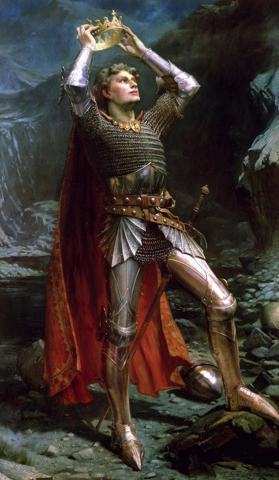
The once and future king: a shadowy British war-leader who medieval writers rebuilt into the emperor of Camelot and the Round Table.
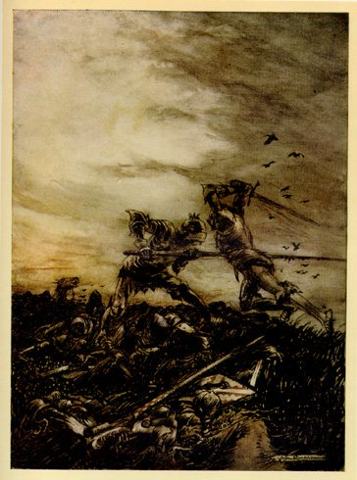
The battle that ended Arthur's reign: a single line in a medieval annal grew, over nine centuries, into the mutual destruction of Arthur and Mordred.
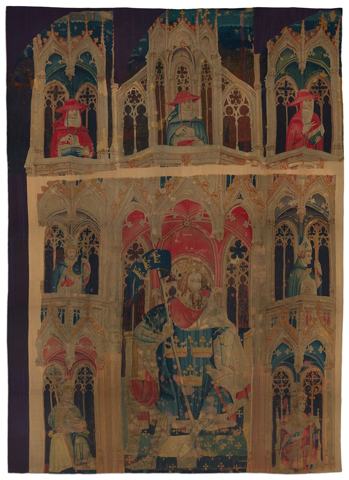
The medieval term for the whole Arthurian tradition, coined around 1200 to separate British legend from the Matter of France and the Matter of Rome.
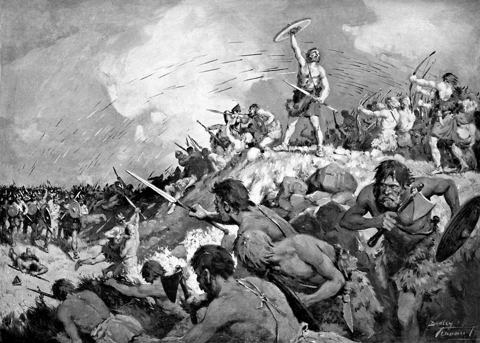
A single line in a 6th-century sermon became the British win historians can't agree on the date or site of — and the victory later tradition gave to Arthur.
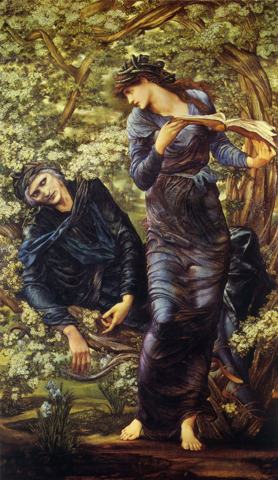
Britain's prophet and enchanter: a mad Welsh seer whom Geoffrey of Monmouth rebuilt as the wizard who made Arthur possible.
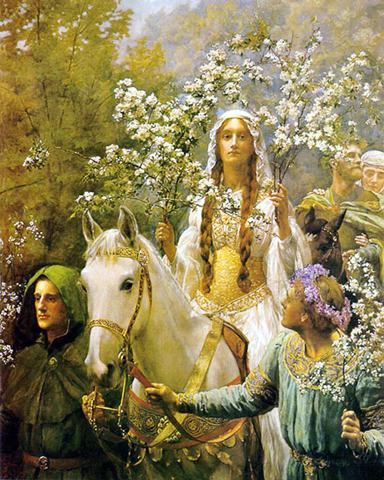
Queen of Britain and Arthur's wife: a figure repeatedly stolen, blamed and reinvented, whose love for Lancelot brings the Round Table down.
Also mentioned inLe Morte d'ArthurPercival (Perceval)
Sources & Further Reading
- 1.Tennyson, Alfred. Idylls of the King. 1859-1885.
- 2.Thomas Malory, Le Morte Darthur (printed by William Caxton, 1485).
- 3.The Mabinogion. Translated by Lady Charlotte Guest. Longmans, 1849.
- 4.Cameron, Julia Margaret. Illustrations to Tennyson's Idylls of the King and Other Poems. Henry S. King and Co., 1875.
- 5.Ford, Colin. Julia Margaret Cameron: 19th Century Photographer of Genius. National Portrait Gallery Publications, 2003.
- 6.Staines, David. Tennyson's Camelot: The Idylls of the King and Its Medieval Sources. Wilfrid Laurier University Press, 1973.
- 7.Mancoff, Debra N. The Return of King Arthur: The Legend Through Victorian Eyes. Harry N. Abrams, 1995.
Spot an error or have a source to suggest? Write to info@viseterna.com. We cite primary sources and modern scholarship, and we correct fast.