
Guinevere
Queen of Britain and Arthur's wife: a figure repeatedly stolen, blamed and reinvented, whose love for Lancelot brings the Round Table down.
Queen Guinevere's Maying, John Collier, 1900 (Cartwright Hall, Bradford) · Public domain · source
The Queen at the Centre
Guinevere is the pivot of the Arthurian tragedy and one of the most unstable characters in it. Depending on which century you read, she is a Welsh queen with a shadowy sister, a Roman-descended noblewoman who marries the usurper Mordred, the courtly beloved whose least word governs the greatest knight in the world, or a penitent nun. What survives every version is her structural role: the kingdom's fate runs through her marriage 7,8. This is medieval legend rather than religion, and the moralising attached to her says more about the writers than about any original story.
Earliest Traces
Her Welsh name is Gwenhwyfar, formed from gwen, "white, fair, blessed", and a second element usually taken as "phantom" or "enchantress"; it is cognate with the Irish name Findabair 7,8. The early Welsh material treats her as a fixed part of Arthur's household without telling a connected story about her. The Triads list three Gwenhwyfars as Arthur's queens, a proliferation that may reflect competing local traditions, and record a blow struck between Gwenhwyfar and Gwenhwyfach as one of the causes of the battle of Camlann 1. There is also a persistent sour note in the Welsh proverbial tradition about her character, of a kind that later French romance would spend centuries either justifying or forgiving.
The Abduction Pattern
Long before the affair with Lancelot exists, the story attached to Guinevere is abduction and rescue. The earliest full instance is in Caradoc of Llancarfan's Life of Gildas, written around 1130 at Glastonbury: Melwas, king of the Summer Country, carries her off and holds her at Glastonbury, King Arthur arrives with the levies of Devon and Cornwall, and Gildas negotiates her return before battle is joined 2. Comparable scenes appear in carvings and in Welsh dialogue poems. Scholars have long noted how closely the pattern resembles otherworld-abduction tales, in which a queen is taken to a land from which no one returns and recovered by a hero who crosses the boundary 7,8.
Geoffrey of Monmouth supplies a different and darker version. His Guanhumara is of noble Roman family and raised in the household of Cador of Cornwall; when Arthur crosses to Gaul, Mordred takes both the crown and the queen, and after Camlann she withdraws to a convent at Caerleon, Geoffrey noting her flight without a word of sympathy 3. Whether she is a victim or a collaborator is left deliberately open, and the ambiguity persisted for centuries 7.
Chretien and the Cart
Chretien de Troyes' Chevalier de la Charrette, written around 1177 at the request of Marie de Champagne, converts the abduction into the founding text of courtly love. Meleagant carries the queen to the kingdom of Gorre; Lancelot pursues her, and at the crucial moment hesitates for two steps before climbing into a criminal's cart, because riding in it means public shame. Guinevere later refuses to speak to him precisely because of those two steps: love should not have calculated 4. The consummation follows, in a scene where Lancelot bends the iron bars of her window and leaves blood on the sheets — evidence that will be used to accuse the queen of a different crime, and the first appearance of the pattern where an accusation against her is factually wrong and morally right.
The Affair That Ends the Kingdom
The thirteenth-century Vulgate Cycle turned Chretien's episode into the load-bearing wall of the whole legend. The prose Lancelot elaborates the affair over thousands of pages, including a sustained episode in which a False Guinevere, claiming to be the true bride, displaces her at court 5. La Mort le Roi Artu then closes the trap: Agravain and Mordred force Arthur to acknowledge what everyone has chosen not to see, the queen is condemned to burn, Lancelot rescues her from the fire, and in the rescue his men kill Gawain's unarmed brothers. The resulting blood feud takes the king and his army to France and leaves Britain to Mordred 5,8. Nobody in this sequence intends the destruction they cause, which is what makes it tragedy rather than melodrama.
Malory's Ending
Malory follows the French but gives Guinevere his own defence of her, describing a love that was "true" in a sense his own century had begun to lose. After the last battle she takes the veil at Amesbury, and when Lancelot comes to her she refuses to see him again or to give him a final kiss, sending him to his own vocation instead. She dies before he reaches her; he carries her body to Glastonbury and buries her beside Arthur, and dies himself soon after 6. It is the most severe and the most affecting exit any version gives her.
In Popular Culture
Nineteenth-century writers were harsh with her — Tennyson has her grovelling at Arthur's feet — and the twentieth century reversed the verdict. T. H. White gives her a full interior life, the musical Camelot (1960) and the film First Knight (1995) centre the love triangle, and Marion Zimmer Bradley's The Mists of Avalon (1983) treats her devout Christianity as the flaw rather than the affair. Recent fiction, film and games most often present her as a political actor in her own right, a reading the medieval texts allow but rarely take up.
Continue Exploring
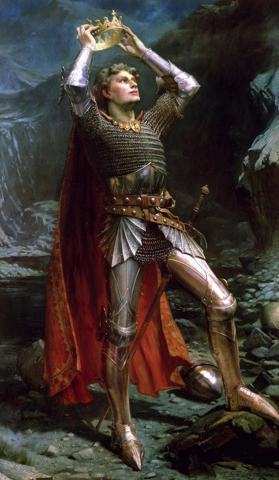
The once and future king: a shadowy British war-leader who medieval writers rebuilt into the emperor of Camelot and the Round Table.
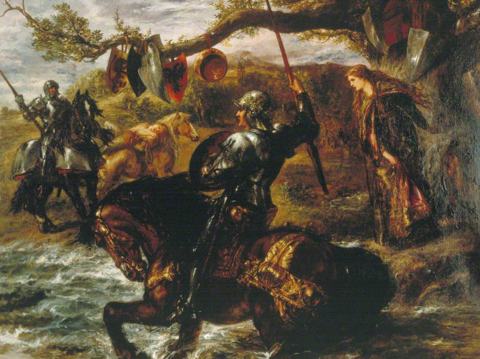
First knight of the Round Table: a French invention raised by a lake fay, whose love for the queen makes him the best knight and ruins the kingdom.
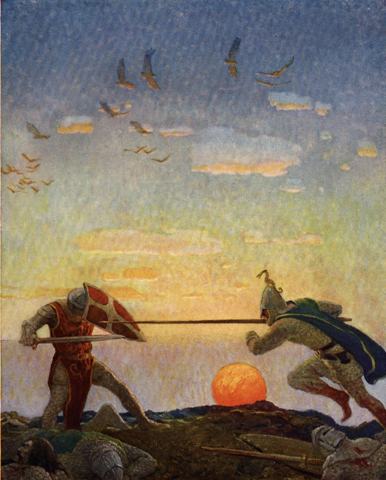
The traitor of Camlann: Arthur's nephew and, in later tradition, his incestuous son, who seizes the crown and destroys the Round Table.
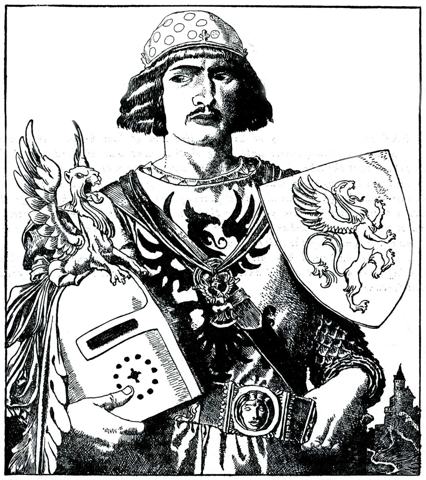
The courteous knight and Arthur's nephew: England's favourite of the Round Table, demoted by French romance and redeemed by an English poet.
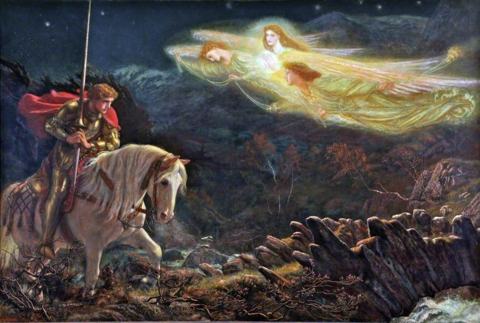
Lancelot's son, invented to succeed where his father failed. The spotless knight who filled the Siege Perilous and achieved the Holy Grail.
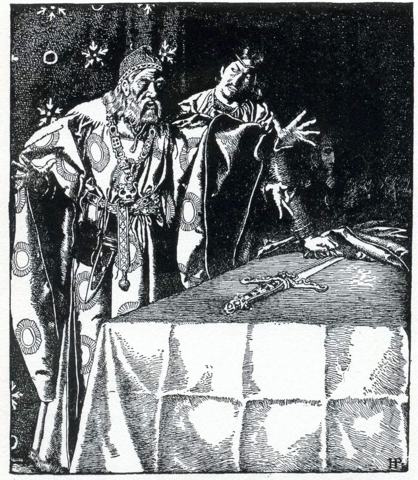
Arthur's foster-brother and seneschal. A magic-gifted warrior in Welsh tradition who became the sharp-tongued butt of French romance.
Also mentioned inAvalonElaine of Astolat (the Lady of Shalott)Glastonbury (Isle of Avalon)Idylls of the KingLe Morte d'ArthurMerlinMorgan le FaySir BorsThe Battle of CamlannThe Green KnightThe Round TableThe Siege PerilousTristan and Iseult
Sources & Further Reading
- 1.Trioedd Ynys Prydein (the Welsh Triads) and early Welsh Arthurian verse.
- 2.Caradoc of Llancarfan, Vita Gildae (c. 1130), chs. 10-11.
- 3.Geoffrey of Monmouth, Historia Regum Britanniae (c. 1136), Books IX-XI.
- 4.Chretien de Troyes, Lancelot, ou le Chevalier de la Charrette (c. 1177-1181).
- 5.The Vulgate Cycle: Lancelot and La Mort le Roi Artu (c. 1215-1235).
- 6.Thomas Malory, Le Morte Darthur (printed by William Caxton, 1485), Books XVIII-XXI.
- 7.Korrel, Peter. An Arthurian Triangle: A Study of the Origin, Development and Characterization of Arthur, Guinevere and Modred. Leiden: E. J. Brill, 1984.
- 8.Archibald, Elizabeth and Ad Putter (eds.). The Cambridge Companion to the Arthurian Legend. Cambridge University Press, 2009.
Spot an error or have a source to suggest? Write to info@viseterna.com. We cite primary sources and modern scholarship, and we correct fast.