
Camelot
Arthur's chief court: a place named almost by accident in one French poem, which grew into the most famous city that never existed.
How Galahad drew out the sword from the floating stone at Camelot, Arthur Rackham, 1917 · Public domain · source
A Court Without a Chronicle
Camelot has no historical claim of any kind, and for the first six centuries of the legend it had no existence either. The chronicle tradition places King Arthur's great plenary court at Caerleon on the Usk, where Geoffrey of Monmouth describes a Roman city of gilded roofs, two fine churches and a college of astronomers, chosen because it was the most splendid place he could imagine in Wales 2. Neither Geoffrey nor Wace nor Layamon mentions Camelot at all 7,8.
The name enters in a single line of Chretien de Troyes' Chevalier de la Charrette, around 1177, where the king is said to have held court at Camelot one Ascension Day. Nothing is described, the place is not important to the poem, and the reading is not even secure — some manuscripts of the poem have a different word entirely 1,8. It is one of the odder facts of European literature that the most famous court in the Western imagination began as a possible scribal variant.
The Vulgate Camelot
The prose cycles of the thirteenth century did the work. In the Vulgate Lancelot and the romances around it, Camelot becomes Arthur's principal seat: a walled city on a river, with a great church of St Stephen where the knights hear mass and where the dead are buried, a meadow outside for tournaments, and the hall in which the Round Table stands 3. It is the place the knights leave at Pentecost and the place they fail to return to. Crucially, the romances never locate it. Camelot sits at a comfortable distance from every real geography, reachable from anywhere in the story and findable on no map, which is exactly what a court of marvels requires 7,8.
Caerleon, Winchester, and Malory's Guess
English writers were less content with vagueness. Malory repeatedly asserts that Camelot is Winchester — the old West Saxon capital, and the city where the great Round Table already hung on a wall 4. His printer disagreed in his own book: William Caxton's preface to the 1485 edition argues for Arthur's historicity by pointing to physical survivals, and places Camelot in Wales, noting the remains of great stone walls there 4,7. A reader in 1485 could therefore buy one volume containing two incompatible identifications, which is a fair summary of the whole question.
Cadbury and the Archaeology
The most persistent modern candidate is Cadbury Castle, an Iron Age hillfort in Somerset. The antiquary John Leland, travelling in the 1540s, recorded that local people called it Camelot and believed Arthur had much resorted there 5. That local tradition prompted excavations directed by Leslie Alcock between 1966 and 1970, which found something genuinely remarkable: the hillfort had been massively refortified in the late fifth or sixth century, with a new rampart around an eighteen-acre enclosure, a gatehouse, and a large timber hall, along with imported Mediterranean pottery 6. It was the seat of a very powerful post-Roman British ruler.
What it was not is evidence for Camelot. Alcock himself, whose 1971 book made the case for a historical Arthurian context as strongly as anyone has, later distanced himself from the Arthurian framing of the dig, and no artefact from Cadbury names anybody 6,7. The find tells us that British warlords of the right period lived in exactly the style the legend describes, and no more than that. Other candidates — Colchester, whose Roman name Camulodunum is temptingly close; Caerleon; Winchester; Tintagel, which the legend assigns to Arthur's conception rather than his court — rest on similarly circumstantial ground 8.
What Camelot Became
By the late Middle Ages the name had detached from any building and become a shorthand for a political ideal: a court where the strong protect the weak, where merit rather than birth wins a seat, and where the king is the first servant of his own law. That is why its destruction carries such weight. Camelot exists in the tradition largely in order to fall, and the writers who built it up most lovingly are the same ones who arranged the collapse.
In Popular Culture
The Lerner and Loewe musical Camelot (1960), based on T. H. White, gave the name its modern emotional register — "one brief shining moment" — and in 1963 Jacqueline Kennedy explicitly applied that image to her husband's administration in an interview for Life, after which "Camelot" became a standing term in American political journalism for a glamorous, short-lived government. Film and television have built it many times, from the fog-and-armour version of Excalibur (1981) to the BBC's Merlin (2008-2012), and games from strategy titles to role-playing series routinely use it as the player's home base. For a place invented by a copying error, it has done remarkably well.
Continue Exploring
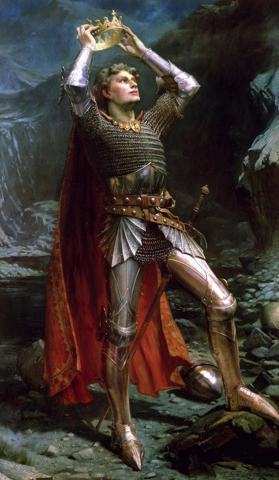
The once and future king: a shadowy British war-leader who medieval writers rebuilt into the emperor of Camelot and the Round Table.
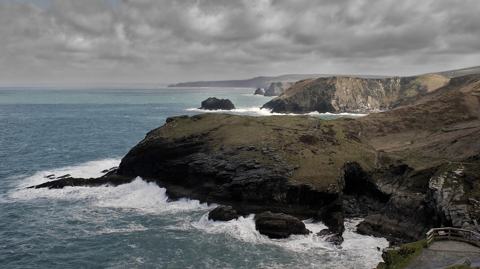
The Cornish clifftop where Geoffrey of Monmouth set Arthur's conception, and where archaeology has since found a real, wealthy post-Roman stronghold.
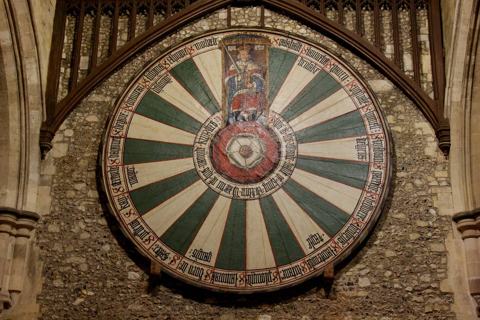
The real oak Round Table hanging in Winchester's Great Hall: tree-ring dated to the reign of Edward I, not Arthur's, and repainted for Henry VIII.
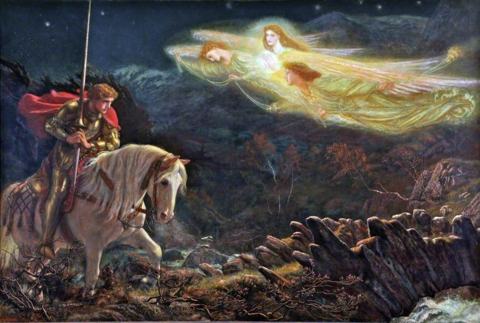
Lancelot's son, invented to succeed where his father failed. The spotless knight who filled the Siege Perilous and achieved the Holy Grail.
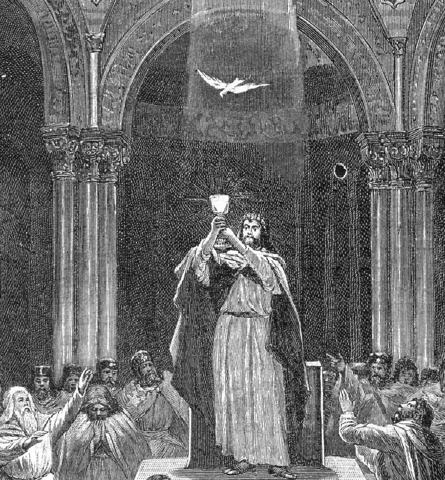
The forest-raised innocent who found the Grail castle and failed to ask the one question that mattered. Arthurian romance's first Grail knight.
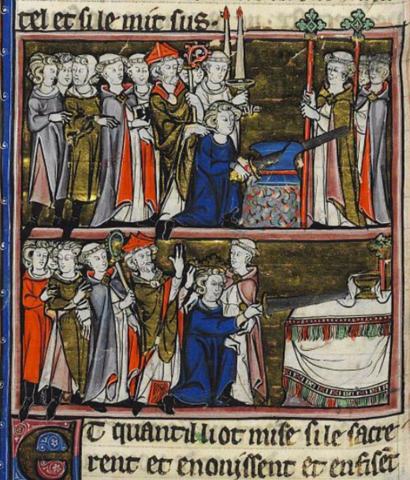
A sword fixed in a churchyard stone, drawable only by Britain's rightful king. Robert de Boron's invention, distinct from Excalibur in most versions.
Also mentioned inElaine of Astolat (the Lady of Shalott)The Fisher KingThe Siege Perilous
Sources & Further Reading
- 1.Chretien de Troyes, Lancelot, ou le Chevalier de la Charrette (c. 1177-1181).
- 2.Geoffrey of Monmouth, Historia Regum Britanniae (c. 1136), Book IX, on the plenary court at Caerleon.
- 3.The Vulgate Cycle: Lancelot and La Mort le Roi Artu (c. 1215-1235).
- 4.Thomas Malory, Le Morte Darthur, with William Caxton's preface (printed 1485).
- 5.John Leland, The Itinerary (c. 1535-1543), on Cadbury Castle.
- 6.Alcock, Leslie. Arthur's Britain: History and Archaeology, AD 367-634. London: Allen Lane, 1971.
- 7.Barber, Richard. King Arthur: Hero and Legend. Woodbridge: Boydell Press, 1986.
- 8.Lacy, Norris J. (ed.). The New Arthurian Encyclopedia. New York: Garland, 1991.
Spot an error or have a source to suggest? Write to info@viseterna.com. We cite primary sources and modern scholarship, and we correct fast.