
The Battle of Camlann
The battle that ended Arthur's reign: a single line in a medieval annal grew, over nine centuries, into the mutual destruction of Arthur and Mordred.
How Mordred was Slain by Arthur, Arthur Rackham, 1917 (The Romance of King Arthur) · Public domain · source
A Single Line in a Chronicle
Camlann's oldest source is barely a sentence. The tenth-century Annales Cambriae records, under the year 537: "the strife of Camlann, in which Arthur and Medraut fell, and there was death in Britain and in Ireland" 1. That is the whole of it — no cause given, no side named, no statement that Arthur and Medraut (the Welsh form of the name Mordred later carries) even fought each other rather than falling together against a common enemy. Everything readers now associate with Camlann — treachery, incest, the adder in the grass — was built onto this one line over the following nine hundred years 1,6.
The Welsh Material
The Welsh Triads, a mnemonic index of story-material rather than narrative in their own right, are only a little more forthcoming. They record Medrawd's raid on Arthur's court at Celliwig, where he eats the whole feast and strikes Guinevere after dragging her from her seat, and elsewhere they list Camlann among the "Three Futile Battles" of the Island of Britain — fought for no good reason and settling nothing 2. A separate triad blames the war on a slap exchanged between two sisters, Gwenhwyfar and Gwenhwyfach, a domestic and faintly absurd cause a long way from Geoffrey of Monmouth's later narrative of usurpation, and a reminder that the earliest Welsh Arthur belongs to a leaner, stranger tradition than the one continental romance eventually fixed in place 2,6.
Geoffrey Turns a Skirmish into a Civil War
Geoffrey of Monmouth's Historia Regum Britanniae, finished around 1136, gives Camlann the shape nearly everyone now assumes. Modredus, left as regent of Britain while Arthur campaigns against Rome, seizes the throne and the queen; Arthur turns back, and the two armies meet at the river Camblan, where Mordred is killed and Arthur is carried off mortally wounded 3. Wace's Norman-French verse and Layamon's English Brut both retell the scene with mounting horror, and Layamon goes further, giving Arthur a prophetic dream of the betrayal before word of it ever reaches him 4.
Malory's Adder
Malory's version, the one nearly every modern retelling descends from, adds the detail that turns Camlann from a defeat into a tragedy. A truce is struck between the two hosts on condition that no sword is drawn; a knight is bitten by an adder in the heath and draws his blade to kill it, and both armies, seeing the flash of steel, charge before either king can call a halt 5. Arthur runs Mordred through with a spear at the end of the fighting; Mordred drives himself up the shaft to land one last blow on his father through the helm. It is one of the most quoted images in English narrative, and it makes the destruction of the Round Table mutual, and in a sense accidental — a war neither man wanted, set off by a snake 5.
Where Was Camlann?
Nobody knows, and the candidates say as much about method as about geography. Geoffrey's "Camblan" was read by later medieval and Tudor writers as the River Camel in Cornwall, near Camelford, and the seventeenth-century antiquarian John Aubrey reported finding armour fragments dug up there 3,6. Philologists have also pointed to Camboglanna, the Roman name of a fort on Hadrian's Wall usually identified with Castlesteads, since its Brittonic form is the closest surviving match in sound to "Camlann" 6. Guy Halsall's skeptical account treats the whole search as close to unanswerable: the Annales Cambriae entry may well have been composed centuries after 537 from an oral or reconstructed date rather than a contemporary record, which leaves no independent evidence against which any site can be tested 7. Historians disagree sharply about how much of Camlann is preserved memory and how much is later invention laid onto one obscure annal 6,7.
After Malory
Idylls of the King, Tennyson's Victorian retelling, turns the battle into elegy rather than action, ending on the barge bound for Avalon instead of on the killing blow, and nearly every stage, film and game version since has kept Malory's basic shape: a truce broken by accident, a king and a usurper who is also, in the developed tradition, his own son, destroying each other on the same field. Camlann is the mirror image of the Battle of Badon, Arthur's first great victory in the same annal — together the two entries bracket his entire career in exactly two sentences, and everything else is what later ages, working within what would come to be called the Matter of Britain, chose to pour into the space between them 1,3,5.
Continue Exploring
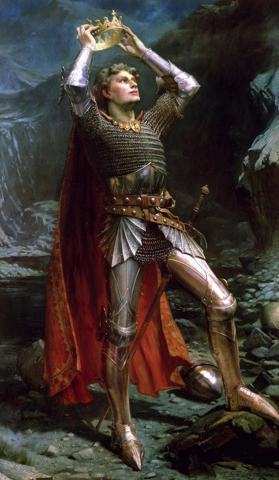
The once and future king: a shadowy British war-leader who medieval writers rebuilt into the emperor of Camelot and the Round Table.
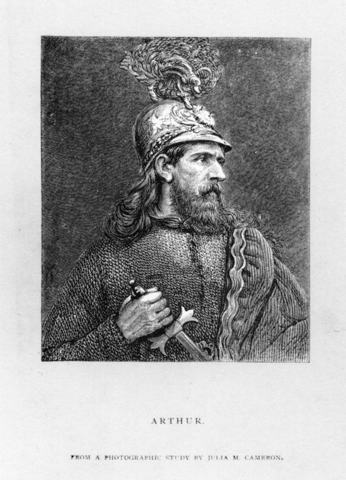
Tennyson's Victorian retelling of the Arthur story in blank verse, published across 26 years — the most influential English version of the legend after Malory.
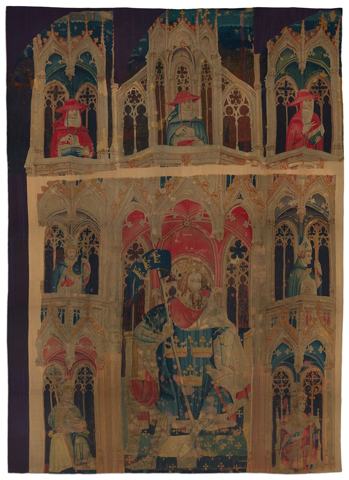
The medieval term for the whole Arthurian tradition, coined around 1200 to separate British legend from the Matter of France and the Matter of Rome.
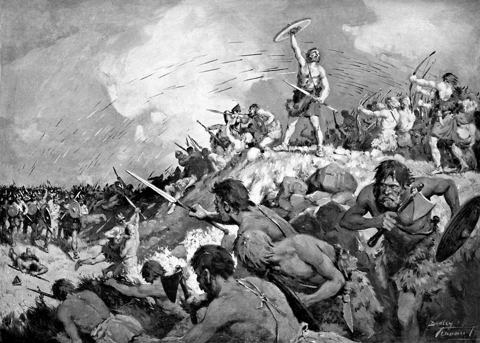
A single line in a 6th-century sermon became the British win historians can't agree on the date or site of — and the victory later tradition gave to Arthur.
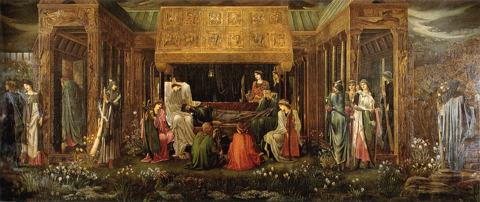
The isle of apples: the healing island where Excalibur was forged and where the wounded Arthur was carried, neither dead nor returned.
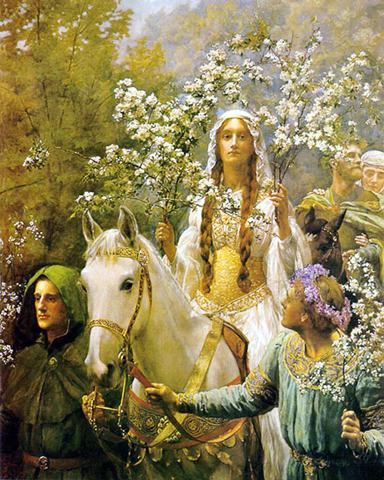
Queen of Britain and Arthur's wife: a figure repeatedly stolen, blamed and reinvented, whose love for Lancelot brings the Round Table down.
Also mentioned inExcaliburGlastonbury (Isle of Avalon)
Sources & Further Reading
- 1.Annales Cambriae (10th century), entry for the year 537.
- 2.Trioedd Ynys Prydein (the Welsh Triads), triads 51, 53 and 84; ed. and trans. Rachel Bromwich. 3rd ed. University of Wales Press, 2006.
- 3.Geoffrey of Monmouth, Historia Regum Britanniae (c. 1136), Book XI.
- 4.Wace, Roman de Brut (1155); Layamon, Brut (c. 1200).
- 5.Thomas Malory, Le Morte Darthur (printed by William Caxton, 1485), Book XXI.
- 6.Higham, N. J. King Arthur: Myth-Making and History. Routledge, 2002.
- 7.Halsall, Guy. Worlds of Arthur: Facts and Fictions of the Dark Ages. Oxford University Press, 2013.
Spot an error or have a source to suggest? Write to info@viseterna.com. We cite primary sources and modern scholarship, and we correct fast.