
Morgan le Fay
The fay of Avalon: healer, shape-shifter and Arthur's half-sister, who became the legend's great enchantress and its most useful enemy.
Morgan-le-Fay, Frederick Sandys, 1864 (Birmingham Museum and Art Gallery) · Public domain · source
Healer First, Villain Later
Morgan le Fay is the most thoroughly rewritten character in Arthurian legend. She enters the tradition as a benevolent otherworld healer, spends the thirteenth century being converted into the court's resident enemy, and arrives in the twentieth as a feminist protagonist. All three Morgans are still in circulation at once, which is why she can seem inconsistent: she is not one character developed over time so much as a name that successive writers found useful 7,8. She is a figure of literary legend, not of religious cult.
The Isle of Apples
Her first appearance by name is in Geoffrey of Monmouth's Vita Merlini, around 1150. Taliesin describes the Isle of Apples, "which men call fortunate", where nine sisters rule and the chief of them is Morgen: she surpasses her sisters in beauty, knows the healing properties of every herb, can change her shape and fly on strange wings, and receives the wounded King Arthur after Camlann, promising a cure if he stays with her 1. There is no hostility in this portrait at all. She is a benign supernatural physician on a paradisal island — the earliest description of Avalon that we have.
Chretien de Troyes, writing at almost the same time, treats "Morgue la fee" as an established fact of the Arthurian world and mentions her twice in passing, both times as a source of medicine: an ointment of her making heals Erec's wounds, and another cures the hero's madness in Yvain 2. In the twelfth century, in other words, Morgan is simply the woman you send to when someone is dying.
Where the Name Comes From
The etymology is disputed and the popular answers are usually wrong. The form Geoffrey uses, Morgen, is generally derived from a Celtic compound meaning something like "sea-born". An older scholarly tradition associated with Roger Sherman Loomis linked her to the Irish war-goddess The Morrigan; that identification is now largely rejected on both linguistic and functional grounds, since the two figures share little beyond a superficial resemblance of name 7,8. A stronger case connects her to Modron, the Welsh reflex of the Gaulish mother-goddess Matrona, who in the Welsh triads is the mother of Owain and the daughter of Afallach — a name from the same root as Avalon 7. What can be said safely is that Morgan carries traces of an older supernatural type without being a documented goddess of any known cult.
The epithet is simply Old French fee, a fay: a woman with otherworldly knowledge and power, not necessarily a witch and originally not evil at all.
The Romance Villain
The great prose cycles of the thirteenth century did three things to her. They made her Arthur's half-sister, one of the daughters of Igerne by the duke of Cornwall. They made her Merlin's pupil, which gives her power a source and a motive. And they gave her a grievance: in the Vulgate Lancelot, Guinevere exposes Morgan's love affair and drives her from court, after which her energy is spent on exposing the queen's own adultery 3,7.
From there she becomes the engine of a whole class of episodes. She traps knights in the Val sans Retour, from which only a faithful lover can free them; she sends chastity tests in the form of a drinking horn or an ill-fitting mantle, designed to humiliate the queen in public; she abducts Lancelot and at one point sends Arthur the incriminating paintings Lancelot has made of his own love affair 3,7. Her hostility is targeted and, in its own terms, coherent: she attacks the lie at the centre of the court.
Malory's Morgan
Malory, drawing on the Post-Vulgate, gives her the sharpest version of the plot. She steals Excalibur and its scabbard, arms her lover Accolon with the true sword and sends him to fight Arthur with a counterfeit, and when the plan fails she rides off and throws the scabbard — which prevents its bearer from bleeding — into a deep lake, a loss that will eventually kill her brother. She later sends him a mantle that burns its wearer to cinders 4,6.
And yet, at the end, Morgan is the first of the queens on the black barge that carries the dying Arthur away, weeping over him and calling him her dear brother 6. Malory never reconciles the two roles because his sources never did. The healer of the Isle of Apples and the poisoner of Book IV are the same person only because they share a name.
The Goddess Behind the Green Knight
The most striking late-medieval use of her is in Sir Gawain and the Green Knight. In the poem's final movement the host reveals that the entire test — the beheading game, the enchanted castle, the temptation — was devised by "Morgne þe goddes", Morgan the goddess, Arthur's half-sister and Merlin's former lover, to test the pride of the Round Table and to frighten Guinevere to death 5,7. She never appears as an actor, only as the withered old woman at Bertilak's side whom the reader has already met without knowing it, and the disclosure retroactively reorganises the whole poem.
Modern Reinvention
Tennyson largely wrote her out; the twentieth century wrote her back in. Marion Zimmer Bradley's The Mists of Avalon (1983) retells the entire legend from the perspective of Morgaine as a priestess of a dying religion, and effectively created the modern popular Morgan: sympathetic, pagan, and displaced by a hostile Christianity. Screen and game versions typically choose one of the two medieval poles — Helen Mirren's Morgana in Excalibur (1981) on the villainous side, and a long line of playable sorceresses in Smite, the Fate franchise and Arthurian role-playing games on both.
Continue Exploring
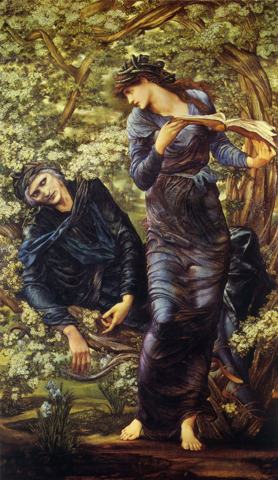
Britain's prophet and enchanter: a mad Welsh seer whom Geoffrey of Monmouth rebuilt as the wizard who made Arthur possible.
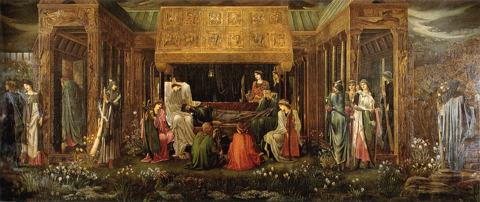
The isle of apples: the healing island where Excalibur was forged and where the wounded Arthur was carried, neither dead nor returned.
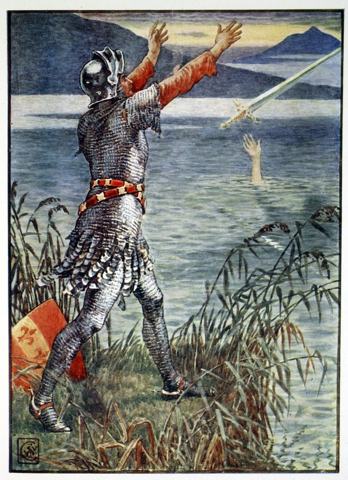
The sword of King Arthur: a Welsh blade called Caledfwlch that became the weapon drawn from a stone, given by a lake, and returned to the water.
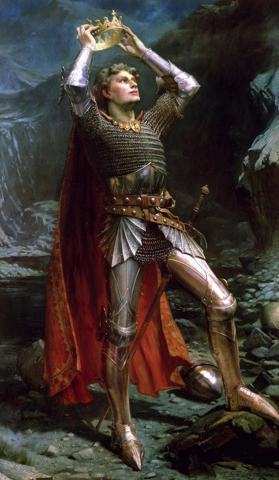
The once and future king: a shadowy British war-leader who medieval writers rebuilt into the emperor of Camelot and the Round Table.
Queen of Britain and Arthur's wife: a figure repeatedly stolen, blamed and reinvented, whose love for Lancelot brings the Round Table down.
First knight of the Round Table: a French invention raised by a lake fay, whose love for the queen makes him the best knight and ruins the kingdom.
Also mentioned inGawainThe Green KnightThe Lady of the LakeTristan and IseultUther Pendragon
Sources & Further Reading
- 1.Geoffrey of Monmouth, Vita Merlini (c. 1150), the passage on the Isle of Apples and Morgen.
- 2.Chretien de Troyes, Erec et Enide and Yvain, ou le Chevalier au Lion (c. 1170-1180).
- 3.The Vulgate Cycle: Lancelot and La Mort le Roi Artu (c. 1215-1235).
- 4.The Post-Vulgate Suite du Merlin (13th century).
- 5.Sir Gawain and the Green Knight (late 14th century), lines 2446-2470.
- 6.Thomas Malory, Le Morte Darthur (printed by William Caxton, 1485), esp. Book IV.
- 7.Larrington, Carolyne. King Arthur's Enchantresses: Morgan and Her Sisters in Arthurian Tradition. London: I. B. Tauris, 2006.
- 8.Lacy, Norris J. (ed.). The New Arthurian Encyclopedia. New York: Garland, 1991.
Spot an error or have a source to suggest? Write to info@viseterna.com. We cite primary sources and modern scholarship, and we correct fast.