
The Battle of Badon
A single line in a 6th-century sermon became the British win historians can't agree on the date or site of — and the victory later tradition gave to Arthur.
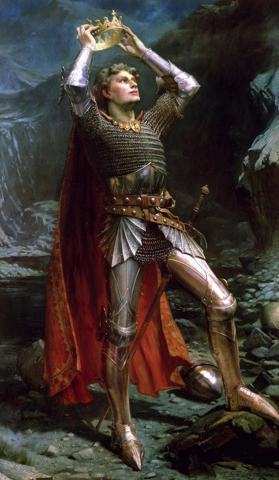
Battle of Mons Badonicus, c. 500 AD, Charles Dudley Tennant, c. 1922 · Public domain · source
A Sermon, Not a Chronicle
The earliest reference to Badon comes from a writer who was not trying to record it for posterity. Gildas, a British cleric writing what is essentially a long sermon against the sins of his contemporary kings, mentions the "siege of Badon Hill" only in passing, as a chronological marker: British fortunes had swung back and forth against the Anglo-Saxons "up to the year of the siege of Badon Hill, and of almost the last great slaughter inflicted on the rascally crew," after which, he implies, decades of peace and then moral decay set in 1,2. Gildas names no commander on either side. He does not mention anyone called Arthur. Everything that later tradition builds on top of Badon has to be read into a text that was never interested in giving it to them 1,2,6.
The Forty-Four Years Puzzle
Gildas dates his own writing, and so indirectly the battle, by his own life: Badon happened, he says, "the forty-fourth year, with one month now elapsed," which he adds is also the year of his birth 1,2. That single clause has generated one of the longest-running arguments in early British history, because it is not clear whether Gildas means forty-four calendar years before he wrote, or a position within an eighty-four-year Easter computation cycle used by British churchmen of the period. Depending on which reading is taken and how Gildas's own floruit is estimated, modern scholars have proposed dates for Badon ranging from the 480s to the 530s, with no consensus in sight 6,7. The vagueness is not a modern imposition — it is built into the only surviving source.
Arthur Enters the Story, Three Centuries Later
Arthur's name is attached to Badon for the first time not by Gildas but by the Historia Brittonum, a Welsh compilation traditionally credited to Nennius and put together around 829–830, nearly three hundred years after the battle it describes 3,4. There Arthur appears as dux bellorum, "leader of battles," fighting alongside the kings of the Britons through twelve named engagements that culminate at Badon, where the text credits him with killing nine hundred and sixty men in a single charge, "and no one laid them low save he alone" 3. It is a folkloric flourish rather than a plausible casualty count, and it marks the point where Badon stops being simply a British victory and becomes specifically Arthur's victory 3,6.
The Annales Cambriae Date
The tenth-century Annales Cambriae goes further still, placing Badon at what corresponds to roughly AD 516 and adding a detail with no earlier source: "the Battle of Badon, in which Arthur carried the cross of our Lord Jesus Christ on his shoulders for three days and three nights, and the Britons were victors" 5. Most historians read "shoulders" as a scribal or textual confusion between the Welsh words for shoulder and shield, imagining a shield marked with a cross rather than Arthur literally bearing one — but either way, the entry has turned a battle into something closer to a religious victory, foreshadowing the sanctified kingship medieval romance would later build around him 5,6.
Looking for the Hill
Nobody has ever identified Mons Badonicus with certainty. The favoured candidates cluster in southern England: Liddington Castle, an Iron Age hillfort above the village of Badbury in Wiltshire, is the most widely cited guess, alongside Bath and Bathampton Down, Badbury Rings in Dorset, and several less popular sites further afield 6,7. None of the proposals rests on archaeological evidence specific to a battle — hillforts of the right period exist at all of them, which is not the same as proof that fighting happened there in the early sixth century. Guy Halsall is blunt about the limits of the exercise: without an agreed date, an agreed combatant list, or a securely dated text closer to the event than Gildas's sermon, matching a name to a hill is closer to educated guessing than to history 7.
Was Arthur Even There?
The honest position, and the one most modern academic treatments now take, is that Badon was very likely a real British victory — Gildas is too close to the event and too uninterested in flattering anyone to have invented it — but that his silence on who led it leaves Arthur's presence entirely unproved 1,6,7. King Arthur enters the record only in the ninth-century retelling, and by the time Idylls of the King and other later works stage Badon as one of his great feats, the story is doing exactly what Gildas's sermon never did: turning an unnamed British stand into a king's personal triumph. Badon and the Battle of Camlann, Arthur's victory and his death, are the only two battles the earliest Welsh annals record for him — and only one of the two names him with any confidence at all 3,5.
Continue Exploring
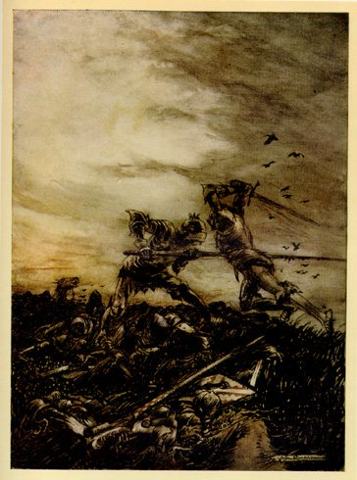
The battle that ended Arthur's reign: a single line in a medieval annal grew, over nine centuries, into the mutual destruction of Arthur and Mordred.
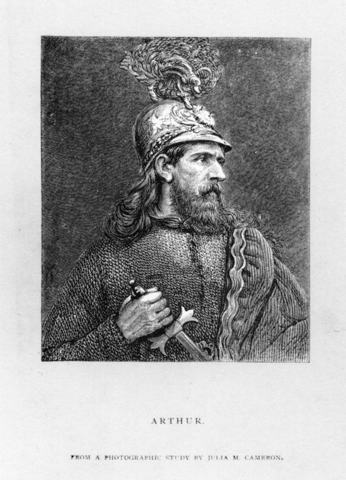
The once and future king: a shadowy British war-leader who medieval writers rebuilt into the emperor of Camelot and the Round Table.
Tennyson's Victorian retelling of the Arthur story in blank verse, published across 26 years — the most influential English version of the legend after Malory.
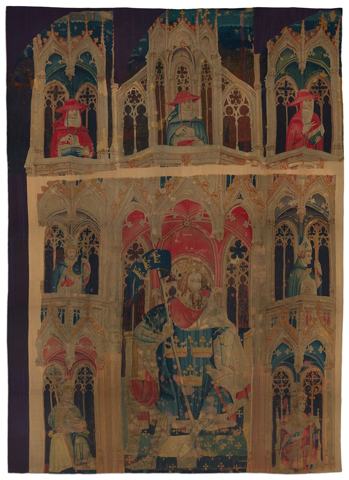
The medieval term for the whole Arthurian tradition, coined around 1200 to separate British legend from the Matter of France and the Matter of Rome.
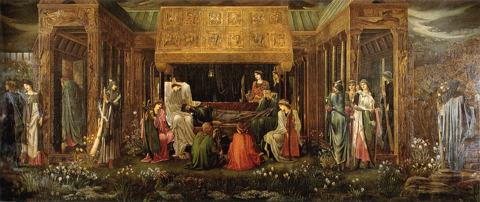
The isle of apples: the healing island where Excalibur was forged and where the wounded Arthur was carried, neither dead nor returned.
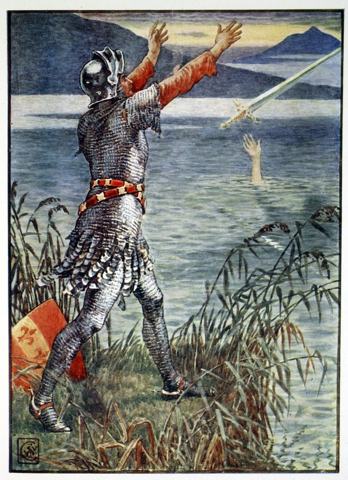
The sword of King Arthur: a Welsh blade called Caledfwlch that became the weapon drawn from a stone, given by a lake, and returned to the water.
Sources & Further Reading
- 1.Gildas, De Excidio et Conquestu Britanniae (mid-6th century), ch. 26.
- 2.Gildas. The Ruin of Britain and Other Documents. Translated by Michael Winterbottom. Phillimore, 1978.
- 3.Nennius (attrib.), Historia Brittonum (c. 829-830), ch. 56.
- 4.Nennius (attrib.). British History and the Welsh Annals. Translated by John Morris. Phillimore, 1980.
- 5.Annales Cambriae (10th century), entry for the year 516 (Badon).
- 6.Higham, N. J. King Arthur: Myth-Making and History. Routledge, 2002.
- 7.Halsall, Guy. Worlds of Arthur: Facts and Fictions of the Dark Ages. Oxford University Press, 2013.
Spot an error or have a source to suggest? Write to info@viseterna.com. We cite primary sources and modern scholarship, and we correct fast.