
Tintagel
The Cornish clifftop where Geoffrey of Monmouth set Arthur's conception, and where archaeology has since found a real, wealthy post-Roman stronghold.
Tintagel Castle, Cornwall, photograph by Terragio67, 2016 · CC BY-SA 4.0 · source
A Real Place With No Real Arthur
Tintagel is a narrow, wave-cut headland on the north Cornish coast, joined to the mainland by a thin neck of rock that has partly collapsed since the Middle Ages, so that "the island" today is reached by a footbridge rather than by land 2,3. It is a genuinely dramatic site — sheer slate cliffs, a natural sea cave known as Merlin's Cave beneath the isthmus, and commanding views along the coast — and it has been a major visitor attraction since Victorian times regardless of what archaeology has or has not confirmed about Arthur 2. The Duchy of Cornwall owns the headland; English Heritage manages the ruins and the visitor site today 3.
Geoffrey's Invention
Tintagel's fame begins with a single episode in Geoffrey of Monmouth's Historia Regum Britanniae. Uther Pendragon desires Ygerna, wife of Gorlois, Duke of Cornwall; Gorlois shuts her away in his stronghold at Tintagel as the safest place he holds, and Merlin disguises Uther in Gorlois's likeness so that he can pass the guards and lie with her, conceiving King Arthur that night 1. Geoffrey's text is narrower than the legend it produced: it never says Arthur was born at Tintagel or that he ever returned there as an adult, only that he was conceived there 1,4. Later medieval and modern retellings routinely expand this single scene into a full royal seat, well beyond anything Geoffrey actually wrote 4.
What the Excavations Found
Early twentieth-century excavation by C. A. Ralegh Radford, followed by a long theory that the site had been a Dark Age Celtic monastery, was substantially overturned by later work 2. Campaigns through the 1990s under Christopher Morris, and a further Cornwall Archaeological Unit project for English Heritage in 2016 and 2017, uncovered the outlines of an extensive high-status secular settlement of the fifth and sixth centuries: dozens of stone buildings terraced into the slope, imported wine amphorae from the eastern Mediterranean, fine tableware from North Africa and Gaul, and glass vessels, in quantities far exceeding any other site of the period in Britain 2,3. The evidence points to a major seat of power for local British rulers with working trade links to the post-Roman Mediterranean world, not a monastery and not, on present evidence, anything that can be tied to a specific named king 3,5.
The Artognou Stone
In 1998, excavators found a piece of reused slate, dated to around the seventh century, inscribed in Latin with a dedication naming a man building or ordering something: "PATERN[--] COLI AVI FICIT ARTOGNOU," roughly "Artognou, father of a descendant of Coll, made this" 3. Press coverage at the time seized on the word "Artognou" as visually close to "Arthur," and the story was widely reported as possible evidence for a historical Arthur. Specialists in Brittonic names reject the connection: Artognou is a different name, built from an element meaning "bear" that was common in the period, and its resemblance to "Arthur" is coincidental rather than a variant spelling 3,4. What the stone does show, more soberly, is that Latin literacy persisted at Tintagel after the end of Roman Britain, which is itself a significant finding about the site's status 3.
Legend Meets Geology
Whether Geoffrey chose Tintagel because of an existing Cornish tradition connecting the site to Gorlois or to some other pre-existing story, or simply because it was the most formidable stronghold he knew of on the Cornish coast, cannot be established from the surviving evidence 4. What is clear is that the choice was extraordinarily effective: a real, visually spectacular, genuinely high-status early medieval site gave the fictional conception scene a physical anchor that has outlasted every attempt at correction 2,4.
Tintagel Today
A striking cantilevered steel footbridge, evoking a broken sword, opened in 2019 to replace the steep stair that previously linked the mainland to the island and to make the site more accessible 3. Tintagel now receives roughly 200,000 visitors a year, formal publication of the 2016-17 excavation results is still in progress, and the site remains, more than any other single location, the place where the literary Arthur and the archaeological record of post-Roman Britain visibly overlap without ever quite touching 3,6.
Continue Exploring
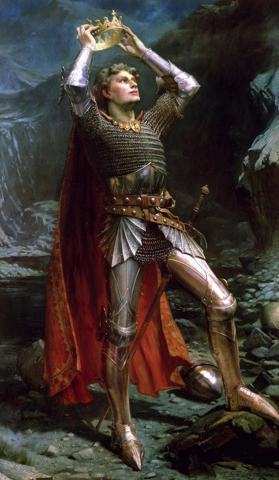
The once and future king: a shadowy British war-leader who medieval writers rebuilt into the emperor of Camelot and the Round Table.
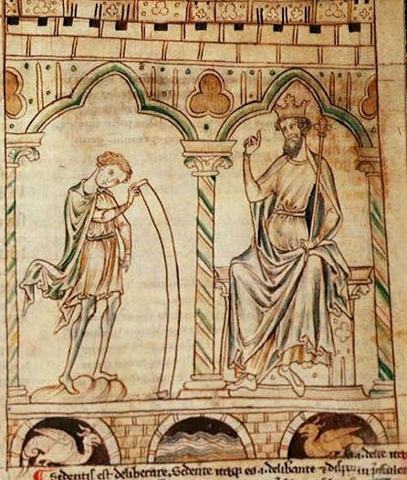
Geoffrey of Monmouth's 1136 pseudo-history that invented most of the Arthur legend as we know it, and was believed as literal fact for four centuries.
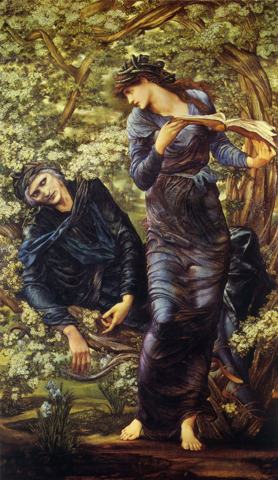
Britain's prophet and enchanter: a mad Welsh seer whom Geoffrey of Monmouth rebuilt as the wizard who made Arthur possible.
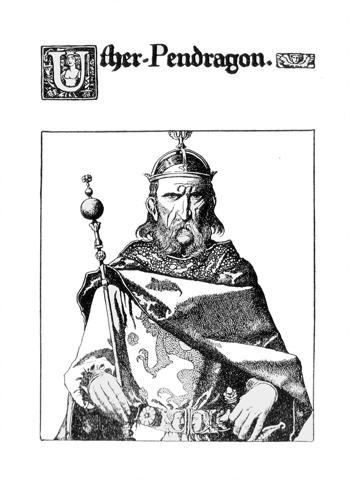
The dragon-star king whose deceit, arranged by Merlin, conceived King Arthur at Tintagel. A thin Welsh figure before Geoffrey of Monmouth gave him a full story.
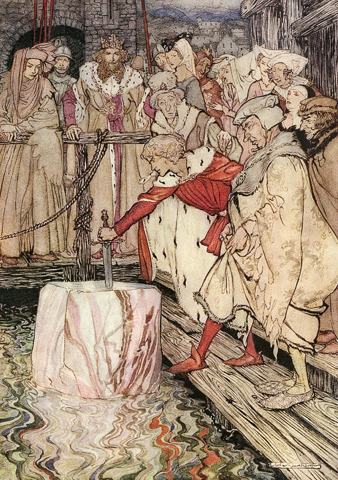
Arthur's chief court: a place named almost by accident in one French poem, which grew into the most famous city that never existed.
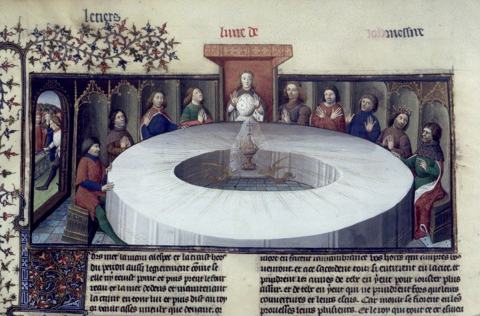
The table without a head: invented in 1155 to stop knights fighting over precedence, it became the name of Arthur's whole fellowship.
Sources & Further Reading
- 1.Geoffrey of Monmouth, Historia Regum Britanniae (c. 1136), Book VIII, on Arthur's conception.
- 2.Thomas, Charles. Tintagel: Arthur and Archaeology. London: Batsford / English Heritage, 1993.
- 3.Barrowman, Rachel C., Colleen E. Batey, and Christopher D. Morris. Excavations at Tintagel Castle, Cornwall, 1990-1999. London: Society of Antiquaries of London, 2007.
- 4.Padel, O. J. Arthur in Medieval Welsh Literature. Cardiff: University of Wales Press, 2000.
- 5.Thomas, Charles. A Provisional List of Imported Pottery in Post-Roman Western Britain and Ireland. Redruth: Institute of Cornish Studies, 1981.
- 6.Lacy, Norris J. (ed.). The New Arthurian Encyclopedia. New York: Garland, 1991.
Spot an error or have a source to suggest? Write to info@viseterna.com. We cite primary sources and modern scholarship, and we correct fast.