
The Siege Perilous
The vacant place at the Round Table that kills any knight who sits in it unworthily, kept for the one who would achieve the Holy Grail.
Galaad on the Siege Perilous, Evrard d'Espinques and workshop, BnF Francais 116, fol. 609, c. 1470 (Bibliotheque nationale de France) · Public domain · source
What It Is
The word has nothing to do with warfare. Siege here is the Old French siege, a seat, and the Siege Perilous is simply the dangerous chair: one place at the Round Table that is left empty because sitting in it without the right to do so is fatal 5,6. In the fully developed romances it is kept for the knight destined to achieve the Holy Grail, and every year the court looks at it and waits 3,6.
It is worth noting how efficient a piece of storytelling this is. A permanently vacant chair at the centre of the most famous fellowship in literature does three things at once: it advertises that the fellowship is incomplete, it dates the ending, and it makes the Grail quest structurally inevitable long before anyone rides out 6,8.
The Grail Table and Judas's Place
The seat's ancestry runs back through a sequence of tables. Robert de Boron, writing around 1200, describes Joseph of Arimathea establishing a table for the Grail in imitation of the table of the Last Supper, with one place left open in memory of the seat Judas vacated when he went out to betray Christ 1,6. The Vulgate Estoire del Saint Graal elaborates the same lineage, treating the empty place as reserved rather than merely unoccupied 2,6.
The tradition is thus explicitly typological: three tables, each prefiguring the next, with the same gap in each. Scholars generally read the motif as part of the thirteenth-century project of grafting the Arthurian world onto sacred history — the Round Table is not merely a knightly institution but the last stage of an inheritance running from Christ through Joseph of Arimathea to Britain 6,7,8.
Merlin and the Round Table
In the Robert de Boron cycle it is Merlin who builds the Round Table for Uther Pendragon on the pattern of the Grail table, and Merlin who explains the empty seat and forbids anyone to try it 1,5. Malory keeps the descent but changes the hands: in his account the table is Uther's, passes to King Leodegrance, and comes to Arthur as Guinevere's dowry, complete with a hundred knights and its unfilled place 5.
The names of the knights entitled to each seat appear in gold letters on the chairs, refreshing themselves as men die and are replaced — a small marvel Malory reports without comment, and the mechanism by which the court eventually learns whom the last seat belongs to 5.
Moses, Brumart, and the Presumptuous
The seat's reputation is built on the men who tested it. In the Grail material a follower of Joseph of Arimathea named Moses, outwardly devout and inwardly hypocritical, begs to be allowed the vacant place at the Grail table; he takes it, and fire or a whirlwind carries him away, and he is not seen again until a Grail knight finds him doing penance long afterwards 2,6.
The Post-Vulgate transfers the lesson to Arthur's court with Brumart or Brumant l'Orgueilleus, a kinsman of King Claudas, who sits in the Siege Perilous out of pride and on a wager and is consumed by fire, leaving only a scroll recording what he was and what he did 4,6,7. Some manuscripts and later summaries give the presumptuous knight other names, and the details of the destruction vary between fire, an opening earth and simple disappearance; the moral is constant 4,6,7.
Galahad Takes the Seat
The payoff comes on the feast of Pentecost in the Queste del Saint Graal. The knights find that fresh letters have appeared on the Siege Perilous that morning, announcing that the seat is to be filled that very day, four hundred and fifty-four years after the Passion — a date the court reads as an appointment being kept rather than a prophecy being made 3,5. Arthur has the inscription covered with a silk cloth 5.
Then a young knight is brought in by an old man in white, Lancelot's son Galahad, newly knighted and armed but without a sword. The cloth is lifted, and beneath the earlier writing his name now stands. He sits, and nothing happens 3,5. It is one of the quietest climaxes in medieval romance: the seat's whole meaning is that it does nothing, this once. That evening the Grail passes through the hall and the fellowship swears the oath that will scatter it 3,5.
Meaning and Afterlife
Read straight, the Siege Perilous is a test of worth. Read as its authors seem to have intended, it is a statement about grace — the seat cannot be earned by prowess, only occupied by the one for whom it was always meant, which is why Lancelot, the best knight alive, is disqualified and his son is not 3,6,8. Some scholars have connected the motif to older Celtic tales of dangerous seats and perilous chairs, though the evidence is thin and the Christian typology is documented in the texts themselves 7,8.
The phrase escaped the legend early and is now used in English for any position of honour that will destroy an unqualified occupant. It has also had a long second life in popular culture, most visibly in comics, where the name was borrowed for an object of quite different function 6,7. At Camelot, though, its meaning stays narrow and rather bleak: the empty chair is the reminder that the fellowship's best day and its last day are the same day 3,6.
Continue Exploring
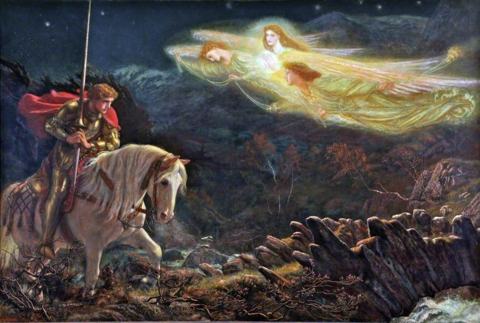
Lancelot's son, invented to succeed where his father failed. The spotless knight who filled the Siege Perilous and achieved the Holy Grail.
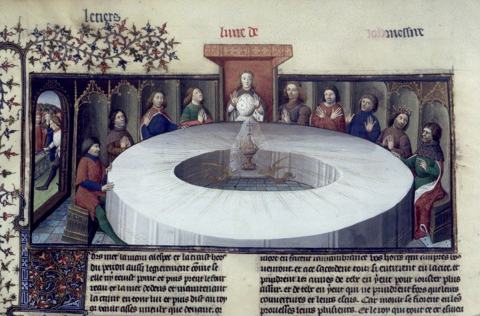
The table without a head: invented in 1155 to stop knights fighting over precedence, it became the name of Arthur's whole fellowship.
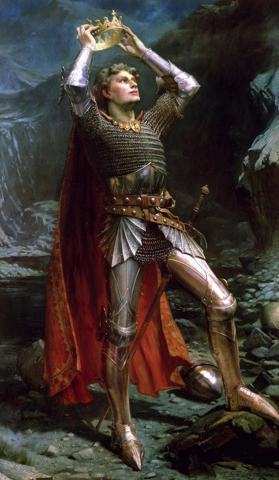
The once and future king: a shadowy British war-leader who medieval writers rebuilt into the emperor of Camelot and the Round Table.
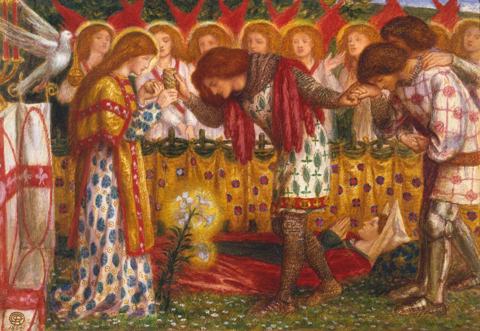
The vessel of the quest: a serving dish in an unfinished French poem that became Christendom's most famous relic and the ruin of the Round Table.
A sword fixed in a churchyard stone, drawable only by Britain's rightful king. Robert de Boron's invention, distinct from Excalibur in most versions.
Queen of Britain and Arthur's wife: a figure repeatedly stolen, blamed and reinvented, whose love for Lancelot brings the Round Table down.
Sources & Further Reading
- 1.Robert de Boron, Joseph d'Arimathie (c. 1200) and the prose Merlin derived from his verse Merlin.
- 2.The Estoire del Saint Graal, in the Vulgate (Lancelot-Grail) Cycle (c. 1215-1235).
- 3.La Queste del Saint Graal, in the Vulgate Cycle (c. 1215-1235).
- 4.The Post-Vulgate Queste del Saint Graal (Old French, c. 1230-1240).
- 5.Thomas Malory, Le Morte d'Arthur, Books III and XIII (completed c. 1469-70; printed by William Caxton, 1485).
- 6."The Siege Perilous", The Camelot Project, Robbins Library Digital Projects, University of Rochester.
- 7.Lacy, Norris J. (ed.). The New Arthurian Encyclopedia. Garland, 1991.
- 8.Barber, Richard. The Holy Grail - Imagination and Belief. Harvard University Press, 2004.
Spot an error or have a source to suggest? Write to info@viseterna.com. We cite primary sources and modern scholarship, and we correct fast.