
The Sword in the Stone
A sword fixed in a churchyard stone, drawable only by Britain's rightful king. Robert de Boron's invention, distinct from Excalibur in most versions.
Arthur drawing the sword and his coronation, Estoire de Merlin manuscript, France, 1280 (Bibliotheque nationale de France) · Public domain · source
Not Geoffrey's Story
The scene everyone pictures at Arthur's coronation is missing from the chronicle that made him famous. Geoffrey of Monmouth's Historia Regum Britanniae (c. 1136) has Arthur crowned at fifteen by inheritance and acclaim; there is no test, no stone, no anvil. The sword-in-the-stone motif is a French addition of roughly a generation later, invented by the poet Robert de Boron, and it is worth treating as an object in its own right rather than folding it into Excalibur, the sword most medieval writers keep carefully separate from it 1,5.
The Test at Christmas
In Robert de Boron's Merlin, the kingdom of Britain has no king after Uther Pendragon's death, and Merlin tells the archbishop to summon every baron to London for Christmas so that God may show his choice. On Christmas morning a squared stone has appeared in the churchyard with a steel anvil set into it and a sword standing through the anvil, inscribed to say that whoever draws it is the rightful king of Britain by heredity 1. The great lords try and fail, one after another, and are told to try again at each of the year's feasts, since no single day should be allowed to settle so large a claim 1,2,3.
A Boy Fetching a Sword
The draw itself is deliberately anticlimactic. The young Arthur, sent by his foster-brother Kay to fetch a blade for a tournament, pulls the sword from the stone without knowing what it is, because it is simply the nearest sword to hand 1,2. Kay claims the feat for himself until his father Ector, suspicious, makes him swear on a relic and forces the truth out; Ector then has Arthur replace the sword and tries to draw it himself before letting the boy try again in front of witnesses 1,4. Even after that the commons need convincing. Malory has Arthur repeat the draw at Candlemas, Easter and Pentecost before the barons finally accept him, and it is only sustained popular pressure, not the miracle alone, that puts him on the throne 4.
Two Different Swords
Malory and the French prose tradition are careful to keep this sword apart from Excalibur. In Malory's account the blade Arthur draws from the stone is broken early in his reign in a fight with King Pellinore, after which Merlin takes him to a lake to receive a second, unrelated sword from an arm rising out of the water 4. The stone sword is a test object: ordinary steel whose entire significance lies in who is permitted to move it, and it is accordingly disposable. Excalibur, by contrast, is a gift with its own scabbard, its own theft, and its own ending, given by the Lady of the Lake rather than won from a church stone. Popular retellings routinely collapse the two into a single weapon, which is precisely the confusion the medieval texts go out of their way to avoid.
A Second Stone at Camelot
The motif was good enough to use twice. In the Grail romances a second sword appears fixed in a block of red marble that floats down the river to Camelot, inscribed to say that only the best knight in the world may draw it 4. Gawain tries under orders and is later wounded by that very blade; Galahad, arriving at court without a sword of his own, draws it on the same day he fills the Siege Perilous, and the pairing marks him as Arthur's true successor in chivalry just as the churchyard sword had marked Arthur as Britain's true king 4.
What the Test Argues
The device is a piece of political theology as much as a story beat. By making the crown depend on an object no wealth or army can force open, Robert de Boron shifts the source of kingship from inheritance or conquest to divine sanction, which fits an age increasingly invested in the idea of the anointed king 5,7. Comparable objects recur across medieval and legendary literature, from the Norse Volsung sword fixed in the great tree Branstock to various folkloric "impossible task" weapons; scholars treat this as a widespread narrative pattern rather than evidence that any one version borrowed directly from another 5,6.
In Popular Culture
Disney's The Sword in the Stone (1963), adapting T. H. White, fixed the scene in modern popular memory and did the most to merge the two swords into one object in the public imagination. Games and fantasy fiction now use "a sword in a stone" as a generic shorthand for a legitimacy test, almost always without the second, later sword the medieval texts insist on keeping separate 7.
Continue Exploring
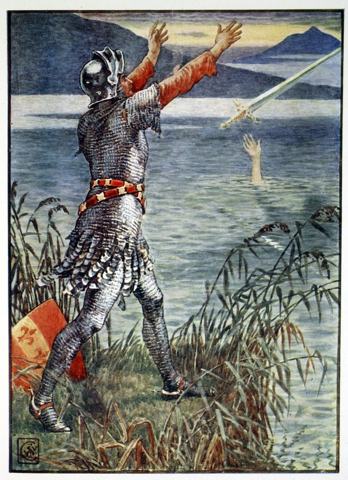
The sword of King Arthur: a Welsh blade called Caledfwlch that became the weapon drawn from a stone, given by a lake, and returned to the water.
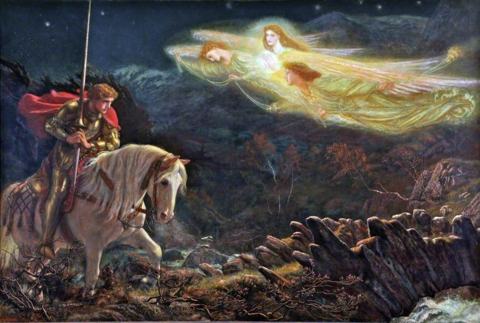
Lancelot's son, invented to succeed where his father failed. The spotless knight who filled the Siege Perilous and achieved the Holy Grail.
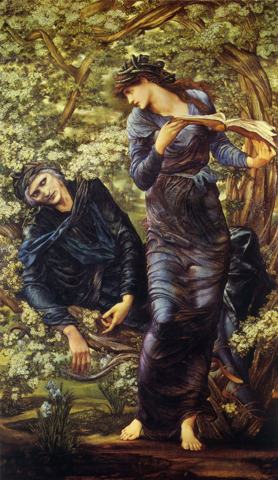
Britain's prophet and enchanter: a mad Welsh seer whom Geoffrey of Monmouth rebuilt as the wizard who made Arthur possible.
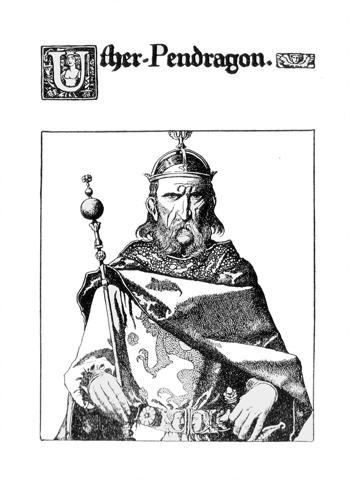
The dragon-star king whose deceit, arranged by Merlin, conceived King Arthur at Tintagel. A thin Welsh figure before Geoffrey of Monmouth gave him a full story.
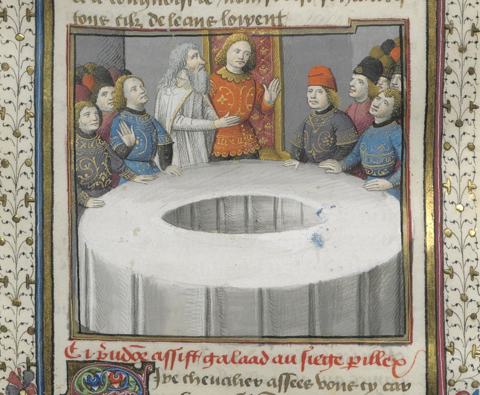
The vacant place at the Round Table that kills any knight who sits in it unworthily, kept for the one who would achieve the Holy Grail.
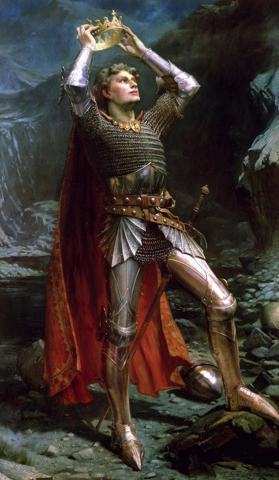
The once and future king: a shadowy British war-leader who medieval writers rebuilt into the emperor of Camelot and the Round Table.
Sources & Further Reading
- 1.Robert de Boron, Merlin (c. 1200).
- 2.The Vulgate Cycle: Estoire de Merlin (c. 1215-1235).
- 3.The Post-Vulgate Suite du Merlin (13th century).
- 4.Thomas Malory, Le Morte Darthur (printed by William Caxton, 1485), Books I and XIII.
- 5.Loomis, Roger Sherman (ed.). Arthurian Literature in the Middle Ages: A Collaborative History. Oxford: Clarendon Press, 1959.
- 6.Lacy, Norris J. (ed.). The New Arthurian Encyclopedia. New York: Garland, 1991.
- 7.Lupack, Alan. The Oxford Guide to Arthurian Literature and Legend. Oxford University Press, 2005.
Spot an error or have a source to suggest? Write to info@viseterna.com. We cite primary sources and modern scholarship, and we correct fast.