
Elaine of Astolat (the Lady of Shalott)
A noblewoman who dies of unrequited love for Lancelot and drifts to Camelot in a barge, now better known as Tennyson's Lady of Shalott.
Elaine, or The Lily Maid of Astolat, Sophie Gengembre Anderson, 1870 · Public domain · source
Two Elaines
The name causes real confusion, and it is worth clearing up first. This Elaine, of the town of Astolat, is not Elaine of Corbenic, the daughter of King Pelles who is tricked into bearing Lancelot's son Galahad; medieval scribes gave both women the same name, and later readers have been mixing them up ever since 3,7. Elaine of Astolat has no child by Lancelot and no connection to the Grail. Her story is smaller and, in its own way, sadder: a young noblewoman falls in love with a man who cannot love her back, and dies of it.
An Italian Original
The earliest coherent version of her tale is not English. A short story called La Damigella di Scalot appears in the thirteenth-century Italian collection Il Novellino, and the French prose Mort Artu, compiled around the same decades, independently gives essentially the same plot to a figure called simply the Demoiselle d'Escalot 1,2. Which text is earlier, or whether both draw on a shared source now lost, is unresolved; Nadege Le Lan's study of the character's reception traces the two branches without settling the priority question 1,2,6. What both agree on is the shape of the story: a girl at Escalot loves a great knight of Arthur's court, is refused, and dies asking that her body be sent by boat to Camelot with a letter in her hand explaining why.
Malory's Fair Maid of Astolat
Malory's version, and the one that fixed most of the story's details in English, unfolds during a tournament. Elaine, daughter of the old baron of Astolat, falls for Lancelot when he lodges at her father's house incognito; she persuades him to wear her token in the lists, which he agrees to precisely because it disguises him from the rest of the court, and nurses him afterward through a wound taken in the fighting 3. When he is well enough to leave, she tells him plainly that she will die if he will not marry her; he cannot, being bound already to Guinevere, and offers her money and land instead, which she refuses 3. She starves herself for ten days and asks to be laid in a barge dressed in her best clothes, a lily in one hand and her letter in the other, and steered downriver by an old boatman to Camelot, where King Arthur and the court read her words and give her an honored burial 3.
Tennyson's Lady of Shalott
Alfred, Lord Tennyson took the same core image and built an almost entirely different poem around it in 1832. His Lady of Shalott is a weaver bound by an unexplained curse to view the world only through a mirror in her tower; she breaks it by looking directly at Lancelot riding past, and the curse kills her as she floats down to Camelot in a boat with her name written on the bow, ending on Lancelot's famous, oblivious remark that she has a lovely face 4. Tennyson returned to the same character under her proper name in "Lancelot and Elaine" (1859), part of Idylls of the King, which follows Malory's tournament-and-refusal plot far more closely 5. The two poems are best read as two treatments of one figure: Shalott is symbolist and enclosed, Elaine is narrative and grounded, and the popular imagination has mostly kept the first name for a story that is, historically, the second one's 4,5,7.
The Pre-Raphaelite Afterlife
Victorian and academic painters returned to both versions of the scene obsessively through the second half of the nineteenth century — the weaver at her mirror and the corpse in the boat became one of the most repainted subjects in English art, attempted by Waterhouse more than once, by William Holman Hunt, by Sophie Anderson, and by many lesser-known hands 7. The Cambridge Companion to the Arthurian Legend places this flood of images among the clearest evidence of how thoroughly Tennyson's retelling, rather than Malory's, shaped what later generations pictured when they thought of Astolat at all 7.
Why the Story Endures
Le Lan's study frames Elaine, across seven centuries of retelling, as a figure defined entirely by dying of love — morte d'amour — and that narrowness is arguably the source of her staying power rather than a limitation of it 6. Unlike Guinevere's love, which survives and helps bring the kingdom down, Elaine's is presented as pure, hopeless, and entirely without blame, which has let each century project its own idea of innocent devotion onto a single boat drifting down a river toward a court that can only mourn her after the fact.
Continue Exploring
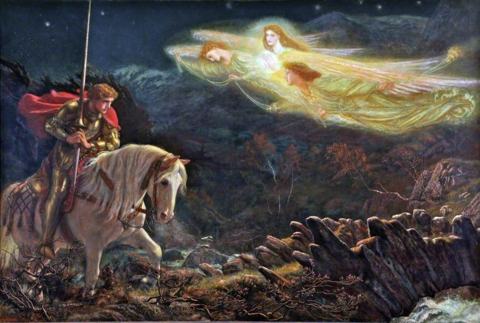
Lancelot's son, invented to succeed where his father failed. The spotless knight who filled the Siege Perilous and achieved the Holy Grail.
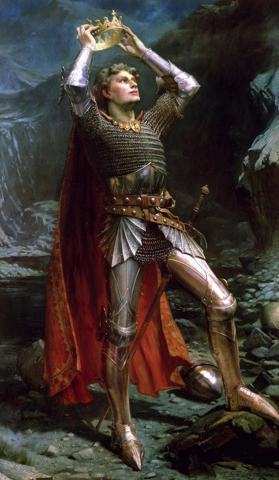
The once and future king: a shadowy British war-leader who medieval writers rebuilt into the emperor of Camelot and the Round Table.
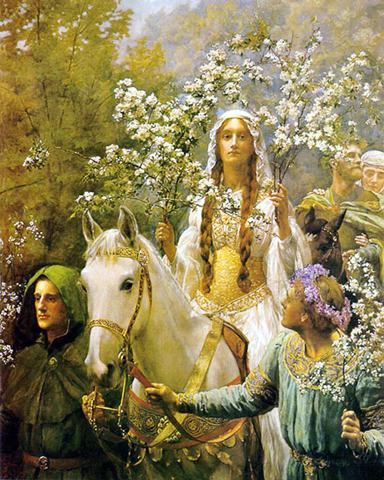
Queen of Britain and Arthur's wife: a figure repeatedly stolen, blamed and reinvented, whose love for Lancelot brings the Round Table down.
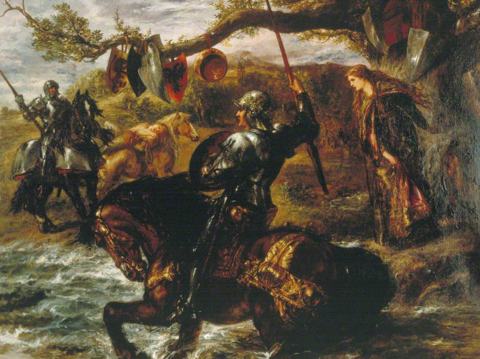
First knight of the Round Table: a French invention raised by a lake fay, whose love for the queen makes him the best knight and ruins the kingdom.
Arthur's chief court: a place named almost by accident in one French poem, which grew into the most famous city that never existed.
Lancelot's cousin and one of three knights who achieve the Holy Grail, and the only one who lives to tell the court what happened at Sarras.
Sources & Further Reading
- 1.La Damigella di Scalot, in Il Novellino (Le Ciento Novelle Antike) (Italian, 13th century).
- 2.La Mort le Roi Artu, in the Vulgate (Lancelot-Grail) Cycle (c. 1215-1235).
- 3.Thomas Malory, Le Morte Darthur (printed by William Caxton, 1485), Book XVIII.
- 4.Alfred, Lord Tennyson, "The Lady of Shalott" (1832; revised 1842).
- 5.Alfred, Lord Tennyson, "Lancelot and Elaine," in Idylls of the King (1859).
- 6.Le Lan, Nadege. La demoiselle d'Escalot (1230-1978): morte d'amour, inter-dits, temps retrouves. Paris: L'Harmattan, 2005.
- 7.Archibald, Elizabeth and Ad Putter (eds.). The Cambridge Companion to the Arthurian Legend. Cambridge University Press, 2009.
Spot an error or have a source to suggest? Write to info@viseterna.com. We cite primary sources and modern scholarship, and we correct fast.