
Percival (Perceval)
The forest-raised innocent who found the Grail castle and failed to ask the one question that mattered. Arthurian romance's first Grail knight.
Parcival vertoont den heiligen Graal, after Theodor Pixis, 1894 (Katholieke Illustratie) · Public domain · source
The Boy Raised in the Woods
Percival begins as a joke about ignorance. In Chretien de Troyes' Conte du Graal, his widowed mother hides him deep in the forest of Wales because knighthood has already killed his father and his brothers, so the boy grows up not knowing what a knight is, what a church is, or even his own name 1. When he blunders into a party of armed riders he takes them for angels, and the moment he decides to go to King Arthur's court his mother collapses at the bridge behind him. He does not look back — a detail Chretien makes him pay for later 1,7.
His education is a series of embarrassments. He seizes a lady's ring and food by force because his mother told him ladies give tokens; he kills the Red Knight with a javelin through the eye because nobody has taught him to fight properly; and the nobleman Gornemant, who finally knights him, gives him the advice that will ruin him: do not talk too much 1. At Camelot he is the boy the seneschal Kay mocks. It is the standard shape of the nice hero — nice in its old French sense of simple, untaught — and Chretien clearly enjoys it 6,8.
The Question He Did Not Ask
At the heart of the poem is the night Percival spends with a lame lord who fishes from a boat because he cannot walk, and who is known to later readers as the Fisher King. During dinner a procession crosses the hall: a squire carrying a lance that bleeds from its tip, then maidens with candelabra, then a damsel bearing a graal — in Chretien simply a serving dish, richly jewelled and blazing with light — and last a silver trencher 1. Percival, remembering Gornemant, says nothing.
The next morning the castle is empty, and a weeping maiden in the woods tells him what his silence cost: had he asked whom the Grail served, and why the lance bled, the wounded king would have been healed 1,7. Later a hideous damsel rides into Arthur's hall to publish the failure before the whole court. Percival vows to find the Grail again, wanders five years, forgets God, and is finally brought by penitents on a Good Friday to a hermit who turns out to be his uncle. The hermit reveals that the Grail carries a single mass wafer, and that this alone has sustained the Fisher King's aged father for twelve years 1,7. Chretien's poem breaks off soon after, unfinished, and the Grail is never explained further — an accident of literary history that arguably did more for the legend than any ending could have 7,8.
Parzival and the Healing Word
Wolfram von Eschenbach took Chretien's fragment and built a finished, far stranger epic around it. His Parzival is the son of Gahmuret and Herzeloyde, half-brother to the piebald Saracen knight Feirefiz, and the Grail is not a dish but a stone, lapsit exillis, guarded by an order of Templar-like knights 2. The wounded king is named Anfortas, and his wound is a punishment for having loved outside the Grail's law 2.
The crucial change is the question itself. Where Chretien's hero must ask whom the Grail serves, Wolfram's must ask a question of simple human pity — roughly, uncle, what ails you? — and the failure to ask it is a failure of compassion rather than of curiosity 2,8. When Parzival at last returns and speaks, Anfortas is healed and Parzival becomes Grail King; his son Loherangrin is the swan knight of the Lohengrin story. Wolfram claims to be following a Provencal source called Kyot, whom most scholars regard as an invention 6,8.
Peredur and the Welsh Background
A third version survives in Welsh. Peredur son of Efrawg follows a recognisably similar road — the fatherless boy, the mocking court, the mysterious castle — but the object carried through the hall is a salver bearing a severed head swimming in blood, and the story resolves as a blood-feud against the Nine Witches of Caer Loyw rather than as a spiritual quest 3. Scholars have argued for over a century about the relationship: whether Peredur adapts Chretien, whether both draw on a lost common source, or whether the Welsh tale preserves older native material that Chretien Christianised. No consensus exists, though few today accept the strongest Celtic-origin claims without qualification 3,6,7.
Overtaken by Galahad
Percival held the Grail alone for barely a generation. When the Cistercian-flavoured Queste del Saint Graal rebuilt the story around a spotless virgin knight, Galahad took the central role and Percival was demoted to one of three companions, alongside Bors, who see the Grail at its fullest 4. He remains a virgin, is tempted by a demon in the shape of a beautiful woman and saves himself by the sign of the cross, and watches his own sister die after giving her blood to cure a leprous lady 4. After Galahad's death at Sarras, Percival takes religious habit and dies within the year, leaving Bors to carry the news home.
Malory follows the Queste closely, making Percivale a son of King Pellinore and brother to Aglovale and Lamorak, and thereby knitting the Grail knight into the great feud between Pellinore's house and the house of Orkney that eventually helps bring the kingdom down 5. Some traditions hold that this genealogy is Malory's tidying rather than his sources' 5,8.
Afterlives
Wagner's Parsifal (1882) went back to Wolfram and turned the story into a music drama of compassion, chastity and redemption, which is why modern audiences most often meet the character in his German form. Tennyson, by contrast, handed the Grail vision to Percivale as narrator in the Idylls of the King, using him to voice the suspicion that the quest itself broke the Round Table 7,8. Between the two, Percival survives less as a knight than as an idea: the one who was pure enough to reach the mystery and green enough to say nothing 7.
Continue Exploring
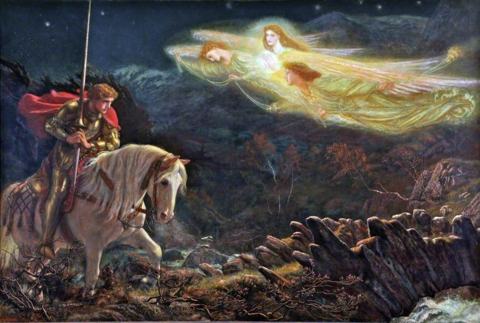
Lancelot's son, invented to succeed where his father failed. The spotless knight who filled the Siege Perilous and achieved the Holy Grail.
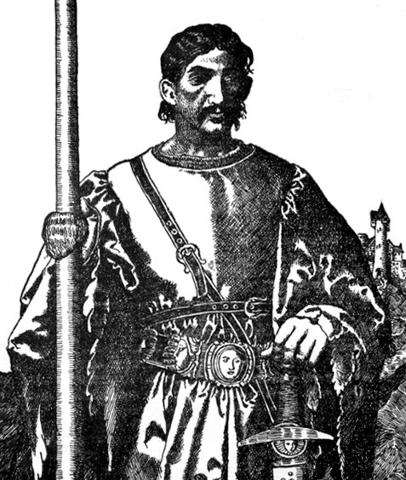
Lancelot's cousin and one of three knights who achieve the Holy Grail, and the only one who lives to tell the court what happened at Sarras.
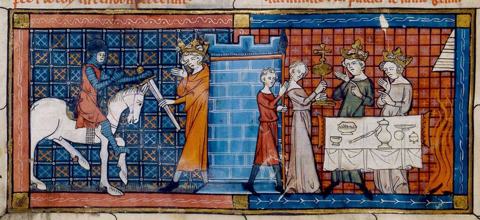
The maimed king who guards the Grail and fishes because he cannot walk. His wound waits on a question no knight thinks to ask.
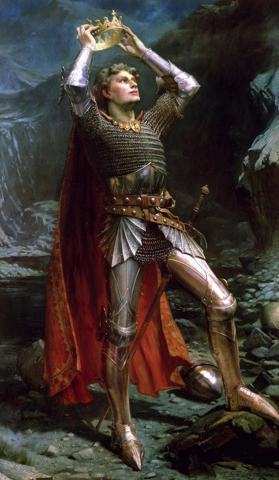
The once and future king: a shadowy British war-leader who medieval writers rebuilt into the emperor of Camelot and the Round Table.
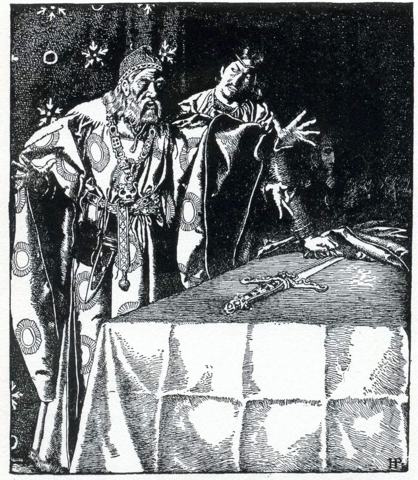
Arthur's foster-brother and seneschal. A magic-gifted warrior in Welsh tradition who became the sharp-tongued butt of French romance.
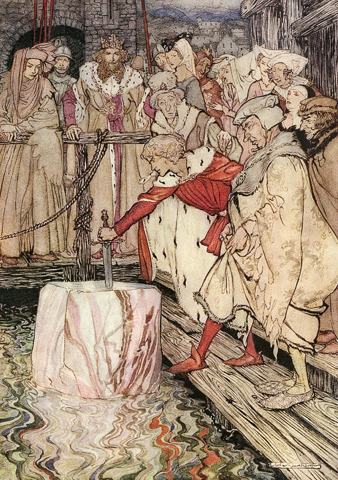
Arthur's chief court: a place named almost by accident in one French poem, which grew into the most famous city that never existed.
Also mentioned inThe Questing Beast
Sources & Further Reading
- 1.Chretien de Troyes, Perceval, ou le Conte du Graal (Old French verse, c. 1181-1190; left unfinished).
- 2.Wolfram von Eschenbach, Parzival (Middle High German, c. 1200-1210).
- 3.Peredur son of Efrawg, in the Mabinogion (Welsh prose; surviving in the White Book of Rhydderch and the Red Book of Hergest, 14th century).
- 4.La Queste del Saint Graal, in the Vulgate (Lancelot-Grail) Cycle (c. 1215-1235).
- 5.Thomas Malory, Le Morte d'Arthur (completed c. 1469-70; printed by William Caxton, 1485).
- 6.Loomis, Roger Sherman (ed.). Arthurian Literature in the Middle Ages - A Collaborative History. Clarendon Press, 1959.
- 7.Barber, Richard. The Holy Grail - Imagination and Belief. Harvard University Press, 2004.
- 8.Archibald, Elizabeth, and Ad Putter (eds.). The Cambridge Companion to the Arthurian Legend. Cambridge University Press, 2009.
Spot an error or have a source to suggest? Write to info@viseterna.com. We cite primary sources and modern scholarship, and we correct fast.