
The Holy Grail
The vessel of the quest: a serving dish in an unfinished French poem that became Christendom's most famous relic and the ruin of the Round Table.
How Sir Galahad, Sir Bors and Sir Percival Were Fed with the Sanct Grael, Dante Gabriel Rossetti, 1864 (Tate, London) · Public domain · source
A Dish in a Procession
The Grail begins as a common noun. In Chretien de Troyes' unfinished Conte du Graal, written in the 1180s, the young Perceval is entertained by a wounded host and watches a procession cross the hall: a squire carrying a white lance from whose tip a drop of blood runs down, then two candlesticks, then a maiden bearing un graal — "a graal", a serving dish of the sort used for large fish — of gold set with jewels, so bright it puts out the candles 1. Perceval, obeying an earlier lesson about not asking too many questions, says nothing. That silence is his catastrophe: had he asked whom the grail served, the maimed Fisher King would have been healed and his land restored. Later in the poem a hermit explains that the vessel carries a single communion wafer, which alone has sustained the king's father for twelve years 1.
Chretien died before finishing. Every element of the later legend — the cup, the blood of Christ, the sanctity, the quest as an institution — was supplied by writers filling that gap, which is Richard Barber's central point: the Grail's power comes precisely from having been left undefined 6.
Christianising the Vessel
Robert de Boron, writing around 1200, gave the answer that stuck. In his Joseph d'Arimathie the vessel is the dish of the Last Supper, given to Joseph of Arimathea, who uses it to catch the blood from Christ's body when he takes it down from the cross. Sustained by it through years of imprisonment, Joseph and his kin carry it west to the "vales of Avaron" and found a line of guardians ending in the Fisher King 2,6. In a single move the Grail becomes a Christian relic with an apostolic pedigree and a British destination — and, not coincidentally, a story that Glastonbury Abbey would later find extremely useful.
A Stone, Not a Cup
The German tradition took a different road. Wolfram von Eschenbach's Parzival, composed around 1210, makes the Grail a stone, lapsit exillis, guarded in a castle by an order of celibate knights called templeisen; it feeds those before it, renews the phoenix, and each Good Friday a dove descends to renew its power 3. Wolfram's version is the source of Wagner's Parsifal and of a long German afterlife, and it is a reminder that the Grail was still an open question a generation after Chretien.
The Quest That Empties the Round Table
The Vulgate Queste del Saint Graal, written in the 1220s under strong Cistercian influence, is the version that determined the shape of the legend. The Grail appears at Camelot at Pentecost, veiled, feeding every knight with the food he most desires; the whole fellowship swears to seek it, and King Arthur weeps, knowing that the Round Table he built will never be whole again 4. He is right. Most of the knights fail and many die. Lancelot, the best knight in the world, is stopped at the threshold and allowed only a glimpse. Only Galahad, Perceval and Bors reach the holy city of Sarras; Galahad looks into the vessel, asks to die at that moment, and is granted it, and the Grail is carried up to heaven and never seen again 4,8.
The theology is severe and deliberate. The Queste is an argument that the chivalric ideal, taken on its own terms, is not enough — and it makes that argument by dismantling the Round Table from the inside. Malory translates the sequence with obvious discomfort and returns to secular tragedy as fast as he decently can 5.
Where Did It Come From?
Three broad explanations have competed. The Celtic-origins school, associated above all with Roger Sherman Loomis, derived the Grail from otherworld vessels of plenty in Irish and Welsh tradition — the inexhaustible cauldron of The Dagda, the cauldron of rebirth in the Mabinogi, the cauldron sought in the Welsh poem Preiddeu Annwn — and read the bleeding lance and maimed king as folktale material 7. The ritual school, best known through Jessie Weston's From Ritual to Romance (1920) and its influence on T. S. Eliot, saw a fertility rite behind the wasteland motif; that theory has essentially no scholarly support today. Barber's account, now widely followed, treats the Grail as a literary invention of the late twelfth century whose Eucharistic meaning was present from Chretien onward and was elaborated by writers responding to each other rather than transmitting an ancient rite 6,8.
The Modern Grail
"Holy grail" has passed into English as a term for any unattainable goal, and the object has had a second life outside literature entirely. Nineteenth-century occultists, twentieth-century antiquarians and a lucrative modern publishing genre have identified it as a relic hidden at Glastonbury or Rennes-le-Chateau, as a bloodline, or as a code — a tradition running from Holy Blood, Holy Grail (1982) to The Da Vinci Code (2003), and comprehensively dismantled by Barber 6. On screen it drives Indiana Jones and the Last Crusade (1989) and is mocked to death in Monty Python and the Holy Grail (1975). Eight hundred years on, the thing works exactly as Chretien left it working: everyone wants it, and nobody can say what it is.
Continue Exploring
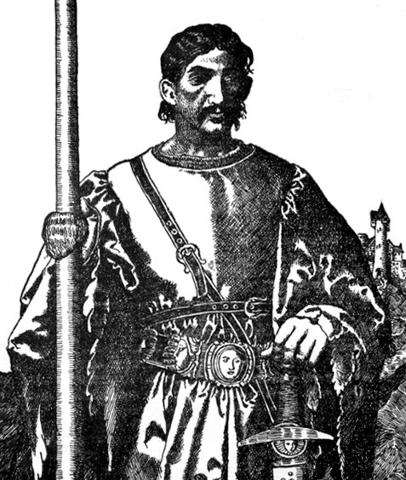
Lancelot's cousin and one of three knights who achieve the Holy Grail, and the only one who lives to tell the court what happened at Sarras.
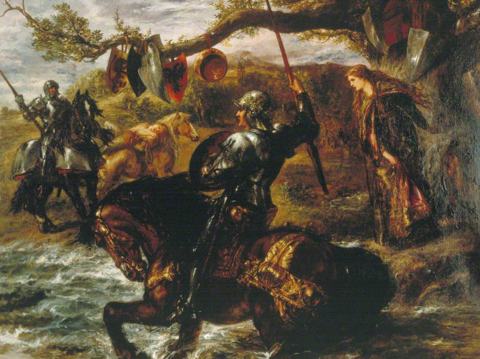
First knight of the Round Table: a French invention raised by a lake fay, whose love for the queen makes him the best knight and ruins the kingdom.
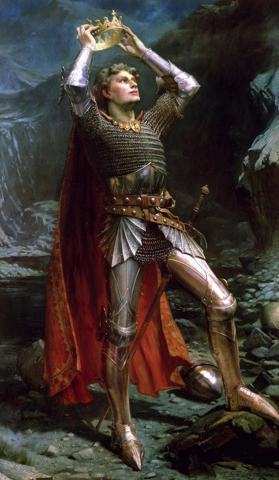
The once and future king: a shadowy British war-leader who medieval writers rebuilt into the emperor of Camelot and the Round Table.
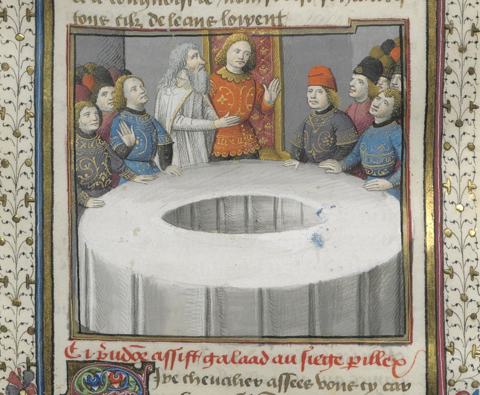
The vacant place at the Round Table that kills any knight who sits in it unworthily, kept for the one who would achieve the Holy Grail.
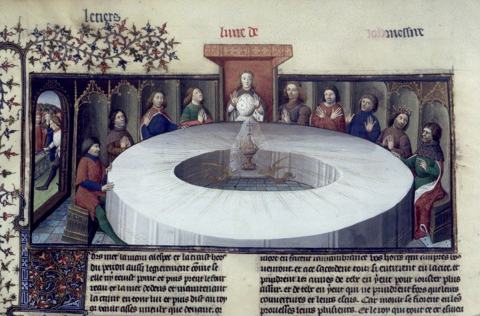
The table without a head: invented in 1155 to stop knights fighting over precedence, it became the name of Arthur's whole fellowship.
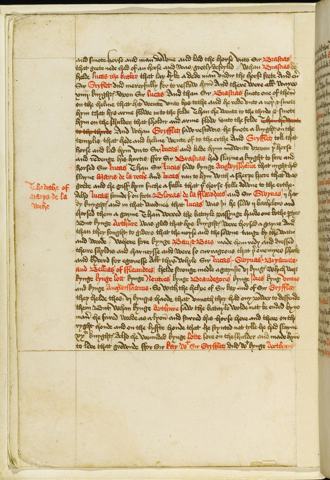
Thomas Malory's 15th-century compilation of the whole Arthurian legend, printed by Caxton in 1485 and rediscovered in a lost manuscript in 1934.
Also mentioned inAvalonGawainGlastonbury (Isle of Avalon)The Fisher King
Sources & Further Reading
- 1.Chretien de Troyes, Perceval, ou le Conte du Graal (c. 1181-1190).
- 2.Robert de Boron, Joseph d'Arimathie, also called the Estoire dou Graal (c. 1200).
- 3.Wolfram von Eschenbach, Parzival (c. 1210).
- 4.La Queste del Saint Graal, from the Vulgate Cycle (c. 1215-1235).
- 5.Thomas Malory, Le Morte Darthur (printed by William Caxton, 1485), Books XI-XVII.
- 6.Barber, Richard. The Holy Grail: Imagination and Belief. Cambridge, MA: Harvard University Press, 2004.
- 7.Loomis, Roger Sherman (ed.). Arthurian Literature in the Middle Ages: A Collaborative History. Oxford: Clarendon Press, 1959.
- 8.Archibald, Elizabeth and Ad Putter (eds.). The Cambridge Companion to the Arthurian Legend. Cambridge University Press, 2009.
Spot an error or have a source to suggest? Write to info@viseterna.com. We cite primary sources and modern scholarship, and we correct fast.