
The Questing Beast
A chimera with a serpent's head and a leopard's body whose belly barks like thirty hounds, pursued for generations by knights who never quite catch it.
The Romance of King Arthur, Arthur Rackham, 1917 · Public domain · source
A Chimera With a Name
Malory describes it plainly the first time it crosses the page: a beast with the head and neck of a serpent, the body of a leopard, the haunches of a lion, and the feet of a hart, and inside its belly a noise "as it had been thirty couple of hounds questing" — that is, baying on a scent 1. The English name comes straight from that sound; French tradition calls it the Beast Glatisant, the Barking or Questing Beast, from the verb glatir, used of a hound's cry 1,6. It is never given a fixed size, an origin, or a mate, and it is never fully described twice the same way, which is itself part of its unsettling character.
Arthur's First Sighting
King Arthur is the first person in Malory's text to see it, and the placement is not accidental. He glimpses the Beast at a woodland well shortly after the episode in which he unknowingly fathers Mordred on his own half-sister — the single act that later destroys his kingdom 1. Malory does not spell out the connection, but the juxtaposition has drawn sustained attention from modern critics, who read the Beast's sudden appearance right after an act of incest as more than coincidence 4,5.
The Post-Vulgate's Dark Etiology
Only one branch of the tradition explains where the creature comes from, and the explanation matches that reading exactly. In the Post-Vulgate Suite du Merlin, a princess lusts after her own brother, is manipulated by a devil into falsely accusing him of rape, and watches her father have him torn apart by dogs; dying, he curses her to bear a monster that will cry with the same sound as the hounds that killed him 2,4. The earlier Vulgate Estoire de Merlin has no such story at all, which means the Beast's meaning was added deliberately by a later writer rather than inherited whole — an emblem, as Antonio Furtado argues, of the incest and violence eating away at Arthur's own court from within 2,4.
Pellinore's Hereditary Burden
For most of Malory's text the Beast belongs to King Pellinore, who chases it obsessively across several books, abandoning ordinary chivalric duty — on one occasion riding past a woman in desperate need of help — because the hunt has become an inherited obligation rather than a choice 1. Pellinore is Percival's father, and the Beast passes, with the rest of his restless nature, down through that family line 6. The quest is presented as both a mark of distinction and a kind of curse: it can be taken up, but in the world of the romances it is never simply finished.
Palamedes and the Unfinished Hunt
After Pellinore's death the chase falls to Sir Palamedes, a Saracen knight whose devotion to it runs alongside his hopeless love for Iseult in the vast Prose Tristan 3,6. Palamedes hunts the Beast for decades without success across most of the tradition; only in some later branches of the Post-Vulgate material is he finally allowed to corner and kill it, an ending scholars read as tied to his eventual conversion to Christianity — worldly desire, whether for a woman or a monster, resolved only once he stops chasing it on its own terms 4,5. Malory's own text leaves the hunt open, which fits a creature whose whole point is that it cannot be finally caught.
What the Beast Means
Modern criticism generally reads the Questing Beast less as a monster to be slain than as a walking diagnosis. Its noisy, doglike interior and its unfixed, composite body have been interpreted as a figure for the moral disorder loose in Logres — Arthur's own kingdom — masked by the outward order of tournaments and quests 4,5. That the story that explains its birth turns on incest, false accusation and a father's cruelty gives the symbol an uncomfortably precise target: the same sin the Beast embodies is the one Arthur himself commits without realizing it.
In Popular Culture
T. H. White's The Once and Future King keeps Pellinore's hunt but plays it for comedy, turning the Beast into a source of running domestic farce rather than dread. More recent games and fantasy fiction tend to borrow only the name and the composite anatomy, using "questing beast" as a byword for an endless, faintly absurd chase rather than the family curse and national symptom the medieval texts intended 6.
Continue Exploring
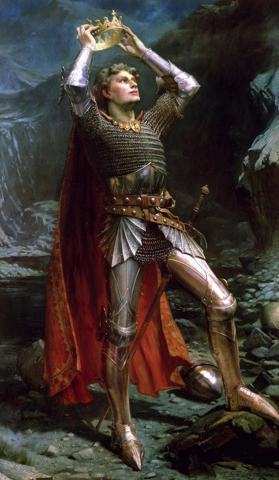
The once and future king: a shadowy British war-leader who medieval writers rebuilt into the emperor of Camelot and the Round Table.
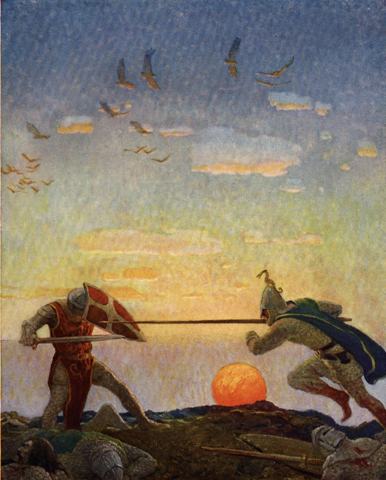
The traitor of Camlann: Arthur's nephew and, in later tradition, his incestuous son, who seizes the crown and destroys the Round Table.
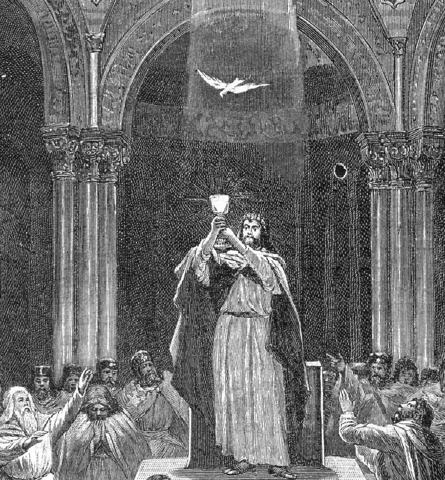
The forest-raised innocent who found the Grail castle and failed to ask the one question that mattered. Arthurian romance's first Grail knight.
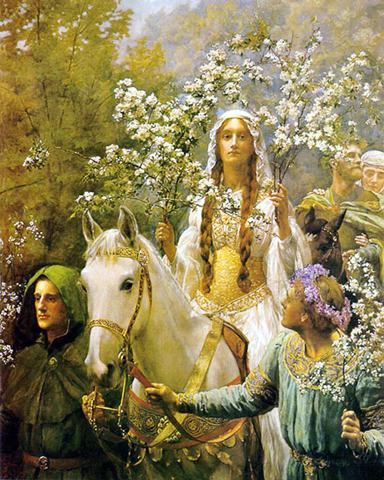
Queen of Britain and Arthur's wife: a figure repeatedly stolen, blamed and reinvented, whose love for Lancelot brings the Round Table down.
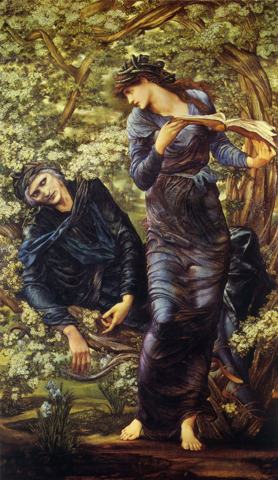
Britain's prophet and enchanter: a mad Welsh seer whom Geoffrey of Monmouth rebuilt as the wizard who made Arthur possible.
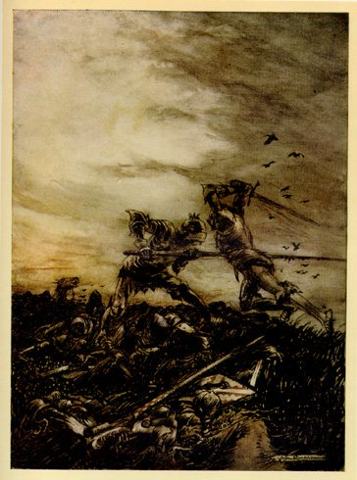
The battle that ended Arthur's reign: a single line in a medieval annal grew, over nine centuries, into the mutual destruction of Arthur and Mordred.
Sources & Further Reading
- 1.Thomas Malory, Le Morte Darthur (printed by William Caxton, 1485), Books I, IX-X and XII.
- 2.The Post-Vulgate Suite du Merlin (Merlin Continuation), in the Post-Vulgate Roman du Graal (13th century).
- 3.The Prose Tristan (Old French, c. 1230-1240).
- 4.Furtado, Antonio L. "The Questing Beast as Emblem of the Ruin of Logres in the Post-Vulgate." Arthuriana 9, no. 3 (1999): 27-48.
- 5.Spellmire, Adam. "The Questing Beast and the Noise of Adventure." Arthuriana 27, no. 2 (2017): 73-86.
- 6.Lacy, Norris J. (ed.). The New Arthurian Encyclopedia. New York: Garland, 1991.
Spot an error or have a source to suggest? Write to info@viseterna.com. We cite primary sources and modern scholarship, and we correct fast.