
Poseidon
God of the sea, earthquakes and horses. Brother of Zeus, wielder of the trident, and the divine enemy who keeps Odysseus from reaching home.
Artemision Bronze (Poseidon or Zeus), Greek, c. 460 BC (National Archaeological Museum, Athens) · CC0 · source
Lord of the Sea and the Shaking Earth
Poseidon is the second son of Cronus and Rhea, brother of Zeus and Hades, and one of the three gods among whom the universe was divided. The Iliad gives the division as a drawing of lots: Zeus took the bright sky, Hades the misty dark, Poseidon the grey sea, and the earth and Olympus were left common to all three. Poseidon cites this in Book 15 to argue that he is Zeus' equal in station and takes no orders from him — before backing down anyway 1,2.
His standing epithets are geological rather than nautical. He is Enosichthon and Ennosigaios, "earth-shaker", and Gaieochos, "holder of the earth": to the Greeks, earthquakes and the sea were the same god's business, which is why the destruction of the Achaean city of Helike by earthquake and wave in 373 BCE was read as his direct act 4,5,7. His weapon, the three-pronged trident, is a tuna-fisher's spear scaled up to divine size, and with it he splits rock, raises storms and calms them 3,6.
Mycenaean Linear B tablets, particularly those from Pylos, show po-se-da-o receiving offerings on a scale that suggests he may have been the leading god of that palace, ahead of Zeus — a strong indication that his prominence is very old and was reduced, not created, by later Greek theology 5,7.
Horses, Bulls and Monsters
Poseidon Hippios, "of horses", is as central as Poseidon of the sea. Various traditions credit him with producing the first horse, in some versions by striking the earth with his trident, in others out of his pursuit of Demeter in Arcadia: she took the form of a mare to escape him, he took the form of a stallion, and the offspring were the immortal horse Arion and a goddess whose name was not spoken outside the mysteries 3,4,6. He is likewise associated with bulls, and sends the beautiful bull from the sea that Minos fails to sacrifice — the animal that fathers the Minotaur on Pasiphae 3,6.
His children are a catalogue of the enormous and the dangerous: the giant Antaeus, the hunter Orion, the winged horse Pegasus and the warrior Chrysaor born from the blood of Medusa, the Cyclops Polyphemus, and the twins Pelias and Neleus. Athenian tradition made him the divine father of Theseus alongside the mortal Aegeus 3,6. Where Zeus fathers heroes and kings, Poseidon tends to father monsters and outsized strongmen — a pattern ancient audiences clearly recognised.
Contests for Cities
Poseidon repeatedly competes with other gods for the patronage of Greek cities, and repeatedly loses. The famous case is Attica: he struck the rock of the Acropolis and produced a spring of salt water — Pausanias reports the "sea" still shown in the Erechtheion in his day — while Athena produced the olive tree, and the judges awarded the land to her. In revenge he flooded the Thriasian plain 3,4,6.
The same story repeats elsewhere: he loses Argos to Hera and dries up the region's rivers in anger, so that the Argolid's rivers run only in winter; he loses Corinth to Helios and is given the Isthmus as compensation; he disputes Aegina with Zeus and Naxos with Dionysus 3,4,6. The pattern preserves a real religious history — Poseidon's cult being older and broader than the classical city-gods who displaced him — rather than a single myth 5,7.
He was worshipped nonetheless at some of the most conspicuous sites in Greece: the temple on the cliff at Sounion, the Isthmian Games at Corinth held in his honour, and the Panionion at Mycale where the Ionian cities held their common festival 4,5,7.
The Enemy of Odysseus
In the Odyssey Poseidon is the antagonist, and the poem is careful to state his grievance as personal rather than cosmic. Odysseus blinded his son the Cyclops Polyphemus and then, in a fit of pride, shouted his own name and city across the water; Polyphemus prayed to his father, and Poseidon granted the curse in every detail — a late homecoming, in a stranger's ship, with all companions lost, to trouble in his own house 1.
The god is absent, feasting among the Ethiopians, at the divine council that finally releases Odysseus from Calypso's island; he returns to find the hero at sea on a raft and smashes it with a storm that would have killed him without the sea-goddess Ino's veil 1. His last act in the poem is to punish the Phaeacians for ferrying Odysseus home: their returning ship is turned to stone within sight of harbour 1. And the seer Tiresias tells Odysseus that the feud can only be closed by carrying an oar inland to people who have never seen the sea and sacrificing to Poseidon there — the sea-god appeased at the one place his power does not reach 1.
Neptune and After
Roman religion identified him with Neptune, originally a god of fresh water and springs, who took on the sea and the trident wholesale from the Greek figure 7. That fusion is the version that reached later European art: the bearded god in a shell chariot drawn by hippocamps, surrounded by Tritons and Nereids, which became a fixture of Renaissance and Baroque fountains and remains the standard image today.
Modern scholarship generally reads him as a deity whose original sphere was broader than the sea — earth, water, horses, and the violent instability of all three — and who was progressively narrowed as Zeus' sky-sovereignty became the organising principle of Greek theology 5,7.
In Popular Culture
Poseidon is the default "angry sea god" of film and games, from Clash of the Titans to the God of War series and Rick Riordan's Percy Jackson novels, where he is the protagonist's father. The 2026 film wave around Christopher Nolan's The Odyssey has renewed attention to his role as the poem's real antagonist — a god pursuing a private grudge for ten years.
Continue Exploring
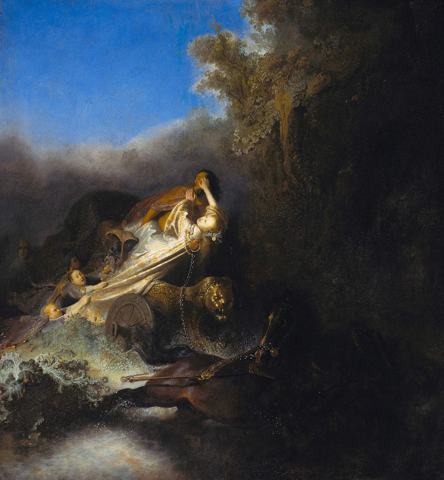
Lord of the underworld and of the wealth beneath the earth. Not a devil — a grim, lawful king whose only rule is that no one leaves.
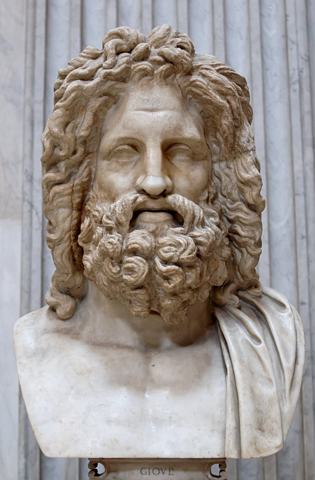
King of the gods and lord of the sky, thunder and justice. He overthrew his own father, divided the universe by lot, and guaranteed the laws of hospitality.
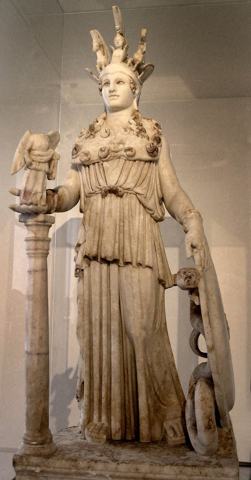
Goddess of wisdom, strategy and craft, born fully armed from the head of Zeus. Patron of Athens, of heroes, and of Odysseus above all.
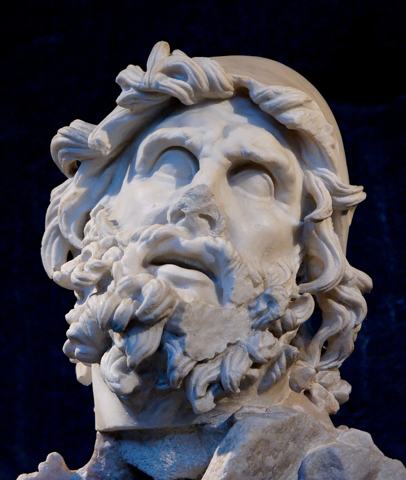
King of Ithaca and the man of many turns. Homer's cleverest hero, who took ten years to sail home from Troy and had to fight for his own house.
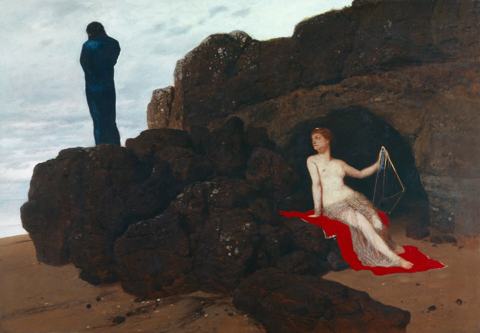
Immortal nymph of the hidden island of Ogygia. She kept Odysseus for seven years and offered him deathlessness; he chose a mortal wife and a rocky island.
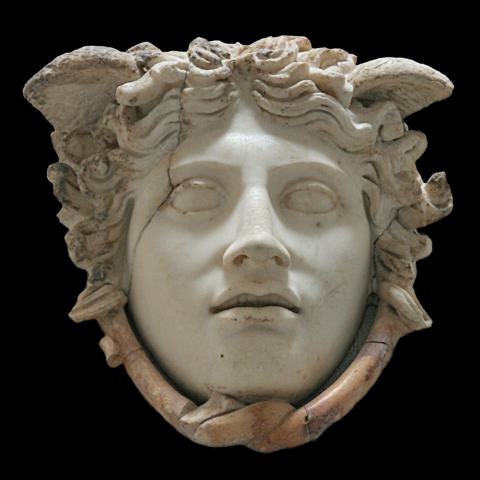
The Gorgon. The only mortal one of three sisters, whose gaze turned men to stone and whose severed head became the most powerful protective emblem in Greek art.
Also mentioned inAchillesAresDemeterHeraMinotaurMount OlympusNeptunePegasusPerseusPolyphemusThe CyclopesThe IliadThe Odyssey (Homer's Epic)The TitansThe Trojan HorseTheseusTiresias
Sources & Further Reading
- 1.Homer, Iliad (esp. Books 13, 15, 20-21) and Odyssey (esp. Books 1, 5, 9, 11, 13).
- 2.Hesiod, Theogony (c. 700 BCE).
- 3.Apollodorus, Bibliotheca (1st-2nd century CE).
- 4.Pausanias, Description of Greece (2nd century CE).
- 5.Burkert, Walter. Greek Religion, trans. John Raffan. Harvard University Press, 1985.
- 6.Gantz, Timothy. Early Greek Myth: A Guide to Literary and Artistic Sources. Johns Hopkins University Press, 1993.
- 7.Hornblower, S., A. Spawforth and E. Eidinow, eds. The Oxford Classical Dictionary, 4th ed. Oxford University Press, 2012.
Spot an error or have a source to suggest? Write to info@viseterna.com. We cite primary sources and modern scholarship, and we correct fast.