
Odysseus
King of Ithaca and the man of many turns. Homer's cleverest hero, who took ten years to sail home from Troy and had to fight for his own house.
Head of Odysseus, Roman marble from the Sperlonga group, 1st c. AD (Museo Archeologico Nazionale, Sperlonga) · Public domain · source
Who Was Odysseus?
Odysseus — Ulysses to the Romans, and so to most of European literature after them — is the king of the small western island kingdom of Ithaca, son of Laertes and Anticleia, husband of Penelope and father of Telemachus. The first word Homer uses of him is polytropos, "of many turns": a man who has been turned about by the world, and who turns the world about in return. Other stock epithets crowd around him — polymetis, "of many counsels", and polytlas, "much-enduring" 1,7.
His family tree is pointed. Through his mother he descends from Autolycus, a master thief said to be a son of Hermes, and it is Autolycus who names the child and takes him hunting boar on Parnassus, where a tusk opens the thigh scar that will later betray his identity 1,5. Homer builds the hero's defining quality — cunning that shades into deceit — into his ancestry rather than treating it as a flaw acquired along the way.
Troy and the Wooden Horse
In the Iliad Odysseus is not the strongest fighter but the indispensable one: he rallies the routed army in Book 2, leads the failed embassy to Achilles in Book 9, and carries out the night raid on the Trojan camp in Book 10 2. Post-Homeric tradition made him more devious still. He is said to have feigned madness to avoid the war, sowing salt into a ploughed field until Palamedes set the infant Telemachus in the furrow and forced him to swerve; later he wins the armour of the dead Achilles in a contest against Ajax, an award that drives Ajax to suicide 3,4,5.
Troy falls by his idea. In the Odyssey the bard Demodocus sings of the hollow horse that Odysseus filled with picked men, and Helen circling it in the dark, calling out to the hidden Greeks in the voices of their wives, while Odysseus held them silent 1. The stratagem is the hero in miniature: the victory is won by a lie that everyone chooses to believe.
The Long Way Home
The nostos, the homecoming, takes ten more years. Odysseus and twelve ships raid the Cicones and are beaten back; a storm drives them past Cythera to the land of the Lotus-Eaters, whose fruit erases the desire to go home. Then follow, in the hero's own telling to the Phaeacians, the great set-pieces of the poem: the cave of the Cyclops Polyphemus, the wind-bag of Aeolus, the cannibal Laestrygonians who destroy all the ships but one, the enchantress Circe, the journey to the edge of the dead to consult Tiresias, the Sirens, Scylla and Charybdis, and the fatal cattle of Helios on Thrinacia 1,7.
Because Books 9-12 are narrated by Odysseus himself, the marvels of the voyage rest on the word of the most persuasive liar in Greek literature — a point ancient and modern readers alike have enjoyed. The last of his crew drowns after the sacrilege on Thrinacia, and he washes alone onto Ogygia, where the goddess Calypso keeps him seven years. Only when Athena raises the matter in the divine assembly, with Poseidon absent among the Ethiopians, is he released to build a raft — and even then Poseidon, whose son he blinded, wrecks it and leaves him to swim ashore on Phaeacian Scheria 1.
Homecoming and the Slaughter of the Suitors
The second half of the poem is a domestic thriller rather than a voyage. Landed on Ithaca and disguised as an old beggar by Athena, Odysseus tests his household from below: the loyal swineherd Eumaeus, the aged dog Argos who recognises him and dies, the nurse Eurycleia who knows the boar scar as she washes his feet, and the hundred-odd suitors consuming his estate while pressing his wife to remarry 1,7. The contest of the great bow — string it, shoot an arrow through twelve axe-heads — is Penelope's device, and it puts the only weapon in the hall into the one pair of hands that can use it. The killing that follows occupies Book 22; a threatened blood-feud with the suitors' families is stopped only by Athena in the poem's closing lines 1.
Cunning and Its Costs
Greek tradition never settled on whether Odysseus' metis — practical intelligence, resource, trickery — was a virtue. Homer admires it; the Athenian tragedians frequently do not, casting him as a cold political operator in Sophocles' Ajax and Philoctetes, and Roman epic inherits that hostility, so that Virgil's Trojans speak of him with loathing 6. Dante puts him in the eighth circle of Hell as a counsellor of fraud, then gives him one of the most admired speeches in the Commedia; Tennyson and Joyce reinvent him again. W. B. Stanford's classic study traces this two-thousand-year argument and identifies the two poles the figure keeps swinging between: the wanderer who longs for home, and the politician who is never quite trusted 6.
He is also a hero with a peculiar afterlife in the real world. Tiresias' prophecy sends him inland after the homecoming, carrying an oar until he meets people who mistake it for a winnowing fan, and promises him a gentle death "from the sea" in prosperous old age — a loose end the lost epic Telegony tied off by having him killed unknowingly by Telegonus, his son by Circe 1,5. Greek settlers in Italy and the west attached his wanderings to their own coastlines and founded cults in his name, which is why so many Mediterranean landmarks claim a place in the story 8.
In Popular Culture
Odysseus is the rare mythic figure with an unbroken run in literature from Homer to James Joyce's Ulysses (1922). Christopher Nolan's The Odyssey, released in July 2026 by Universal Pictures, stars Matt Damon as Odysseus and Anne Hathaway as Penelope, and was shot entirely with IMAX film cameras. The adaptation has renewed interest in the poem's second half — the homecoming — which screen versions have traditionally cut short in favour of the monsters.
Continue Exploring
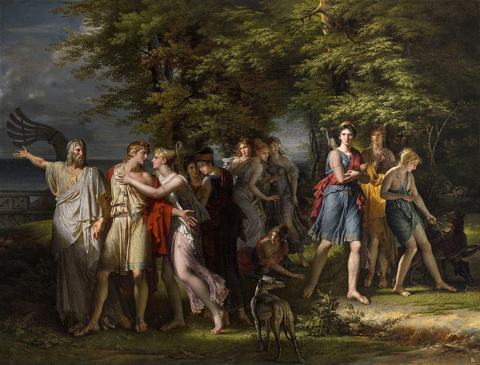
Prince of Ithaca and son of Odysseus. The Odyssey opens with his coming of age: a boy with no father learning how to be a man in a hall full of enemies.
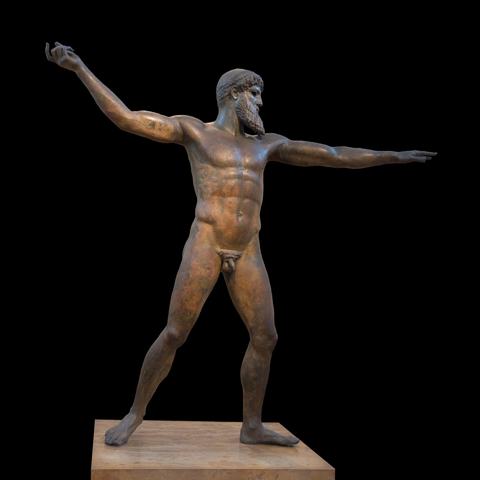
God of the sea, earthquakes and horses. Brother of Zeus, wielder of the trident, and the divine enemy who keeps Odysseus from reaching home.
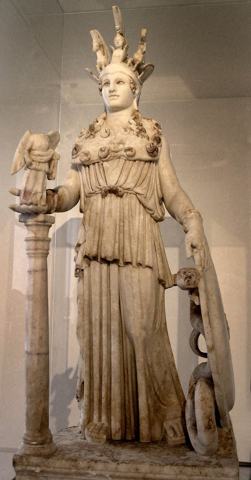
Goddess of wisdom, strategy and craft, born fully armed from the head of Zeus. Patron of Athens, of heroes, and of Odysseus above all.
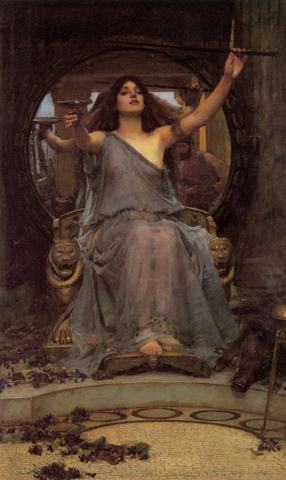
Goddess-enchantress of the island of Aiaia. She turned Odysseus' crew into swine, then became the one guide who told him how to reach the dead.
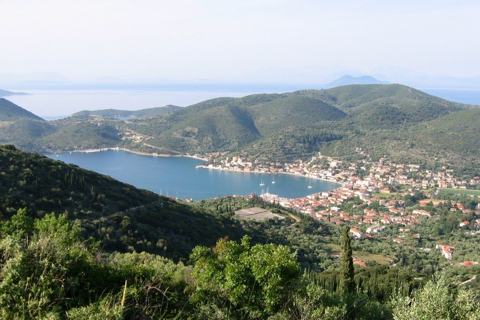
The rocky island kingdom of Odysseus and the destination of the Odyssey — a small, goat-grazed place worth ten years of sailing to get back to.
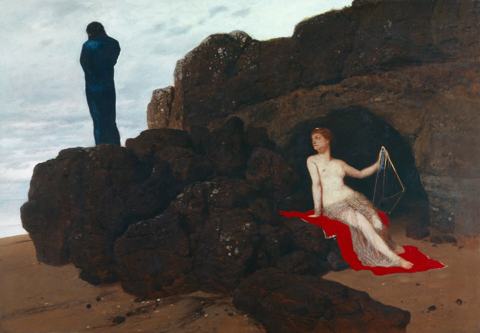
Immortal nymph of the hidden island of Ogygia. She kept Odysseus for seven years and offered him deathlessness; he chose a mortal wife and a rocky island.
Also mentioned inAchillesAeolusHadesHermesPenelopePolyphemusScylla and CharybdisThe CyclopesThe Lotus-EatersThe Odyssey (Homer's Epic)The SirensThe Trojan HorseThe Trojan WarTiresias
Sources & Further Reading
- 1.Homer, Odyssey (c. 8th-7th century BCE), esp. Books 1, 5, 9-12, 19, 21-24.
- 2.Homer, Iliad (c. 8th century BCE), esp. Books 2, 9-10.
- 3.Apollodorus, Bibliotheca and Epitome (1st-2nd century CE).
- 4.Ovid, Metamorphoses, Book 13 (c. 8 CE).
- 5.Gantz, Timothy. Early Greek Myth: A Guide to Literary and Artistic Sources. Johns Hopkins University Press, 1993.
- 6.Stanford, W. B. The Ulysses Theme: A Study in the Adaptability of a Traditional Hero. Oxford: Blackwell, 1954.
- 7.Heubeck, A., S. West, J. B. Hainsworth, A. Hoekstra, J. Russo and M. Fernandez-Galiano. A Commentary on Homer's Odyssey, 3 vols. Oxford: Clarendon Press, 1988-1992.
- 8.Malkin, Irad. The Returns of Odysseus: Colonization and Ethnicity. University of California Press, 1998.
Spot an error or have a source to suggest? Write to info@viseterna.com. We cite primary sources and modern scholarship, and we correct fast.