
The Titans
The twelve children of Sky and Earth who ruled before Zeus. Cronus, Rhea, Oceanus, Prometheus' line — and the ten-year war that buried them in Tartarus.
The Fall of the Titans, Cornelis Cornelisz. van Haarlem, 1588-1590 (Statens Museum for Kunst, Copenhagen) · Public domain · source
The Twelve
The Titans are the twelve children of Ouranos, the Sky, and Gaia, the Earth: the six brothers Oceanus, Coeus, Crius, Hyperion, Iapetus and Cronus, and the six sisters Theia, Rhea, Themis, Mnemosyne, Phoebe and Tethys 1,5. Hesiod's Theogony is the source for the canonical list, and it makes them the second stage of the cosmos — after the primordial powers Chaos, Gaia, Tartarus and Eros, and before the gods of Olympus 1.
Hesiod also supplies the name's explanation: Ouranos called them Titans, "the straining ones", because they strained (titainontas) in reckless deeds against their father, and vengeance (tisis) would follow 1. Like most etymologies in early Greek poetry this is a pun rather than a derivation; the real origin of the word is unknown, and some scholars suspect it is not Greek at all 7,8.
Ouranos, the Sickle, and Cronus
Ouranos pressed himself on Gaia continually and forced their children back inside her, so that none could be born. Gaia, in pain, made a sickle of grey adamant and asked her sons to act; only the youngest, Cronus, dared. He lay in ambush, castrated his father as he came down over the earth, and threw the severed parts away — from the drops of blood came the Erinyes, the Giants and the Meliai, and from the foam around the flesh in the sea rose Aphrodite 1.
Cronus then ruled, and repeated his father's crime in a new form. Warned that his own child would overthrow him, he swallowed each infant as Rhea bore them: Hestia, Demeter, Hera, Hades and Poseidon. Rhea, pregnant with the sixth, fled to Crete, hid the baby in a cave on Mount Aegaeon or Dicte, and handed her husband a stone wrapped in swaddling clothes, which he swallowed without looking 1,5.
The Titanomachy
Grown, Zeus forced Cronus to bring up the stone and then the children, and the war began. The Theogony says it lasted ten years, fought from Olympus on one side and Mount Othrys on the other, with neither side able to break the other 1.
The turn came from an alliance. On Gaia's advice Zeus went down to Tartarus and released the prisoners Ouranos had shut away — the three Hundred-Handers, Cottus, Briareos and Gyes, and the Cyclopes, who in gratitude forged the thunder and lightning that became his weapon 1,5. Hesiod's battle scene is the loudest passage in early Greek poetry: the sea boiling, the earth burning, Tartarus shaking, and the Hundred-Handers throwing three hundred rocks at a time until the Titans were buried under the volley 1.
The defeated were bound and cast down into Tartarus, as far below earth as earth is below heaven — a bronze anvil, Hesiod says, would fall nine days to reach it — behind a bronze wall and gates, with the Hundred-Handers set as guards 1. Homer knows the same tradition, placing Cronus and Iapetus in the lowest pit, below the light of Helios and the winds 3.
Not all Titans fought. Oceanus stands apart in Homer and in Prometheus Bound; Themis and Mnemosyne join the Olympian order and become, respectively, the mother of the Horae and Moirai and the mother of the Muses by Zeus 1,4. Prometheus, son of Iapetus, sides with Zeus in the war and only later becomes his opponent over the matter of fire — see Mount Olympus for the regime that replaced them 1,4.
The Second Generation
Much of the working machinery of the Greek cosmos is Titan-born. Hyperion and Theia produce Helios the Sun, Selene the Moon and Eos the Dawn; Coeus and Phoebe produce Leto, mother of Apollo and Artemis, and Asteria, mother of Hecate; Oceanus and Tethys produce the rivers and three thousand Oceanids; Iapetus fathers Atlas, Menoetius, Prometheus and Epimetheus 1,5.
Atlas' punishment — holding up the sky at the western edge of the world — is the visible remnant of the defeated regime, and Menoetius was blasted into Erebos by the thunderbolt 1. It is worth noting that the Titans are not the Giants: the Gigantomachy is a separate war, fought later by the Olympians against the sons of Gaia born from Ouranos' blood, and the two are conflated constantly in modern retellings and often in ancient art 5,8.
Nor was Cronus purely a villain. Hesiod's Works and Days sets the golden race of men under Cronus' rule, living without toil or age, and later tradition — including Pindar — has him released to reign over the Isles of the Blessed 2,8. Roman writers merged him with Saturn, whose December festival was a memory of that lost ease 8.
Eastern Roots and the Orphic Turn
The succession pattern — sky god castrated by his son, son overthrown by a storm god who wins with the thunderbolt — is not uniquely Greek. The Hurrian-Hittite Kumarbi cycle, recorded centuries before Hesiod, has Anu castrated by Kumarbi, who is in turn displaced by the storm god Teshub; the Babylonian Enuma Elish offers a further parallel. Most specialists now accept that Hesiod's theogony stands in a Near Eastern tradition transmitted through the eastern Mediterranean, though the route and date are debated 7,8.
A quite different Titan story circulated in Orphic circles: that the Titans lured the infant Dionysus with toys, tore him apart and ate him, and were destroyed by Zeus' thunderbolt, humanity then arising from the residue and carrying both Titanic guilt and a divine spark. Pausanias attributes the tale of the Titans as Dionysus' killers to the sixth-century poet Onomacritus, but the full anthropogony is explicit only in very late Neoplatonic sources, and how far back it really goes is one of the most contested questions in the field 6,8.
Continue Exploring
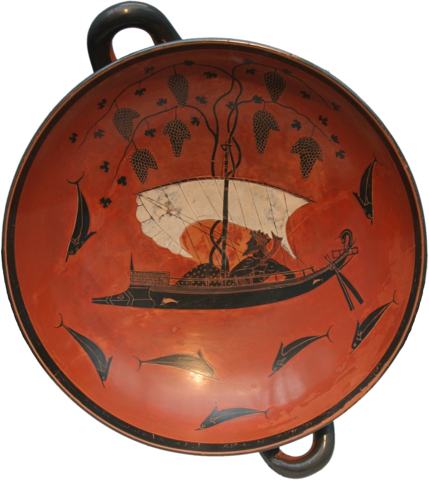
Twice-born god of wine, madness and the mask. He dissolves the boundary between god and beast, and destroys the cities that refuse him.
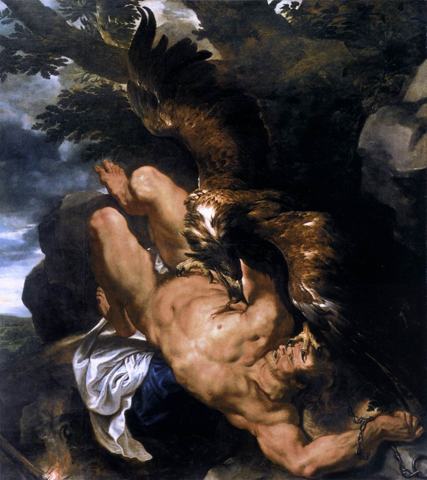
The Titan who tricked Zeus, stole fire for humanity, and paid with an eagle sent daily to eat his regenerating liver - freed, in the end, by Heracles.
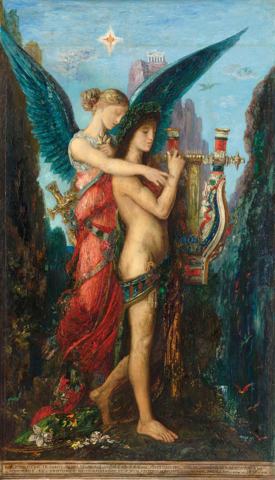
Hesiod's archaic poem tracing the gods from primordial Chaos to the reign of Zeus, the closest thing Greek religion has to an official genealogy.
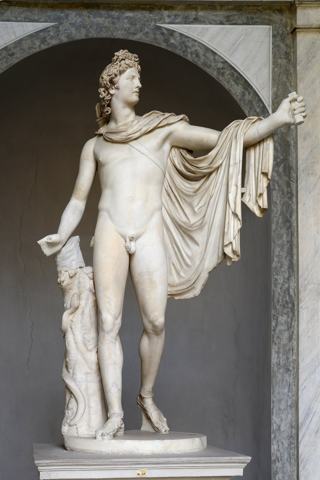
Twin of Artemis, lord of Delphi. God of prophecy, music, healing and plague — the far-shooter whose arrows bring both the cure and the sickness.
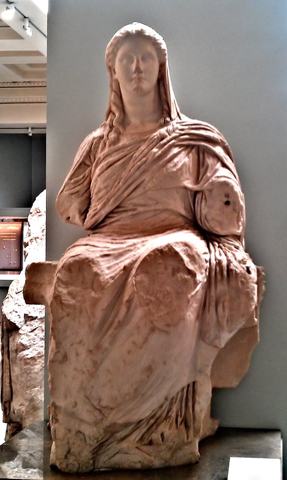
Goddess of grain and the mother who stopped the world's harvest to get her daughter back. Founder of the Eleusinian Mysteries.
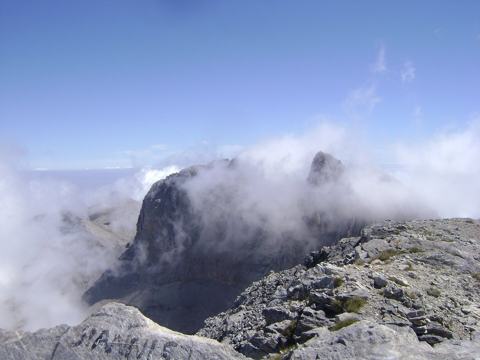
Home of the gods. A real snow-capped mountain in northern Greece that Homer made into a cloudless upper world where the twelve immortals hold court.
Sources & Further Reading
- 1.Hesiod, Theogony (c. 700 BC).
- 2.Hesiod, Works and Days — the races of men and the rule of Cronus (c. 700 BC).
- 3.Homer, Iliad — Books 8, 14 and 15 (c. 8th-7th century BC).
- 4.Aeschylus (attrib.), Prometheus Bound (5th century BC).
- 5.Apollodorus, Bibliotheca (Library) 1.1-1.2, 1st-2nd century AD.
- 6.Pausanias, Description of Greece — Book 8.37 (Onomacritus and the Titans), c. AD 160-180.
- 7.West, M. L. The East Face of Helicon — West Asiatic Elements in Greek Poetry and Myth. Oxford University Press, 1997.
- 8.Burkert, Walter. Greek Religion. Trans. John Raffan. Harvard University Press, 1985.
Spot an error or have a source to suggest? Write to info@viseterna.com. We cite primary sources and modern scholarship, and we correct fast.