
The Odyssey (Homer's Epic)
Homer's epic of Odysseus's ten-year voyage home from Troy, the founding adventure story of Western literature and the subject of a 2026 film.
Bust of Homer, Roman copy of a Greek original (British Museum) · Public domain · source
What the Odyssey Is
The Odyssey is one of two epic poems credited to Homer: twenty-four books and roughly 12,000 lines of dactylic hexameter following the Greek hero Odysseus on his ten-year voyage home from Troy 1,5. It is composed in an artificial, elevated literary dialect blending several regional forms of ancient Greek, built for oral performance rather than silent reading, and stands with its companion epic The Iliad as the twin foundation of the Western epic tradition 5,6. Where the Iliad is a poem of war, the Odyssey is a poem of return, trickery, and the slow reassembly of a household and an identity 3,5.
A Poem Made for the Ear
Scholars generally place the poem's crystallization into something like its present form in the eighth or seventh century BCE, the product of a long oral tradition of professional singers who built their lines from a stock of ready-made phrases and repeated "type-scenes" rather than reciting a fixed, memorized text 4,5. Whether "Homer" names a single poet, a school of poets working across generations, or simply the tradition itself is the unresolved center of the so-called Homeric Question. West argued from close study of vocabulary, formula, and dialect that the Odyssey is a distinct, probably later composition than the Iliad, made by a poet who knew the older epic and deliberately varied its methods 4. Finley's classic study reads the poem's manners, gift-exchange, and household economy as reflecting an early Iron Age Greek world rather than the Bronze Age setting the story claims for itself, one more reason scholars treat "Homer" as poetry rather than history 3.
The Journey the Poem Tells
The poem opens years into Odysseus's absence, with Telemachus coming of age on an Ithaca overrun by suitors courting his mother Penelope, while the hero himself sits marooned on the island of the nymph Calypso 1,2. Only then does the poem loop backward, through Odysseus's own first-person account to the Phaeacians, over the decade of wandering: the land of the Lotus-Eaters, where a fruit erases the will to go home; the cave of the Cyclops Polyphemus, son of Poseidon, blinded and cursed by name; the floating island of the wind-god Aeolus; the witch Circe, who turns half the crew to swine and then becomes host and lover; a journey to the underworld to consult the seer Tiresias; the song of the Sirens; the strait of Scylla and Charybdis; and the wreck that leaves Odysseus alone on Calypso's shore 1,2,6.
The second half, once Odysseus reaches home in disguise, is a different kind of story: a slow, suspicious homecoming, a reunion with Telemachus, the stringing of the great bow that only Odysseus can draw, the killing of the suitors, and finally Poseidon's lingering anger settled by a peace Athena brokers 1,2.
How the Text Survived
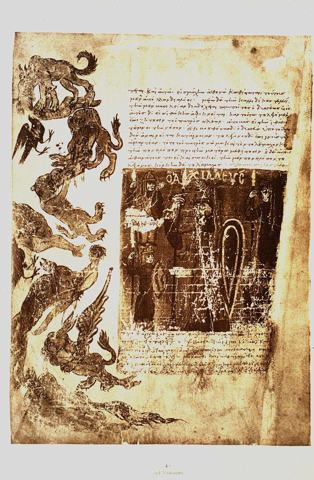
No manuscript approaching Homer's own lifetime exists. The poem was carried orally for centuries before it was fixed in writing, and the earliest physical evidence is Odyssey fragments among the huge cache of Homeric papyri recovered from Hellenistic and Roman Egypt, which by sheer volume make Homer the best-attested author of Greco-Roman antiquity 5,6. Alexandrian scholars such as Aristarchus of Samothrace produced the first critical editions in the third and second centuries BCE, dividing the poem into its twenty-four books and marking lines they suspected were later additions, an editorial habit that shaped every edition since 5. The medieval manuscript tradition that carries the text to the present is almost entirely Byzantine, copied and recopied by scholars a thousand or more years after the poem's composition, so that every modern printed Odyssey is a reconstruction assembled from comparing hundreds of imperfect, disagreeing copies rather than a single authoritative original 4,6.
Translating Homer
English translations of the Odyssey number in the dozens and each generation tends to claim its own. Robert Fagles's 1996 version, in loose, muscular free verse, became a standard classroom text for a generation of readers 1. Emily Wilson's 2018 translation, the first published English rendering by a woman, uses a tighter iambic pentameter matched line-for-line to the Greek and is noted for translating loaded words, such as the Greek term for enslaved household women, without softening euphemism 2. The gap between the two shows how much a translator's choices shape which Odyssey a reader actually meets, and why classicists keep producing new ones rather than settling on one 2,5.
The Odyssey Now
The poem's grip on popular storytelling has never really loosened. It stands behind works as different as modernist fiction, film epics, and, in 2026, a major studio adaptation directed by Christopher Nolan, the latest sign that a story roughly three thousand years old still draws an audience 5,6.
Continue Exploring
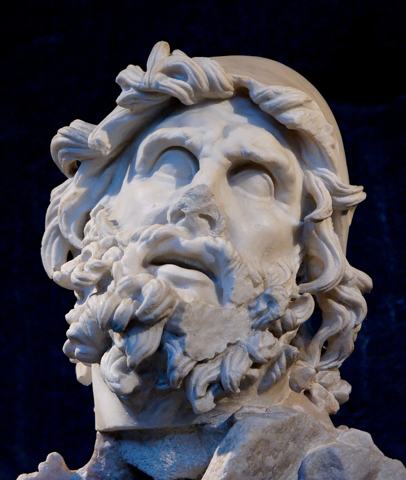
King of Ithaca and the man of many turns. Homer's cleverest hero, who took ten years to sail home from Troy and had to fight for his own house.
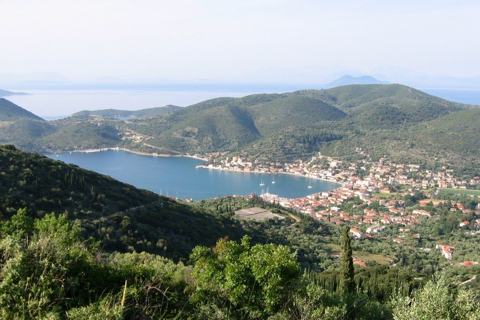
The rocky island kingdom of Odysseus and the destination of the Odyssey — a small, goat-grazed place worth ten years of sailing to get back to.
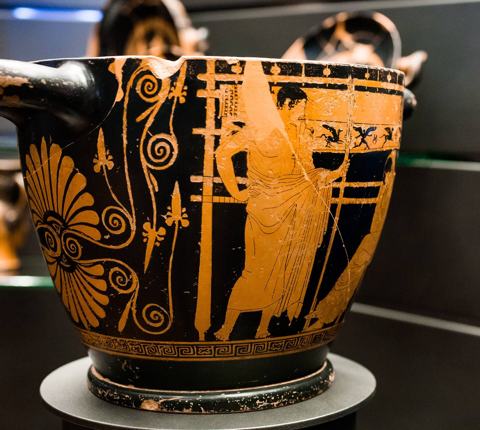
Queen of Ithaca and wife of Odysseus. She held a kingdom together for twenty years with a loom, a riddle, and a bow contest nobody could win.
Homer's epic of the final weeks of the Trojan War, opening with Achilles's rage and closing with the ransom of Hector's body.
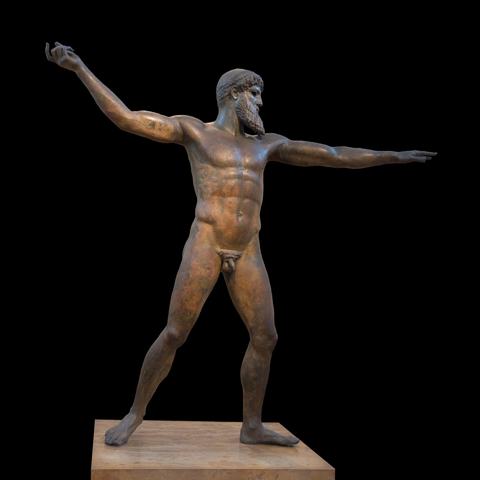
God of the sea, earthquakes and horses. Brother of Zeus, wielder of the trident, and the divine enemy who keeps Odysseus from reaching home.
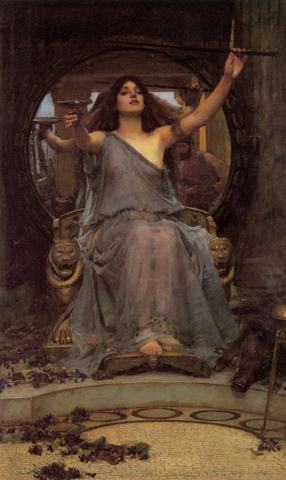
Goddess-enchantress of the island of Aiaia. She turned Odysseus' crew into swine, then became the one guide who told him how to reach the dead.
Sources & Further Reading
- 1.Homer. The Odyssey. Translated by Robert Fagles. Viking, 1996.
- 2.Homer. The Odyssey. Translated by Emily Wilson. W.W. Norton, 2018.
- 3.Finley, M.I. The World of Odysseus. New York Review Books, 2002.
- 4.West, M.L. The Making of the Odyssey. Oxford University Press, 2014.
- 5.Powell, Barry B. Homer. Blackwell, 2004.
- 6.Nagy, Gregory. The Best of the Achaeans: Concepts of the Hero in Archaic Greek Poetry. Johns Hopkins University Press, 1979.
Spot an error or have a source to suggest? Write to info@viseterna.com. We cite primary sources and modern scholarship, and we correct fast.