
The Cyclopes
The round-eyed ones — three divine smiths who forged Zeus's thunderbolt, a race of lawless one-eyed shepherds, and the builders of walls no man could lift.
Apollo in the Forge of Vulcan, Diego Velazquez, 1630 (Museo del Prado, Madrid) · Public domain · source
Three Kinds of Cyclops
The Greek Kyklopes means "round-eyes" or "wheel-eyes," and the single eye is almost the only thing the ancient sources agree on 7. Behind the one name stand at least three groups who have nothing in common but the eye 7.
There are Hesiod's three, immortal sons of Sky and Earth, master smiths who arm the gods 2. There are Homer's shepherds, a whole people of lawless giants herding sheep in caves, of whom Polyphemus is one 1. And there are the wall-builders, anonymous craftsmen credited with the fortifications of Mycenae and Tiryns 5. Gantz treats them as distinct traditions that later writers merged with varying success, and the merging is the source of most modern confusion 7.
Hesiod's Smiths
In the Theogony, Ouranos and Gaia produce three Cyclopes: Brontes (Thunderer), Steropes (Lightning-flash) and Arges (Bright) — like the gods in every respect except that a single eye sits in the middle of the forehead 2. Hesiod says outright that they gave Zeus the thunder and made the thunderbolt, and their names are simply the three components of a storm 2.
Their father imprisons them along with their monstrous brothers, and they stay bound until Zeus, preparing for war against the Titans, releases them 2,3. In gratitude they hand over the thunder, the lightning and the blazing bolt, which the Theogony presents as the decisive advantage in that war 2. Apollodorus repeats the sequence and adds the parallel gifts distributed at the same moment: the helmet of invisibility for Hades and the trident for Poseidon 3.
These Cyclopes are not monsters in the narrative sense. They are divine technicians, and their appearances in later literature keep them at a forge 3,6.
Homer's Shepherds
The Odyssey describes something else entirely. Its Cyclopes are a people, not three individuals: overbearing and lawless, living in hollow caves in the mountain tops, each laying down rules for his own wives and children with no regard for anyone else 1. They hold no assemblies and have no law-courts 1.
Homer stresses that they neither plant nor plough — and that wheat, barley and vines grow for them anyway, watered by the rain of Zeus 1. They have no ships and no shipwrights, so they never visit the fertile island lying just off their coast, which Odysseus notes could support a fine settlement in the hands of people who worked 1. The passage is a portrait of natural abundance wasted on beings without the arts of civilised life 1,8.
Homer does not, in fact, say these Cyclopes have one eye. It is deducible — Odysseus and his men drive a stake into "the eye," singular, and Polyphemus afterwards has no sight at all — but the poem never announces the feature the way Hesiod does 1,7. Heubeck's commentary observes that the Odyssey assumes an audience already familiar with the folk-tale type, and that the blinding-of-the-ogre story has close analogues in many later European and Near Eastern traditions 8.
Polyphemus
The one Cyclops with a biography is Polyphemus, son of Poseidon and the sea-nymph Thoosa 1. He traps Odysseus and his men in his cave, eats six of them, and is blinded with a sharpened, fire-hardened olive stake after Odysseus gets him drunk on unmixed wine and gives his name as Outis, Nobody — so that the neighbouring Cyclopes, hearing him shout that Nobody is killing him, go back to bed 1.
The men escape tied under the bellies of his rams. Odysseus then shouts his real name from the ship, and Polyphemus prays to his father for the curse that shapes the rest of the poem: that the man reach home late, alone, in another's ship, and find trouble in his house 1. Euripides staged the same episode as a satyr play, the only complete satyr drama to survive, adding Silenus and a chorus of satyrs and playing the cannibal ogre for comedy 4.
The Wall-Builders
A third tradition has nothing to do with either group. Pausanias, touring the Argolid in the second century CE, reports that the walls of Mycenae were made by Cyclopes, and that Proetus brought Cyclopes from Lycia to build the fortifications of Tiryns — masonry of stones so large that a pair of mules could not shift the smallest of them 5.
The explanation is architectural. Mycenaean citadels are built from irregular limestone blocks weighing many tonnes, laid without mortar, and later Greeks who had lost the technique attributed the work to a vanished race of giants 5,7. Archaeologists still call the style Cyclopean masonry, which is a Greek myth surviving as a technical term 5.
Death, and the Forge Under Etna
The divine Cyclopes have an ending. When Zeus kills Asclepius with a thunderbolt for raising the dead, Apollo cannot take revenge on Zeus and kills the Cyclopes who made the weapon instead — for which he is sentenced to a year's servitude to a mortal king 3,7. Some versions have him kill their sons rather than the Cyclopes themselves, an adjustment made precisely because they are elsewhere still at work 3,7.
Still at work is where Hellenistic and Roman poetry keeps them. Callimachus sends the child Artemis to their forge to ask for her bow, and lets her pull the chest hair of Brontes while the others hammer 6. Virgil puts Brontes, Steropes and Pyracmon in Vulcan's cavern beneath the Aeolian islands, beating out thunderbolts and, in the Aeneid, the shield of Aeneas 6. The volcanic setting under Etna is a late addition, but it is the image that survived: one-eyed giants at an anvil inside a mountain, making the weapons of the gods 6,7.
Continue Exploring
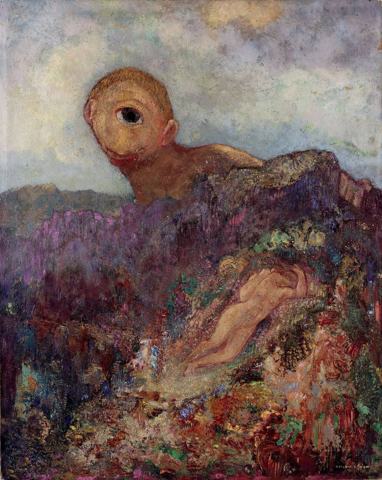
The one-eyed Cyclops of Odyssey 9. A cave-dwelling giant and son of Poseidon, blinded by a man who called himself Nobody.
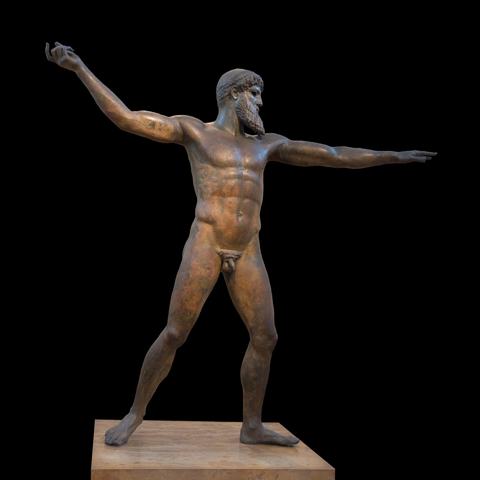
God of the sea, earthquakes and horses. Brother of Zeus, wielder of the trident, and the divine enemy who keeps Odysseus from reaching home.
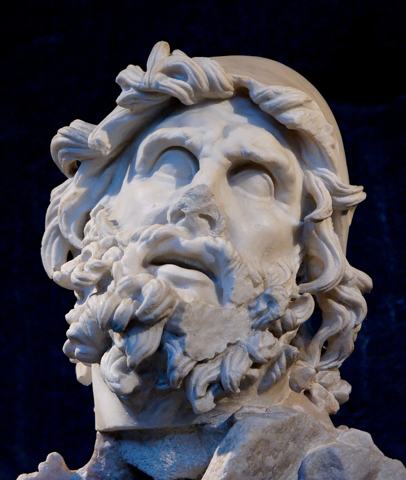
King of Ithaca and the man of many turns. Homer's cleverest hero, who took ten years to sail home from Troy and had to fight for his own house.
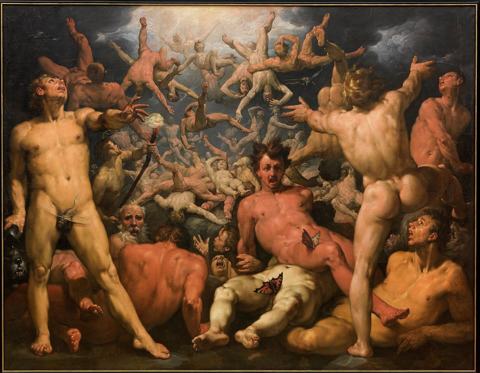
The twelve children of Sky and Earth who ruled before Zeus. Cronus, Rhea, Oceanus, Prometheus' line — and the ten-year war that buried them in Tartarus.
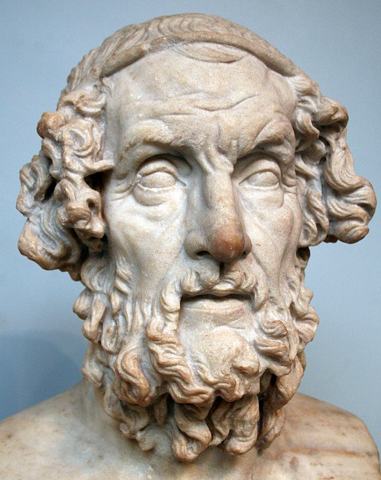
Homer's epic of Odysseus's ten-year voyage home from Troy, the founding adventure story of Western literature and the subject of a 2026 film.
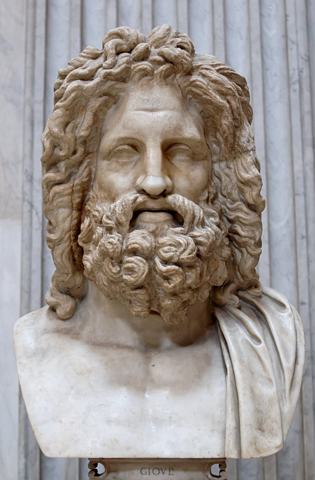
King of the gods and lord of the sky, thunder and justice. He overthrew his own father, divided the universe by lot, and guaranteed the laws of hospitality.
Sources & Further Reading
- 1.Homer, Odyssey 9.105–566.
- 2.Hesiod, Theogony 139–146 and 501–506.
- 3.Apollodorus, Bibliotheca 1.1.2, 1.2.1 and 3.10.4.
- 4.Euripides, Cyclops (satyr play, c. 408 BCE).
- 5.Pausanias, Description of Greece 2.16.5 and 2.25.8.
- 6.Callimachus, Hymn 3 (to Artemis) 46–86; Virgil, Aeneid 8.416–453.
- 7.Gantz, Timothy. Early Greek Myth: A Guide to Literary and Artistic Sources. Johns Hopkins University Press, 1993.
- 8.Heubeck, Alfred & Arie Hoekstra. A Commentary on Homer's Odyssey, Volume II: Books IX–XVI. Clarendon Press, 1989.
Spot an error or have a source to suggest? Write to info@viseterna.com. We cite primary sources and modern scholarship, and we correct fast.