
Polyphemus
The one-eyed Cyclops of Odyssey 9. A cave-dwelling giant and son of Poseidon, blinded by a man who called himself Nobody.
The Cyclops, Odilon Redon, c. 1914 (Kroller-Muller Museum, Otterlo) · Public domain · source
Two Kinds of Cyclops
Greek myth preserves two quite different sets of one-eyed giants, and they are frequently confused. Hesiod's Cyclopes — Brontes, Steropes and Arges, "Thunder", "Lightning" and "Bright" — are sons of Ouranos and Gaia, master smiths who forge the thunderbolt for Zeus and are counted among the divine order 2,7. Homer's Cyclopes are something else entirely: a scattered, lawless herding people who plant nothing, hold no assemblies, know no law, and live in caves on a fertile coast they never cultivate, each giving the law to his own wife and children and caring nothing for his neighbours 1.
Polyphemus, whose name means "much spoken of", is the greatest of the second kind and a son of Poseidon by the sea-nymph Thoosa 1. Robert Mondi's study argues that Homer has fused an old folktale about a shepherd ogre with a separate mythological tradition of Cyclopes, which is why the Homeric figure is at once a fairy-tale monster and the pointed inverse of a Greek city-dweller 6. The episode is not really about a giant; it is about what a society looks like without laws, agriculture, or hospitality.
The Cave
Odysseus lands on the Cyclopes' shore with twelve companions and, against their advice, waits in the cave to see what its owner is like and whether he will give guest-gifts. The Cyclops returns with his flocks, rolls a doorstone across the entrance that twenty-two wagons could not move, and — after listening politely to Odysseus' appeal to Zeus as protector of strangers — replies that the Cyclopes care nothing for Zeus, and eats two of the men 1,8.
Escape is impossible by force: the men cannot move the doorstone, so killing the giant in his sleep would seal them in with the corpse. This constraint is what makes the trap a test of intelligence rather than strength, and it is the hinge of the whole scene 1,8.
Nobody, the Stake and the Sheep
Odysseus' plan runs in three parts. First he offers the Cyclops undiluted wine of unusual strength, a gift he had received from a priest of Apollo among the Cicones. Second, asked his name in return for a promised "guest-gift", he answers Outis — "Nobody". Third, with the giant unconscious and drunk, the men sharpen an olive-wood stake in the fire and drive it into his single eye, turning it like a shipwright's drill 1.
The joke pays off immediately. When the neighbouring Cyclopes gather outside and ask what is wrong, Polyphemus shouts that Nobody is killing him by force or by guile, and they go home telling him to pray to his father. Homer extends the pun: the alternative form of outis in the oblique cases, me tis, is indistinguishable in sound from metis, the cunning that is Odysseus' defining attribute 1,8. In the morning the blind giant sits at the entrance feeling the backs of his sheep as they file out, and the men escape lashed under their bellies, Odysseus beneath the great ram that comes last.
The Curse of Poseidon
The hero then makes the mistake that costs him ten years. Safely offshore, he shouts back his taunts, and — pressed by pride — gives his real name and city, so that the Cyclops will know who blinded him. Polyphemus hurls two mountain-sized rocks that nearly swamp the ship, then prays to his father Poseidon: let Odysseus never reach home, or if he must, let him come late and badly, in another man's ship, having lost all his companions, and find trouble in his house 1.
That prayer is the plot of the rest of the poem. Every clause of it is fulfilled exactly, which is why Book 9 functions as the Odyssey's hinge rather than as one adventure among many 7,8. It also supplies the poem's clearest moral: Odysseus survives by intelligence and suffers by boasting.
Galatea: The Other Polyphemus
A wholly different Polyphemus grew up in later Sicilian poetry — a lovesick pastoral figure rather than a cannibal. Theocritus makes him a young Cyclops singing hopelessly to the sea-nymph Galatea from the shore, consoling himself that at least he has cheese; the tone is comic and affectionate, and Theocritus' Cyclops is aware he is ridiculous 4,7. Ovid darkens it back down: his Polyphemus, rejected in favour of the youth Acis, crushes the boy under a boulder, and Galatea turns her lover's blood into a river 5,7.
Euripides' satyr play Cyclops, the only complete satyr drama to survive, dramatises the Homeric episode with Silenus and a chorus of satyrs as the giant's unwilling slaves, and gives Polyphemus a sardonic speech arguing that wealth is the only real god 3,7. Between the three traditions the Cyclops became one of the most-adapted monsters in the classical repertoire — ogre, buffoon and tragic lover in turn.
In Popular Culture
The blinding of Polyphemus is among the earliest and most frequently depicted scenes from the Odyssey in ancient art, appearing on Greek vases from the seventh century BCE onward, and the Cyclops remains the poem's best-known monster in modern adaptations — the 2026 film wave around Christopher Nolan's The Odyssey has put him back in front of a mass audience. "Nobody" as an escape trick has since been recycled in fantasy fiction and games often enough to be a genre convention in its own right.
Continue Exploring
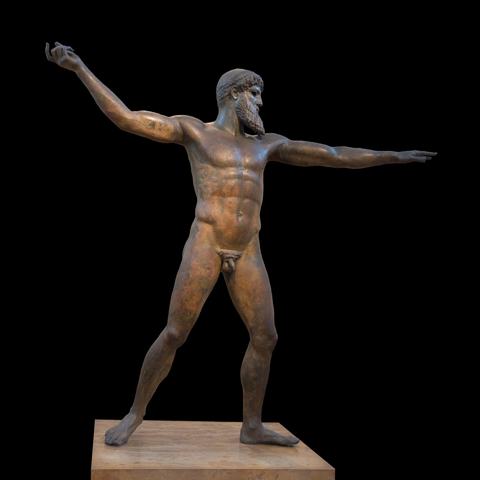
God of the sea, earthquakes and horses. Brother of Zeus, wielder of the trident, and the divine enemy who keeps Odysseus from reaching home.
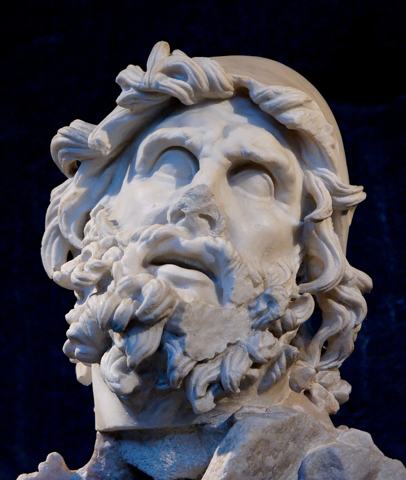
King of Ithaca and the man of many turns. Homer's cleverest hero, who took ten years to sail home from Troy and had to fight for his own house.
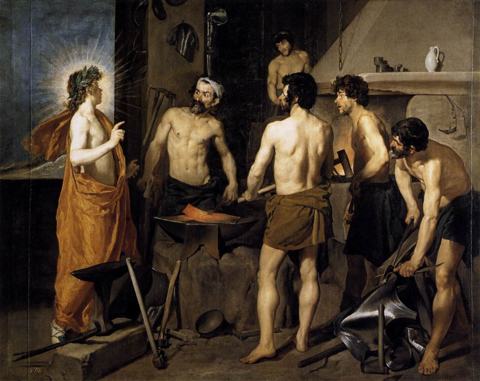
The round-eyed ones — three divine smiths who forged Zeus's thunderbolt, a race of lawless one-eyed shepherds, and the builders of walls no man could lift.
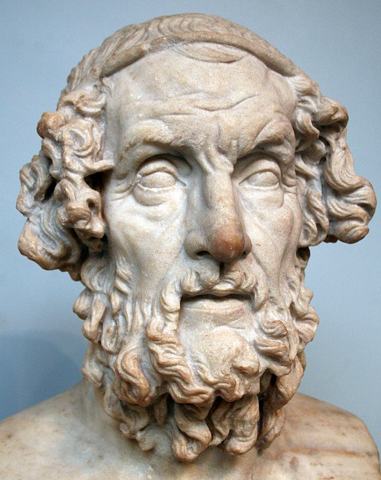
Homer's epic of Odysseus's ten-year voyage home from Troy, the founding adventure story of Western literature and the subject of a 2026 film.
King of the gods and lord of the sky, thunder and justice. He overthrew his own father, divided the universe by lot, and guaranteed the laws of hospitality.
The flower-eating men — Homer's gentlest disaster, a people whose food is no weapon and yet erases the desire to go home.
Sources & Further Reading
- 1.Homer, Odyssey (c. 8th-7th century BCE), esp. Book 9.
- 2.Hesiod, Theogony (c. 700 BCE).
- 3.Euripides, Cyclops (5th century BCE).
- 4.Theocritus, Idylls 6 and 11 (3rd century BCE).
- 5.Ovid, Metamorphoses, Book 13 (c. 8 CE).
- 6.Mondi, Robert. 'The Homeric Cyclopes: Folktale, Tradition, and Theme.' Transactions of the American Philological Association 113 (1983), 17-38.
- 7.Gantz, Timothy. Early Greek Myth: A Guide to Literary and Artistic Sources. Johns Hopkins University Press, 1993.
- 8.Heubeck, A., S. West, J. B. Hainsworth, A. Hoekstra, J. Russo and M. Fernandez-Galiano. A Commentary on Homer's Odyssey, 3 vols. Oxford: Clarendon Press, 1988-1992.
Spot an error or have a source to suggest? Write to info@viseterna.com. We cite primary sources and modern scholarship, and we correct fast.