
Neptune
Lord of the sea — though the Romans knew him first as a god of springs and running water, honoured at midsummer when the rivers ran lowest.
Triumph of Neptune, Roman mosaic, 2nd-3rd c. AD (Bardo National Museum, Tunis); photo Tony Hisgett, CC BY 2.0 · CC BY 2.0 · source
Fresh Water First
Latin Neptunus is an old name of uncertain derivation; Cicero's Stoic speaker offers the guess that it comes from nare, "to swim," which is the sort of etymology Roman intellectuals produced when the real answer had already been lost 5. What the ritual evidence shows is that Rome's original water god was not primarily maritime 6,7.
Rome was not a sea power for the first several centuries of its existence. It was an inland city on a river, dependent on springs, wells and the Tiber, and its water god's oldest festival is concerned with exactly that 6,7. The sea came later, along with the Greek Poseidon, whose myths and iconography were transferred onto Neptune wholesale once the equation was made 7.
The Neptunalia
His festival, the Neptunalia, fell on 23 July — the hottest, driest stretch of the Roman summer, when springs failed and the Tiber ran low 1. Varro records the distinctive practice: participants built umbrae, rough shelters of branches and leaves, and spent the day beneath them drinking and feasting beside the water 1.
It is one of the very few Roman festivals with no procession, no magistrate, and no temple at its centre — a day of shade, water and wine, marked in the earliest calendars Rome preserved 1,6. Whatever Neptune later became, his oldest public rite is a response to drought 6,7.
Neptunus Equester and the Horse
The other archaic strand ties him to horses. Roman antiquarians identified Neptune with Consus, a god whose underground altar lay buried in the Circus Maximus and was uncovered only for his festivals, the Consualia of 21 August and 15 December, at which horses and mules were garlanded, excused from work, and raced 1,3.
Livy sets Rome's most notorious foundation episode at exactly that festival: Romulus invites the neighbouring Sabines to the Consualia games, and the Roman men seize their daughters during the show 2. Later writers glossed Consus as Neptunus Equester, "Neptune of the horse," aligning him with the Greek Poseidon Hippios, who was likewise both earth-shaker and horse-breeder 1,3,7.
Virgil keeps the association alive at the literary level, staging the funeral games of Book 5 under Neptune's eye and giving him the calming of the storm in Book 1 — where the god rebukes the winds and the poet compares him to a statesman quelling a riot, an image that turns a sea-god into a model of Roman authority 4.
Temples and the Sea
A temple of Neptune stood in the Circus Flaminius on the Campus Martius by the late third century BCE, in the district Rome used for triumphal and military display, and the pattern of his later cult follows Rome's naval expansion 2,6. Sailors and traders vowed to him; safe arrivals were credited to him; and shipwreck was his to prevent or permit 6,7.
Roman writers give him a consort, Salacia, whose name Varro connects with salum, the open sea, and sometimes a second figure, Venilia, associated with the incoming wave 1. Neither has much of a cult, and both look like the Roman habit of pairing a god with a personified aspect of his own domain rather than an imported Greek Amphitrite 1,7.
The Sea Wars of the Late Republic
Neptune's most politically loaded moment came in the civil wars after Caesar's death. Sextus Pompeius, who controlled Sicily and the sea lanes and repeatedly starved Rome of grain, publicly styled himself the son of Neptune, wore a sea-blue cloak, and put the god on his coinage — a claim of divine descent pitched directly against the Julian family's claim to Venus 6.
The response was to take the god off him. Agrippa, commanding for Octavian, defeated Sextus at Naulochus in 36 BCE, and after Actium built the Basilica Neptuni on the Campus Martius as a monument to naval victory 6,7. Neptune subsequently appears on imperial coinage with his foot on a prow, an emblem of command over the sea rather than of the sea's own moods 6.
Trident, Mosaic, and Afterlife
Once fused with Poseidon, Neptune inherited the full Greek apparatus: the trident, the chariot drawn by hippocamps, the retinue of Tritons and Nereids, the power to raise storms and shake the earth 4,7. Roman art ran with it. From the second century CE the "triumph of Neptune" became one of the standard subjects of floor mosaics across the empire, and especially in North Africa, where the god rides the waves surrounded by the seasons and by marine creatures — an image of prosperity carried by sea trade as much as a religious statement 7.
What that long career shows is how a Roman god could be almost entirely rebuilt without ever changing his name. The Neptune of the imperial mosaics — trident, chariot, Nereids, the whole Greek repertoire — has essentially nothing in common with the god of the leaf shelters on 23 July, and the Romans kept both without discomfort 1,6,7.
Continue Exploring
Goddess of love and desire — and the divine ancestress of Rome itself, mother of Aeneas and the claimed forebear of the family of Julius Caesar.
God of the sea, earthquakes and horses. Brother of Zeus, wielder of the trident, and the divine enemy who keeps Odysseus from reaching home.
The two-faced Roman god of doors, beginnings and endings, named first in every prayer, whose gates in the Forum stood open only while Rome was at war.
The one great Greek god Rome adopted without renaming him — plague-healer, oracle-giver, and the personal patron Augustus built into the imperial order.
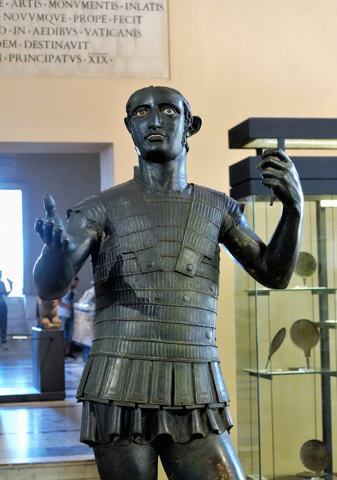
God of war and father of Rome — honoured above almost every other deity, with his own month, his own dancing priests, and the twins he fathered on a Vestal.
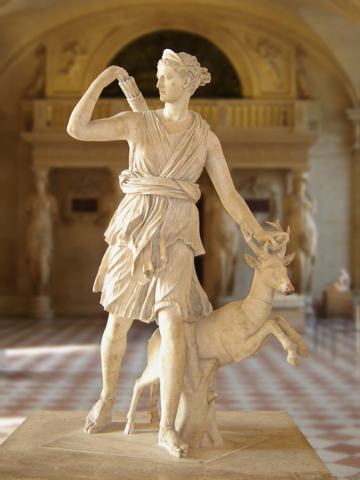
Roman goddess of the hunt, wild places and the moon, whose oldest sanctuary at Lake Nemi was guarded by a priest who held office by killing his predecessor.
Sources & Further Reading
- 1.Varro, De Lingua Latina (1st century BCE), Books 5–6.
- 2.Livy, Ab Urbe Condita (c. 27 BCE) — esp. Books 1 and 28.
- 3.Ovid, Fasti (c. 8 CE).
- 4.Virgil, Aeneid (29–19 BCE), Books 1 and 5.
- 5.Cicero, De Natura Deorum (45 BCE), Book 2.
- 6.Beard, Mary, John North & Simon Price. Religions of Rome, Volume 1: A History. Cambridge University Press, 1998.
- 7.Scheid, John. An Introduction to Roman Religion. Edinburgh University Press, 2003.
Spot an error or have a source to suggest? Write to info@viseterna.com. We cite primary sources and modern scholarship, and we correct fast.