
Medusa
The Gorgon. The only mortal one of three sisters, whose gaze turned men to stone and whose severed head became the most powerful protective emblem in Greek art.
Medusa Rondanini, Roman copy after a Greek original attributed to Pheidias, 5th c. BC (Glyptothek, Munich) · CC BY-SA 3.0 · source
The Mortal Sister
The earliest full account is in Hesiod. The sea-god Phorcys and his sister Keto produced three Gorgons living beyond famous Ocean at the edge of night: Sthenno, Euryale, and Medusa, who suffered grievously because she alone was mortal while the other two were ageless and deathless 1.
Hesiod adds, without comment, that Poseidon lay with her in a soft meadow among spring flowers, and that when Perseus cut her head off, the winged horse Pegasus and the giant Chrysaor sprang from her neck 1. That is the whole archaic story: a decapitation that produces life rather than ending it.
Her name is generally derived from the verb medein, "to rule" or "to guard" — the Gorgon is a guardian, and what she guards is a boundary at the world's edge 7,8. The petrifying gaze, later the defining detail, is not in Hesiod at all; it enters the tradition afterwards 7.
Perseus and the Head
The best-connected version of the quest is Apollodorus'. King Polydectes of Seriphos, wanting Perseus out of the way so he can pursue the hero's mother Danae, demands the Gorgon's head as a contribution to a wedding gift. Perseus, guided by Hermes and Athena, first finds the Graiai — three grey sisters sharing one eye and one tooth between them — steals the eye, and ransoms it for directions to the nymphs 3.
From the nymphs he takes winged sandals, the kibisis — a special bag for the head — and the cap of Hades, which makes the wearer invisible. Hermes gives him an adamantine sickle. He finds the Gorgons asleep and, because a direct look would kill him, cuts the head off while Athena guides his hand and he watches the reflection in a bronze shield 3,7.
The details do the theological work. Perseus never sees Medusa. He kills her indirectly, in her sleep, with borrowed equipment, watching a mirror — the least heroic set of circumstances in Greek myth, and the only ones that could possibly succeed 7,8.
Her blood matters as much as her head. Apollodorus says the blood from the left vein is a deadly poison and that from the right raises the dead, and that Athena gave it to Asclepius; Ovid adds that drops falling over Libya bred the serpents that infest the desert 3,4.
Ovid's Version, and the Trouble With It
The story most people know today — that Medusa was a beautiful girl raped by Poseidon in Athena's temple and punished by the goddess with a head of snakes — is Ovid's, written in Latin around the year 8 CE, some seven hundred years after Hesiod 4.
In Metamorphoses Book 4, a guest at Perseus' wedding feast asks why Medusa alone of the sisters had serpents in her hair, and the answer is that she was famous for her beauty, especially her hair, until Poseidon took her in Minerva's shrine; the goddess turned away, covered her eyes with her aegis, and changed the hair to snakes 4.
This is a Roman poet's addition, and Greek sources give no hint of it — Hesiod's Gorgons are born monstrous, children of sea-monsters, with no transformation involved 1,7. That does not make Ovid's version illegitimate; it makes it a different, later myth. It is the source of the modern reading of Medusa as a punished victim, and of nearly every retelling since 7,8.
The Face on the Shield
Long before the story stabilised, the face existed. The gorgoneion — a frontal mask with round staring eyes, tusks, a lolling tongue and a grimace — is one of the most common images in archaic Greek art, and it appears on things that need protecting: temple pediments, shields, armour, house doors, ovens, drinking cups and coins 6,7. The great early example is the Gorgon on the west pediment of the temple of Artemis on Corfu, carved around 580 BCE and roughly three metres tall. Homer already knows the emblem: the Iliad describes the Gorgon head as grim and terrible on Athena's aegis, and again on Agamemnon's shield 2,6.
Walter Burkert and others have argued that the mask came first and the narrative afterwards — that an apotropaic face, meant to frighten off harm by being more frightening than the harm, was supplied with a biography when Greek myth got systematic 6. The frontal presentation is the tell. Almost all archaic Greek figures are shown in profile; the gorgoneion looks straight out, because its whole function is to be looked at 6,7.
Rationalists and Tombs
Ancient writers were already sceptical. Pausanias, touring Argos, records a mound said to hold Medusa's head, and passes on a rationalising account in which she was a Libyan queen ruling near Lake Tritonis, killed by Perseus in a night raid, whose head was carried to Greece because of its extraordinary beauty. He offers a second version in which she was simply a large and unusually wild woman 5.
Placing the Gorgons in Libya, at the southern edge of the known world, fits the archaic habit of putting monsters where the maps run out 5,7. Ogden's survey groups Medusa with the wider Greek family of serpent-guardians — the hydra, the Colchian dragon, Python at Delphi — figures whose defeat by a hero founds something: a city, a cult, a kingship 8.
Two Medusas
What survives is really two figures wearing one name. The archaic Medusa is a born monster at the edge of the world, sister to two immortals, cursed only by being able to die — a guardian whose face was carved on temples for centuries because it worked, and whose death produces a winged horse 1,6,7. The Latin Medusa is a beautiful woman assaulted in a temple and disfigured by the goddess who should have protected her, whose monstrousness is imposed from outside 4.
Almost every modern retelling descends from the second, because Ovid is the version medieval and Renaissance Europe actually read, and because punishment landing on the wrong person is more legible to later audiences than a genealogy of sea-monsters 4,7. The reading of Medusa as victim rather than antagonist is not a modern invention imposed on the Greeks — but it is Roman, and it is late.
The older layer keeps showing through anyway. Whatever story is attached to her, the image has not changed in two and a half thousand years: a face that stares straight out at whoever is looking 6,8.
Continue Exploring
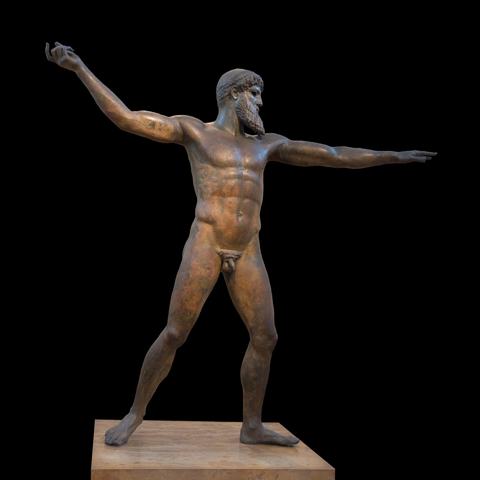
God of the sea, earthquakes and horses. Brother of Zeus, wielder of the trident, and the divine enemy who keeps Odysseus from reaching home.
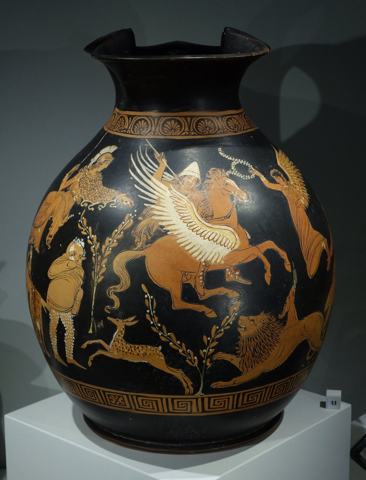
The winged horse born from a Gorgon's blood, tamed by Bellerophon to kill the Chimera, and set by Zeus to carry his thunder and lightning.
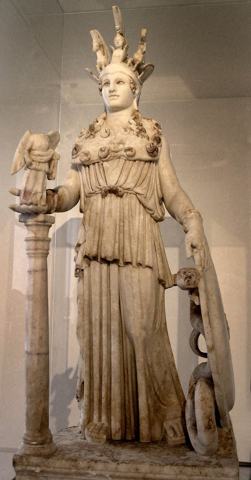
Goddess of wisdom, strategy and craft, born fully armed from the head of Zeus. Patron of Athens, of heroes, and of Odysseus above all.
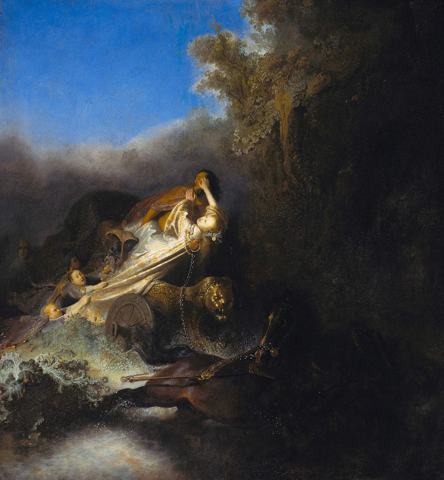
Lord of the underworld and of the wealth beneath the earth. Not a devil — a grim, lawful king whose only rule is that no one leaves.
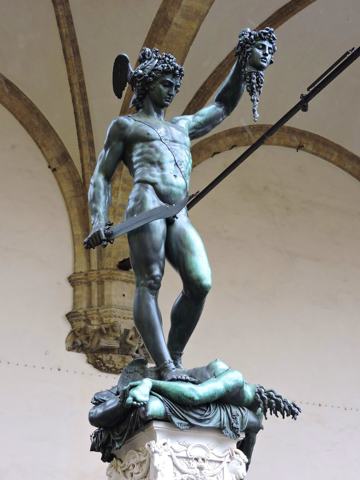
The hero who beheaded the Gorgon Medusa with borrowed weapons, rescued Andromeda from a sea-monster, and fulfilled the prophecy he spent his life escaping.
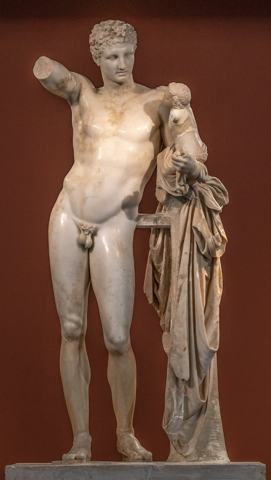
Messenger of the gods and guide of the dead. Patron of travellers, traders, heralds and thieves, and the only Olympian who crosses every boundary at will.
Also mentioned inMinotaur
Sources & Further Reading
- 1.Hesiod, Theogony (c. 700 BCE), lines 270-286.
- 2.Homer, Iliad (c. 8th century BCE), esp. 5.738-742 and 11.32-37.
- 3.Apollodorus, Bibliotheca (1st-2nd century CE), 2.4.1-5.
- 4.Ovid, Metamorphoses (c. 8 CE), Books 4-5.
- 5.Pausanias, Description of Greece (c. 150-180 CE), 2.21.5-6.
- 6.Burkert, Walter. Greek Religion — Archaic and Classical. Trans. John Raffan. Harvard University Press, 1985.
- 7.Gantz, Timothy. Early Greek Myth — A Guide to Literary and Artistic Sources. Johns Hopkins University Press, 1993.
- 8.Ogden, Daniel. Drakon — Dragon Myth and Serpent Cult in the Greek and Roman Worlds. Oxford University Press, 2013.
Spot an error or have a source to suggest? Write to info@viseterna.com. We cite primary sources and modern scholarship, and we correct fast.