
Perseus
The hero who beheaded the Gorgon Medusa with borrowed weapons, rescued Andromeda from a sea-monster, and fulfilled the prophecy he spent his life escaping.
Perseus with the Head of Medusa, Benvenuto Cellini, 1545-1554 (Loggia dei Lanzi, Florence) · CC BY 2.0 · source
A Prophecy in a Bronze Chamber
An oracle warns King Acrisius of Argos that his daughter Danae will bear a son who will kill him. Acrisius shuts her in an underground bronze chamber to keep her childless, but Zeus reaches her as a shower of gold, and Perseus is born anyway 1,5. Acrisius, unwilling to kill his own grandson outright and risk the gods' anger, seals mother and infant in a wooden chest and sets it adrift on the sea 1. The chest washes up on the small Cycladic island of Seriphos, where a fisherman named Dictys hauls it in and raises the boy as his own 1,6.
Trouble follows Perseus into adulthood. Dictys's brother, King Polydectes, wants Danae for himself and wants her grown son out of the way. When Perseus rashly promises Polydectes any gift he names, the king demands the one thing he expects to be impossible: the head of the Gorgon Medusa, whose gaze turns anyone who meets it to stone 1,6.
Borrowed Weapons
Perseus does not go alone in any real sense; the story is explicit that he could not have succeeded without help. Athena and Hermes guide him first to the Graiai, three grey-haired sisters who share a single eye and a single tooth between them, and Perseus steals the eye as they pass it hand to hand, trading it back only for directions to the nymphs of the north 1. From the nymphs he receives winged sandals, a magic satchel called the kibisis to carry the severed head safely, and the cap of Hades, which renders its wearer invisible; Hermes supplies an adamantine sickle, and Athena a polished bronze shield 1,6. Every tool is borrowed, and every one of them is necessary; the story insists that raw courage alone would have gotten Perseus killed 7.
The Death of Medusa
Of the three Gorgon sisters, only Medusa is mortal, and it is this fact, not any difference in ferocity, that decides the whole plan 1,5. Perseus finds the Gorgons asleep, watches Medusa's reflection in Athena's shield rather than looking at her directly, and cuts off her head in a single stroke while Athena steadies his aim 1,7. From her severed neck spring the winged horse Pegasus and the warrior Chrysaor, both said to be children of Poseidon conceived before her death 1,5. Pindar's Pythian 12 credits the episode with inventing a new form of music: hearing the surviving Gorgons' wail of grief, Athena is said to have modelled the many-toned melody of the aulos on their keening, a strange, sound-based footnote to an otherwise silent decapitation 2. Perseus seals the head in the kibisis and, wearing the cap of invisibility, flies from the enraged survivors on Hermes's winged sandals, a chase neither of them has any hope of winning 1.
A Bride Bought from a Sea-Monster
Flying home across Ethiopia, Perseus finds the princess Andromeda chained to a coastal rock, offered up to a sea-monster sent by Poseidon after her mother Cassiopeia boasted that Andromeda's beauty rivalled the Nereids' 3,4. He kills the monster, turning it to stone with Medusa's head in some tellings, spearing it in others, and, after negotiating her hand with her father Cepheus, marries her on the spot 3,4. Ovid gives the episode its fullest telling, folding a wedding-feast brawl with Andromeda's spurned former fiance Phineus into the scene and letting Perseus finish that fight the same way he finished the monster's, by making his enemies look at the Gorgon's face 3. Ancient geographers placed the rescue at Jaffa on the Levantine coast, and Pausanias records local Argive traditions tying the couple's descendants directly to the Argive royal house 3,4.
An Accident Fulfils the Prophecy
The oracle Acrisius tried to outrun catches up with him anyway. Returning to Greece, Perseus competes in funeral games at Larissa and throws a discus that veers off course into the crowd, striking and killing an old man who turns out to be Acrisius, present incognito 1,6. Ashamed to take the throne of a grandfather he has killed, Perseus trades kingdoms with his cousin Megapenthes, taking Tiryns in exchange and founding, in the same regional tradition, the neighbouring citadel of Mycenae 1,4. Pausanias reports that Mycenaeans in his own day still pointed to a well within the walls and a set of underground chambers as Perseus's own work, treating the founder as a real builder rather than only a legend 4.
Legacy of a Borrowed Sword
Perseus and Andromeda's children become the Perseid dynasty that rules the Argolid for generations. One branch of the family line runs down, several generations later, to Alcmene and her son Heracles, so that the hero who kills Medusa and the hero of the Twelve Labours share the same blood 1,6. Medusa's head, given to Athena and mounted on her aegis, outlived every other part of the story as an image: the Gorgon face on shields, temples and coins is one of the most reproduced images in Greek art, and it survives Perseus himself by centuries 5,7. Ogden situates Perseus within a wider Greek pattern of monster-slayers whose victories found cities and dynasties rather than simply ending threats, a category that also includes the men who kill the Minotaur and the Hydra of Lerna 7.
Continue Exploring
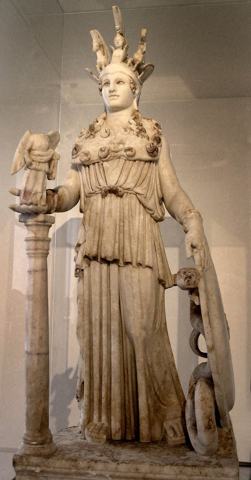
Goddess of wisdom, strategy and craft, born fully armed from the head of Zeus. Patron of Athens, of heroes, and of Odysseus above all.
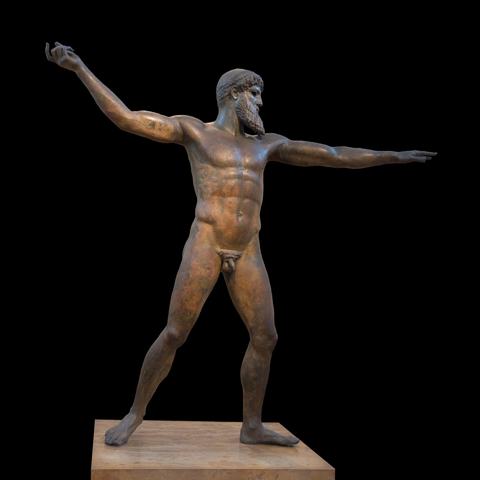
God of the sea, earthquakes and horses. Brother of Zeus, wielder of the trident, and the divine enemy who keeps Odysseus from reaching home.
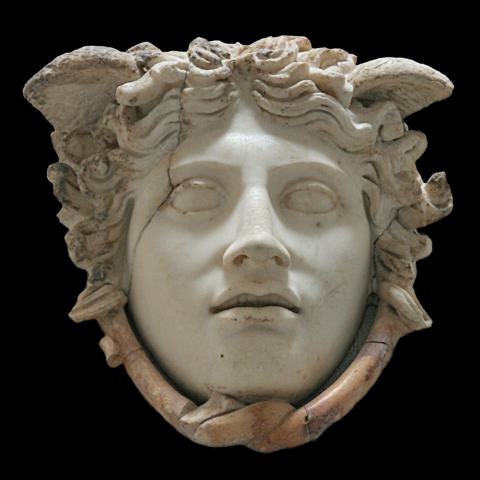
The Gorgon. The only mortal one of three sisters, whose gaze turned men to stone and whose severed head became the most powerful protective emblem in Greek art.
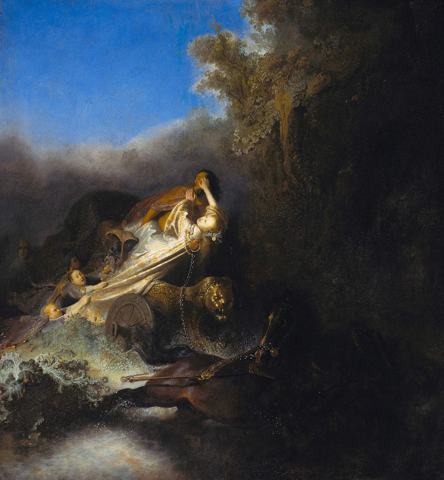
Lord of the underworld and of the wealth beneath the earth. Not a devil — a grim, lawful king whose only rule is that no one leaves.
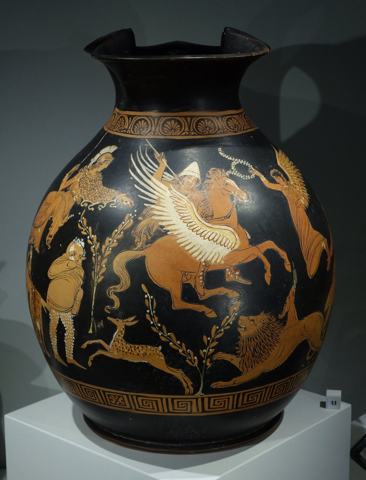
The winged horse born from a Gorgon's blood, tamed by Bellerophon to kill the Chimera, and set by Zeus to carry his thunder and lightning.
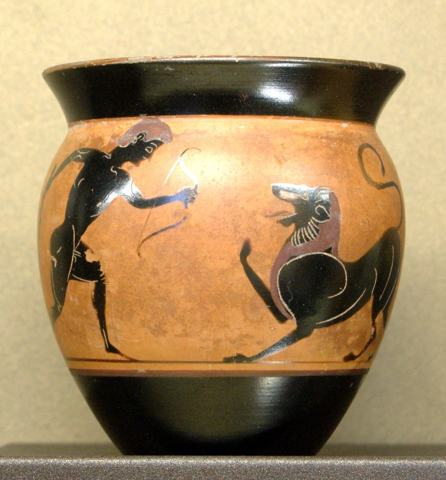
Zeus's mortal son, driven mad by Hera and set twelve impossible labours as penance - the strongest man in Greek myth, who died in agony and rose to Olympus.
Sources & Further Reading
- 1.Apollodorus, Bibliotheca (Library), 2.4.1-5 (1st-2nd century CE).
- 2.Pindar, Pythian 10 and 12 (5th century BCE).
- 3.Ovid, Metamorphoses, Books 4-5 (c. 8 CE).
- 4.Pausanias, Description of Greece, esp. 2.16, 2.18, 2.23 (c. 150-180 CE).
- 5.Hesiod, Theogony, lines 270-286 (c. 700 BCE).
- 6.Gantz, Timothy. Early Greek Myth: A Guide to Literary and Artistic Sources. Johns Hopkins University Press, 1993.
- 7.Ogden, Daniel. Perseus. Routledge, 2008.
Spot an error or have a source to suggest? Write to info@viseterna.com. We cite primary sources and modern scholarship, and we correct fast.