
Hera
Queen of the gods. Zeus's sister, wife and most dangerous opponent — goddess of marriage in cult, and in Homer the one Olympian he is genuinely wary of.
Hera Barberini, Roman statue after a Greek original, 2nd c. AD (Museo Pio-Clementino, Vatican Museums) · Public domain · source
Swallowed, and Married to Her Brother
Hera is a daughter of the Titans Kronos and Rhea, and one of the children Kronos swallowed at birth to forestall the prophecy that a son would overthrow him. When Zeus forced his father to disgorge them, Hera came back into the world alongside Hestia, Demeter, Hades and Poseidon 2,4.
She then married the brother who had freed her. Hesiod places the union at the end of a list of Zeus's wives, calling her his last and legitimate one, and names their children as Hebe, Ares and Eileithyia 2. The pairing of siblings is not treated as scandalous in the sources; it is treated as constitutional, the arrangement that gives Olympus a stable head and a stable queen 6,7.
The one child she produces alone is a grievance. Hesiod says Hera bore Hephaestus without union, in anger and rivalry with her husband — a direct answer to Zeus bringing Athena out of his own head 2,7. The Homeric Hymn to Apollo makes the resentment explicit and has her produce the monster Typhaon in the same spirit, complaining that Zeus dishonours her before all the immortals 3.
The Homeric Queen
The Iliad gives Hera more direct speech than any goddess except Athena, and its portrait is formidable rather than flattering. Her fixed epithets are boopis potnia Here, "ox-eyed lady Hera", and leukolenos, "white-armed" — the first probably older than Homer and possibly a survival from an era when the goddess and the cow were more closely identified 6,8.
Her hatred of Troy drives the plot. Homer alludes only briefly to its cause, in Book 24, where the gods recall the insult of Paris' judgement, but the consequence runs through the whole poem: Hera will see the city destroyed, and says in Book 4 that Zeus may raze her three favourite cities in exchange, and she will not object 1,7.
Book 14 contains her masterpiece. Determined to get Zeus's attention off the battlefield, Hera bathes, dresses, borrows the embroidered band of Aphrodite that carries desire and persuasion, bribes the god Sleep with a promise of one of the Graces, and seduces her husband on the peak of Mount Ida, where the earth throws up crocus and hyacinth beneath them and a golden cloud closes over. While he sleeps, the Greeks drive the Trojans back 1,7. It is the only successful deception of Zeus in the epic, and it is carried out entirely with the tools of a wife.
Zeus's retaliation in Book 15 is a memory rather than an act: he reminds her of the time he hung her from the sky with anvils on her ankles and golden bonds on her wrists, and threw out of heaven any god who tried to help. The threat works 1. The marriage at the centre of Greek myth is a power struggle in which both parties know exactly what the other is capable of 7,8.
The Long Vendetta
Hera's most familiar role in later mythography is as the persecutor of Zeus's lovers and their children, and the catalogue is long. Io is turned into a cow and set under the guard of hundred-eyed Argos, then driven across the world by a gadfly. Leto, pregnant with Apollo and Artemis, is refused a birthplace by every land until floating Delos accepts her. Semele, pregnant with Dionysus, is persuaded by a disguised Hera to ask Zeus to appear in his true form, and is burned to death by it. Callisto, Aegina and others follow 4,7.
The most sustained campaign is against Heracles, whose name means "glory of Hera" — an irony the Greeks noticed and never explained away 6,7. She delays his birth so that Eurystheus is born first and takes the kingship, sends serpents into his cradle, and drives him mad. Homer has Zeus tell the story of the delayed birth in Book 19 as an example of how even he was outwitted 1,4.
Modern readers often ask why the goddess of marriage punishes the women rather than the husband. The answer the sources imply is that she cannot touch him and can touch them, and that her province is not romance but the institution — legitimacy, succession, the standing of a wife 6,8.
The Great Sanctuaries
The literary shrew and the cult goddess are strikingly different, and the archaeology insists on the difference. Hera received some of the earliest and largest temples in the Greek world: the Heraion on Samos, rebuilt repeatedly and at one point the largest temple in Greece; the Argive Heraion, which dominated the plain of Argos; and the temple of Hera at Olympia, older than the temple of Zeus beside it 5,6.
Her festivals were substantial civic events. Pausanias describes the Heraia at Olympia, a foot-race for unmarried girls run in the stadium on a shortened course, organised by a college of sixteen women 5. At Plataea, the Daidala festival re-enacted a myth in which Zeus, estranged from Hera, staged a fake wedding to a wooden bride and provoked her back; the image was burned on a great pyre on Mount Kithairon 5. At Argos, Pausanias reports a spring called Kanathos in which Hera bathed each year and became a virgin again 5.
That last rite points at something the myths obscure. Hera's cult marks the phases of a woman's life — maiden, bride, wife — as a cycle rather than a fall, and the annual renewal of virginity belongs to a goddess of far greater independent standing than Homer's jealous consort 6,8.
An Older Goddess Underneath
Scholars have long suspected that Hera predates her marriage. Her sanctuaries at Samos and Argos are older than the developed Olympian scheme, her Mycenaean name appears in Linear B, and her cattle associations and the sheer scale of her early temples suggest a great goddess of the Argolid and the eastern Aegean who was later fitted into a patriarchal family structure as a wife 6,8.
On that reading, the quarrelling in Homer is a literary trace of an institutional merger: a powerful independent cult absorbed into a pantheon headed by a sky-god, with the friction written into the story as a bad marriage 8. The etymology of her name remains unsettled, with proposals linking it to hora, "season" or "ripeness", and to heros — none conclusive 6,8.
Her Roman counterpart, Juno, inherited the marriage portfolio and much else, but also carried functions of her own, and the identification flattens as much as it explains 6.
Continue Exploring
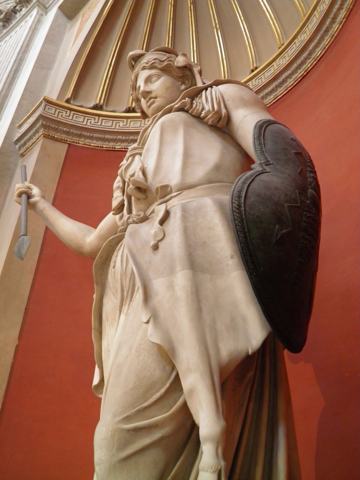
Queen of the gods — Rome's guardian of women, childbirth and the state, whose sacred geese warned the Capitol and whose temple gave us the word money.
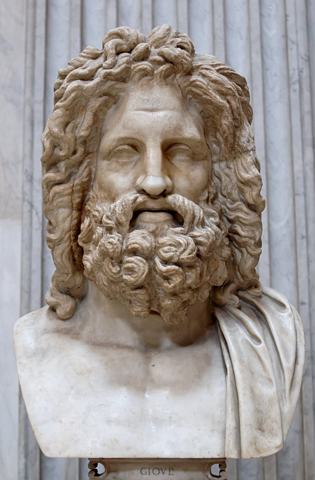
King of the gods and lord of the sky, thunder and justice. He overthrew his own father, divided the universe by lot, and guaranteed the laws of hospitality.
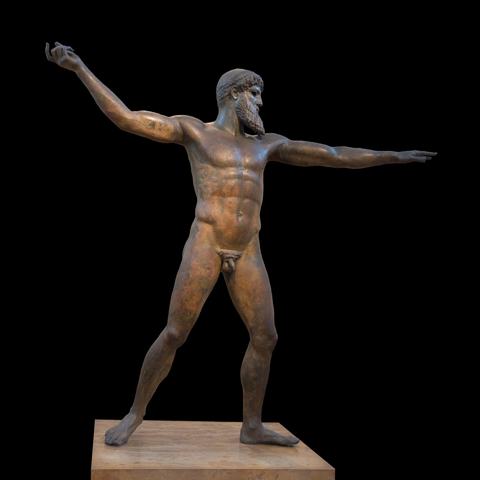
God of the sea, earthquakes and horses. Brother of Zeus, wielder of the trident, and the divine enemy who keeps Odysseus from reaching home.
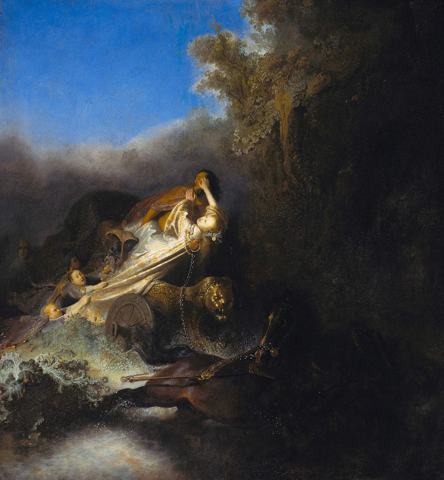
Lord of the underworld and of the wealth beneath the earth. Not a devil — a grim, lawful king whose only rule is that no one leaves.
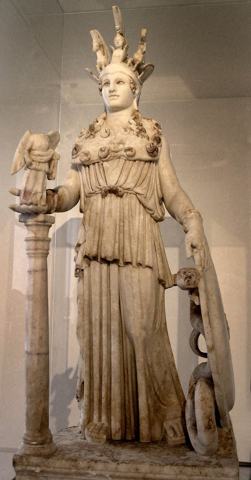
Goddess of wisdom, strategy and craft, born fully armed from the head of Zeus. Patron of Athens, of heroes, and of Odysseus above all.
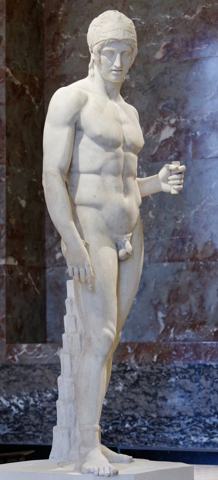
The Greek god of war as slaughter rather than strategy — hated by his own father, beaten by Athena, and worshipped anyway on the edges of the Greek world.
Also mentioned inAphroditeApolloArtemisDemeterDionysusHeracles (Hercules)Jason and the ArgonautsMount OlympusThe Golden FleeceThe IliadThe Lernaean HydraThe Titans
Sources & Further Reading
- 1.Homer, Iliad (c. 8th century BCE), esp. Books 1, 4, 14-15, 19 and 24.
- 2.Hesiod, Theogony (c. 700 BCE), esp. lines 453-506 and 921-929.
- 3.Homeric Hymn to Apollo (c. 6th century BCE), lines 300-355.
- 4.Apollodorus, Bibliotheca (1st-2nd century CE), Books 1-2.
- 5.Pausanias, Description of Greece (c. 150-180 CE), esp. Books 2, 5 and 9.
- 6.Burkert, Walter. Greek Religion — Archaic and Classical. Trans. John Raffan. Harvard University Press, 1985.
- 7.Gantz, Timothy. Early Greek Myth — A Guide to Literary and Artistic Sources. Johns Hopkins University Press, 1993.
- 8.O'Brien, Joan V. The Transformation of Hera — A Study of Ritual, Hero, and the Goddess in the Iliad. Rowman & Littlefield, 1993.
Spot an error or have a source to suggest? Write to info@viseterna.com. We cite primary sources and modern scholarship, and we correct fast.