
Minotaur
Bull of the labyrinth. The bull-headed son of a Cretan queen, hidden in a maze and fed Athenian children until Theseus followed a thread in.
Theseus and the Minotaur, Attic black-figure kylix, c. 515 BC (Musee du Louvre, F 83) · Public domain · source
Asterios, the Starry One
"Minotaur" is a description, not a name: Minotauros, the bull of Minos. The creature's actual name in the sources is Asterios or Asterion — "starry" — which is also the name of the Cretan king who raised Minos, and the reuse is probably deliberate rather than confused 1,5,7.
He is described consistently as a man's body with a bull's head, and just as consistently as something the Cretan royal house is ashamed of. He is not a monster from the edge of the world in the manner of Medusa or the Chimaera. He is a family member, born inside a palace, and hidden underneath it 7,8.
A Bull Kept Back
The cause is a broken promise. Minos, contesting the kingship of Crete, prayed to Poseidon to send a bull from the sea as a sign that the throne was his, vowing to sacrifice the animal immediately. The bull came, magnificent; Minos took the throne, and then put the bull into his herds and sacrificed a lesser one 1,8.
Poseidon's revenge is aimed sideways. He causes Minos' wife Pasiphae to conceive an overwhelming desire for the bull, and she persuades the Athenian craftsman Daedalus, then resident at the court, to build her a hollow wooden cow covered in hide, in which she can be presented to it. The Minotaur is the result 1,3,8.
Ovid tells the sequel with obvious relish: Minos, wanting the family disgrace out of sight, has Daedalus construct a building of blind passages that confuses the eye with winding ways, and shuts the creature in the innermost part 3. The Labyrinth is not a prison built for a monster. It is built to hide a scandal, and the monster is incidental to its purpose 7,8.
The Athenian Tribute
The story becomes Athenian through a death. Minos' son Androgeos was killed in Attica — the sources disagree on how, whether by the bull of Marathon, by ambush, or through jealousy at the games — and Minos made war on Athens and won. The peace terms required Athens to send seven youths and seven maidens to be put into the Labyrinth 1,2,7.
Even the frequency is disputed. Apollodorus has the tribute sent yearly; other accounts, including material Plutarch reviews, make it every nine years, or every eight 1,2,7. The disagreement is typical of Greek myth as it actually survives — there is no canonical text, only a cluster of authors arguing about details centuries after the stories formed 7,8.
Theseus, newly arrived in Athens as the king's son, volunteers for the third consignment. Plutarch records that the ship sailed under a black sail, and that Aegeus gave the crew a white one to hoist if his son came back alive 2.
The Thread
In Crete, Minos' daughter Ariadne falls in love with Theseus and gives him the means to solve the building: a ball of thread, obtained on Daedalus' advice, tied at the entrance and unwound as he goes in 1,2,7. He kills the Minotaur — with a sword in most accounts, with his bare hands in some, which is how the vase-painters preferred it — and follows the line back out, taking the Athenian children with him 7.
Then the story turns cold. Theseus sails with Ariadne and abandons her on Naxos, where Dionysus finds her; the sources offer a range of excuses and Plutarch reports several, visibly uncomfortable with all of them 2,7. And approaching Athens, Theseus forgets to change the sail. Aegeus, watching from the shore, sees black and throws himself down 2,7. The hero's homecoming kills his father, which is the price the myth charges for the victory in the maze 8.
Daedalus, blamed for both the wooden cow and the thread, escapes Crete with his son Icarus on wings of feather and wax — the second-most-famous consequence of a building designed to keep a secret 3,7.
Knossos, the Labyrinth, and the Double Axe
The archaeological ground under this is unusually rich. Arthur Evans began excavating at Knossos in 1900 and uncovered a Bronze Age palace complex of extraordinary size and complexity, with frescoes of young athletes vaulting over the horns of charging bulls, and stone double axes used as a cult symbol throughout 6,8.
The word labrys for a double axe supplied a popular etymology — labyrinth as "the place of the double axe" — which is attractive but not securely demonstrated; the word's ending points to a pre-Greek origin, and it may simply be an old, borrowed name for the building 6,8. The firmer evidence is a Linear B tablet from Knossos recording an offering to da-pu-ri-to-jo po-ti-ni-ja, "the Mistress of the Labyrinth" — which shows that a labyrinth and a goddess associated with it were part of Cretan religion centuries before any Greek told this story 6.
Bull-leaping frescoes, bull-horn architecture and the sheer disorienting scale of the palace plan make the Cretan setting look like a memory rather than an invention, though what the Greeks remembered was probably the prestige and strangeness of Minoan Crete rather than any specific rite 6,8.
Athenian Politics and the Ship of Theseus
The Athenians used the myth. Theseus was their national hero, credited with unifying Attica, and the Minotaur episode gave them a founding story in which Athens throws off tribute to a foreign sea-power — a useful shape for a city building a maritime empire in the fifth century 6,7. Pausanias records the scene painted in Athenian public buildings, and it appears on the Parthenon's metopes and on state coinage 5,7.
Plutarch, writing as a biographer rather than a mythographer, preserves the rationalist versions too: that the local historian Philochorus reported a Cretan tradition in which the Labyrinth was merely a prison, and the "Minotaur" a brutal general named Tauros whom Theseus beat in funeral games 2.
And one Athenian afterlife outlived the myth entirely. Plutarch notes that the ship in which Theseus sailed home was preserved by the Athenians for centuries, its decaying timbers replaced plank by plank, so that philosophers used it as a standing example in disputes about whether a thing that has had every part replaced is still the same thing 2. The Ship of Theseus is still in use as a problem, some two thousand years later, and it started as a footnote to a story about a bull in a basement.
Continue Exploring
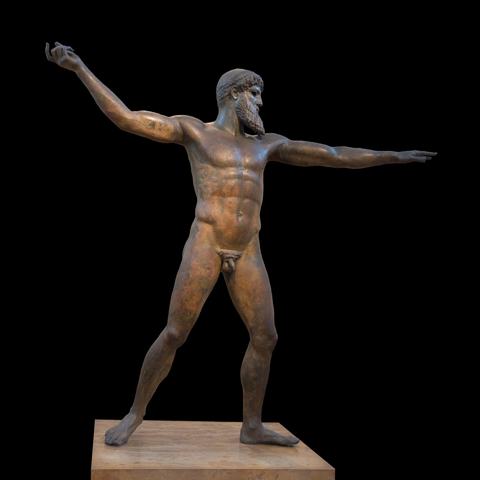
God of the sea, earthquakes and horses. Brother of Zeus, wielder of the trident, and the divine enemy who keeps Odysseus from reaching home.
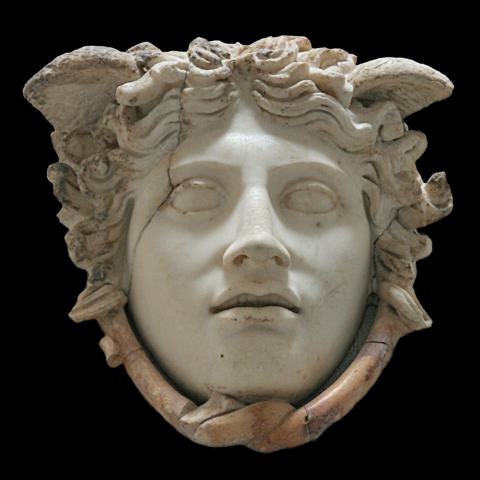
The Gorgon. The only mortal one of three sisters, whose gaze turned men to stone and whose severed head became the most powerful protective emblem in Greek art.
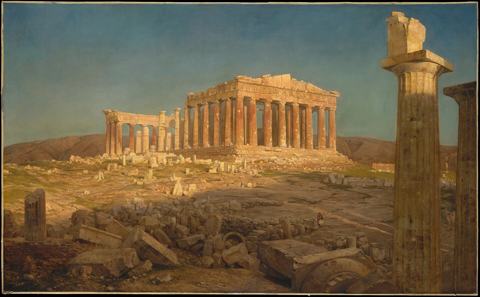
The Doric temple to Athena on the Athenian Acropolis, built under Pericles, decorated by Phidias, and still the most famous ruin in Greece.
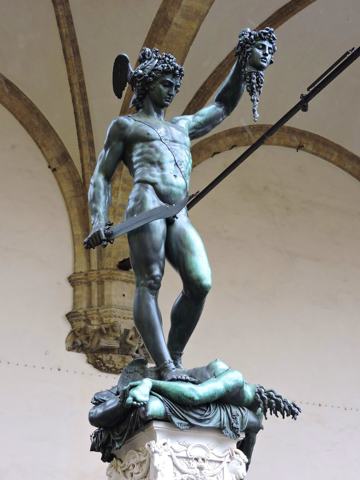
The hero who beheaded the Gorgon Medusa with borrowed weapons, rescued Andromeda from a sea-monster, and fulfilled the prophecy he spent his life escaping.
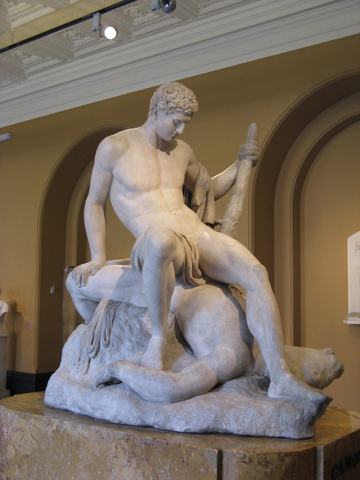
Athens's founding hero - slayer of the Minotaur, unifier of Attica, and the man whose forgotten sail cost his own father's life.
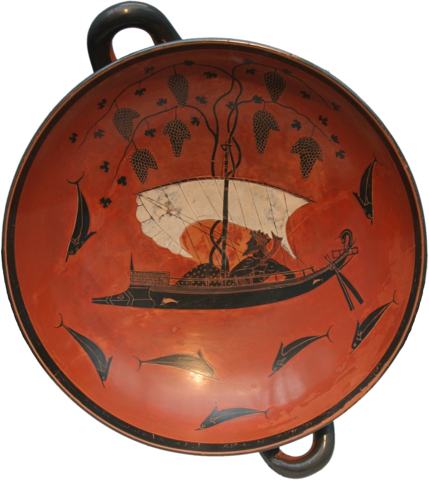
Twice-born god of wine, madness and the mask. He dissolves the boundary between god and beast, and destroys the cities that refuse him.
Sources & Further Reading
- 1.Apollodorus, Bibliotheca (1st-2nd century CE), 3.1.3-4, 3.15.7-8 and Epitome 1.7-11.
- 2.Plutarch, Life of Theseus (c. 100 CE), esp. chapters 15-23.
- 3.Ovid, Metamorphoses (c. 8 CE), Book 8, lines 131-182.
- 4.Diodorus Siculus, Bibliotheca historica (1st century BCE), Book 4.
- 5.Pausanias, Description of Greece (c. 150-180 CE), esp. 1.24 and 2.31.
- 6.Burkert, Walter. Greek Religion — Archaic and Classical. Trans. John Raffan. Harvard University Press, 1985.
- 7.Gantz, Timothy. Early Greek Myth — A Guide to Literary and Artistic Sources. Johns Hopkins University Press, 1993.
- 8.Hard, Robin. The Routledge Handbook of Greek Mythology. Based on H. J. Rose's Handbook of Greek Mythology. Routledge, 2004.
Spot an error or have a source to suggest? Write to info@viseterna.com. We cite primary sources and modern scholarship, and we correct fast.