
Achilles
The greatest fighter at Troy, doomed by his own choice of a short glorious life over a long quiet one, and undone in the one place he could still be wounded.
Briseis Led from Achilles' Tent, Roman fresco from the House of the Tragic Poet, Pompeii, 1st century AD (Museo Archeologico Nazionale, Naples) · Public domain · source
Son of a Goddess
Achilles was the son of Peleus, mortal king of the Myrmidons in Phthia, and the sea-nymph Thetis, whom Zeus and Poseidon both courted until a prophecy warned that Thetis's son would surpass his father, at which point both gods married her off to a mortal instead 3,6. Their wedding was itself the spark of the Trojan War: uninvited, the goddess Eris tossed in a golden apple inscribed "to the fairest," and the resulting dispute among Hera, Athena and Aphrodite ended in the Judgement of Paris 3,6. Thetis, unwilling to accept an ordinary mortal life for her son, is said in later tradition to have dipped the infant in the river Styx, holding him by one heel, to make him invulnerable everywhere the water touched, a detail nowhere in Homer that appears fully worked out only centuries later, in Statius 2,7. Homer's Achilles is simply the best fighter alive, not literally invincible; his single point of failure is a later addition to the story, not its original shape 6,7.
Choosing Glory
Sent as a boy to the centaur Chiron for his education in fighting, music and medicine, Achilles was hidden by Thetis on the island of Skyros, dressed as a girl among the daughters of King Lycomedes, once it became clear Troy could not be taken without him 3. Odysseus is credited with exposing him: laying weapons among a peddler's gifts of jewellery and cloth, he watched to see which "daughter" reached for the sword 3. The choice Achilles makes once found is the one Homer keeps returning to. In the Iliad, Achilles tells the embassy sent to win back his goodwill that his mother has given him two possible fates, a long, obscure life at home or a short life and undying glory at Troy, and that he sailed for Troy already knowing which one he had picked 1. That knowledge, not his spear, is what makes him the poem's tragic centre: everything he does, he does with the ending already visible to him 1,8.
The Wrath
The Iliad's entire plot is the consequence of a single insult. When Agamemnon is forced to give up his own prize of war, the priest's daughter Chryseis, he seizes Achilles's prize instead, the captive woman Briseis, and Achilles, publicly humiliated, withdraws from the fighting and asks his mother to persuade Zeus to let the Trojans win until the Greeks are made to feel exactly what his absence costs them 1. The poem's opening word in Greek is menis, "wrath," and it names Achilles's anger as the engine of everything that follows, including the deaths the anger causes among his own side while he sulks in his tent 1,8. King reads this refusal not as simple pride but as the poem's central argument about what honour actually costs, both the man who withholds himself and the men who die because he did 8.
Grief and Vengeance
Achilles's closest companion, Patroclus, begs to wear his armour into battle to rally the faltering Greeks, and dies at Hector's hands doing it 1. What follows is the fastest, hardest turn in the poem: grief drives Achilles back into the war he had abandoned, Hephaestus forges him a new set of arms at Thetis's request, and he kills Hector in single combat before dragging the body behind his chariot around Troy's walls for days, an act even the gods find excessive 1. The Iliad closes not on that violence but on its undoing: Priam, Hector's father, comes by night to Achilles's tent to beg for his son's corpse, and the two men, enemy king and enemy's killer, weep together before Achilles finally relents and returns the body for burial 1. It is the single most-cited scene in the poem for a reason: the deadliest man at Troy is also, briefly, its most human 1,6.
The Undying Weak Point
Achilles's own death happens after the Iliad ends, and Homer never narrates it, though the poem foreshadows it repeatedly, through the prophecy of Achilles's own dying horse and through Hector's final curse 1. Later epic filled the gap: in the Posthomerica and in Apollodorus's Epitome, Paris, guided or directly assisted by Apollo, the god who has opposed Achilles throughout the war, kills him with an arrow at the Scaean Gate, and post-classical tradition specifies the wound lands in the one unwashed spot left by Thetis's grip in the Styx, his heel 3,4. His bones are burned and mixed with Patroclus's in a single urn, and funeral games are held in his honour, the same ritual pattern the Iliad had already used for Patroclus 3,4. Quintus and the wider Epic Cycle add a darker coda: his ghost, appearing after the fall of Troy, demands the sacrifice of the Trojan princess Polyxena on his tomb before the Greek fleet is allowed to sail home 3,4.
Achilles After Homer
Even his armour outlived him as a plot device. Ovid's Metamorphoses stages the formal contest between Ajax and Odysseus over who should inherit it, a rhetorical duel Odysseus wins and that drives Ajax to suicide, an episode Ovid uses to help close out the whole cycle of Trojan War stories before moving on to Rome's founding myths 5. Alexander the Great is said to have slept with a copy of the Iliad under his pillow and to have visited what was shown as Achilles's tomb at the start of his Asian campaign, treating the hero as a personal model rather than a literary character 8. Statius's unfinished Achilleid turned the Skyros episode into a full poem in its own right, and it is chiefly through Statius and the tradition he crystallised that "Achilles' heel" entered common usage as a phrase for the one flaw that undoes an otherwise formidable person 2,7. Burgess's study traces how thoroughly these "afterlife" details, the heel, the ghost, the ambush at the gate, accreted onto a figure whose only fixed certainty, in the oldest layer of the tradition, was that he would die young and be remembered forever 7.
Continue Exploring
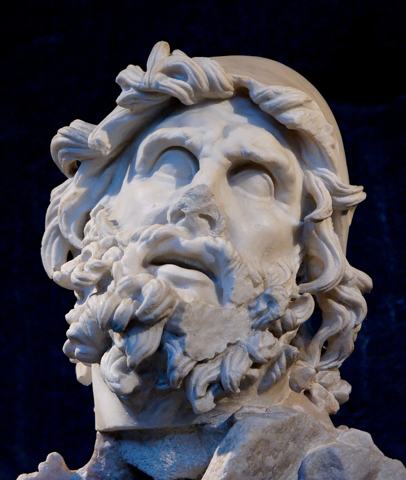
King of Ithaca and the man of many turns. Homer's cleverest hero, who took ten years to sail home from Troy and had to fight for his own house.
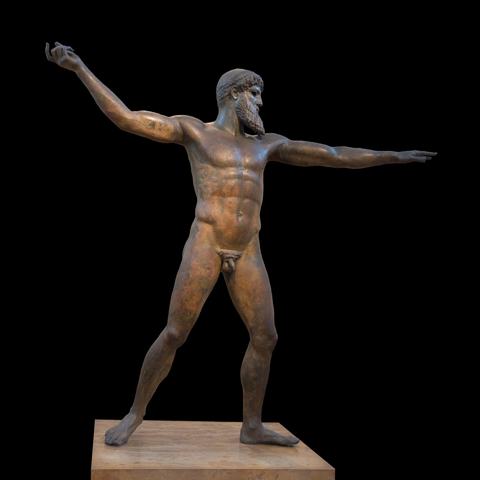
God of the sea, earthquakes and horses. Brother of Zeus, wielder of the trident, and the divine enemy who keeps Odysseus from reaching home.
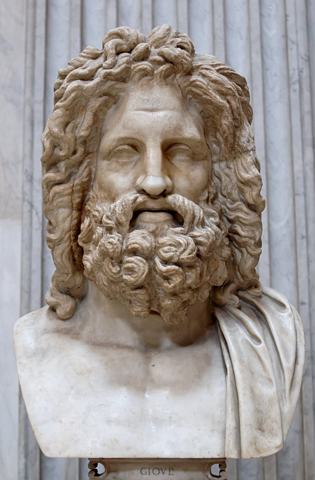
King of the gods and lord of the sky, thunder and justice. He overthrew his own father, divided the universe by lot, and guaranteed the laws of hospitality.
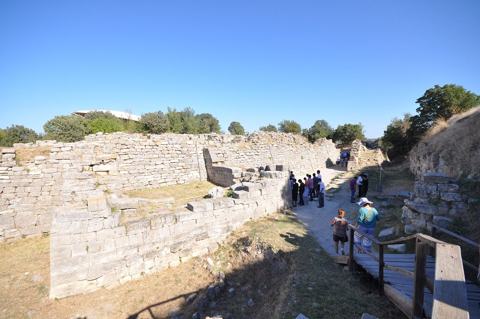
The ten-year siege of Troy that Homer sang, and the real Bronze Age city at Hisarlik whose ruins keep the question of a historical war unresolved.
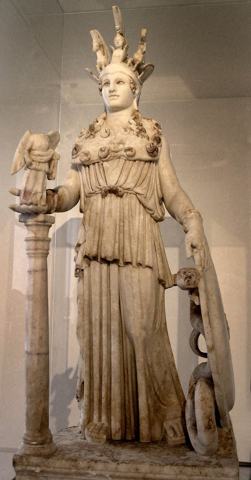
Goddess of wisdom, strategy and craft, born fully armed from the head of Zeus. Patron of Athens, of heroes, and of Odysseus above all.
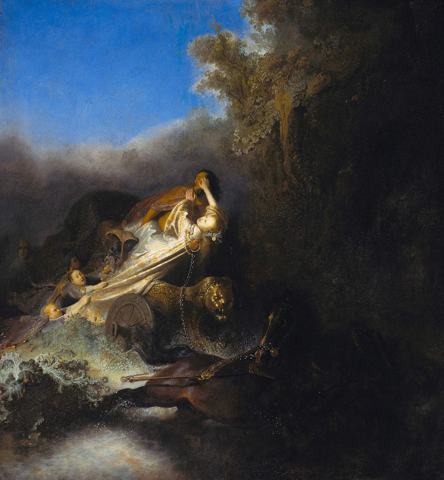
Lord of the underworld and of the wealth beneath the earth. Not a devil — a grim, lawful king whose only rule is that no one leaves.
Sources & Further Reading
- 1.Homer, Iliad (c. 8th century BCE).
- 2.Statius, Achilleid (c. 94-96 CE).
- 3.Apollodorus, Bibliotheca and Epitome (1st-2nd century CE).
- 4.Quintus of Smyrna, Posthomerica, Books 1-3 (3rd-4th century CE).
- 5.Ovid, Metamorphoses, Books 12-13 (c. 8 CE).
- 6.Gantz, Timothy. Early Greek Myth: A Guide to Literary and Artistic Sources. Johns Hopkins University Press, 1993.
- 7.Burgess, Jonathan S. The Death and Afterlife of Achilles. Johns Hopkins University Press, 2009.
- 8.King, Katherine Callen. Achilles: Paradigms of the War Hero from Homer to the Middle Ages. University of California Press, 1987.
Spot an error or have a source to suggest? Write to info@viseterna.com. We cite primary sources and modern scholarship, and we correct fast.