
Pegasus
The winged horse born from a Gorgon's blood, tamed by Bellerophon to kill the Chimera, and set by Zeus to carry his thunder and lightning.
Apulian red-figure oinochoe depicting Bellerophon, Pegasus and the Chimaera, 4th century BCE (MARTA, Taranto) · CC BY 4.0 · source
Born From a Gorgon's Death
Pegasus is born from a killing, not from any ordinary birth. When the Gorgon Medusa is beheaded, Hesiod says two things spring from her severed neck at once: the winged horse Pegasus and a giant named Chrysaor, both fathered on her by Poseidon in a meadow among spring flowers, long before the beheading itself ever happens in the story. The horse's wings, and the strange manner of his birth, are simply given, with no explanation offered for why a union between a sea-god and a monster should produce a flying animal at all 1.
A Name From the Springs
Hesiod also supplies the name's own explanation, tying it to geography rather than to character: Pegasus is called that, he says, because he was born beside the pegai, the springs of Oceanus at the edge of the world. The etymology is folk rather than certain — the word's actual historical origin is still debated by linguists — but it is the explanation the earliest surviving source itself gives, and later writers did not seriously dispute it 1,6.
Thunder-Bearer for Zeus
What Pegasus does immediately after being born is unusually specific for a Hesiodic aside: he flies straight up to Olympus and takes a permanent post there, carrying thunder and lightning for Zeus. That detail makes Pegasus, in the oldest layer of the myth, less a hero's mount than a piece of divine equipment — the animal that delivers the sky god's own weapon — and the far more famous later story of Bellerophon riding him is a separate tradition grafted on afterward 1,6.
Bellerophon's Golden Bridle
The pairing with the hero Bellerophon is not in Homer at all. The Iliad's account of Bellerophon's exploits — killing the fire-breathing Chimera and fighting the Solymi and the Amazons — never mentions a horse, winged or otherwise, and the connection first survives in Pindar and in the mythographers who follow him 6. Pindar's version has Bellerophon try repeatedly to catch Pegasus and fail, until the seer Polyidus tells him to sleep in Athena's temple; the goddess appears in a dream, hands him a golden bridle, and he wakes to find Pegasus drinking at the spring Peirene in Corinth and tames him with it on the spot 2,4.
Killing the Chimera, Then Falling
Bridled and airborne, Bellerophon uses Pegasus to fight the fire-breathing Chimera from above, out of reach of its flames — Ogden's survey of Greek dragon-slaying places the Chimera and its eventual defeat squarely in the same pattern as other monster-guardian stories, won only with an advantage no ordinary weapon supplies — and later against the Solymi and the Amazons, feats that would have killed him on the ground 5. Success does not end well for him. Pindar's account of the sequel is brief and pointedly moralizing: Bellerophon tries to ride Pegasus all the way up to the company of the gods on Olympus, and Zeus sends a gadfly to sting the horse, which throws its rider back down to earth to wander alone, hated by gods and avoided by men, while Pegasus alone reaches the heights Bellerophon had aimed for 3,4.
Afterlife in Sky and Story
The horse outlives the hero he made famous. Later tradition places Pegasus among the stars as a constellation, and connects him to the Muses through a second spring, Hippocrene on Mount Helicon, said to have burst from the ground where his hoof struck the rock — the source, poets later claimed, of poetic inspiration itself 4,6. Almost none of that survives from Hesiod's own austere account of a thunder-carrying war-horse; what stayed constant across two and a half thousand years of retelling is simpler than any single version of the story — a horse that flies, and the repeated, specific warning that reaching too high on his back is what breaks the men who ride him 1,3.
Continue Exploring
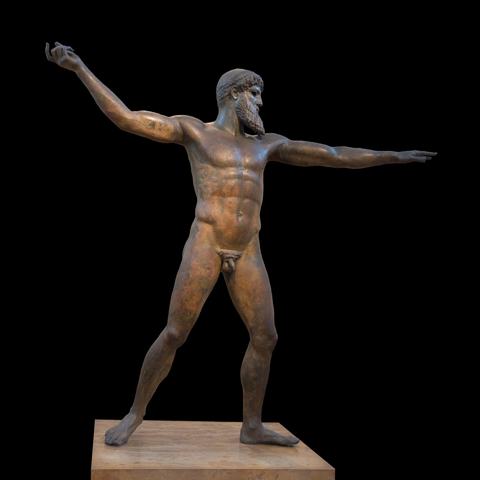
God of the sea, earthquakes and horses. Brother of Zeus, wielder of the trident, and the divine enemy who keeps Odysseus from reaching home.
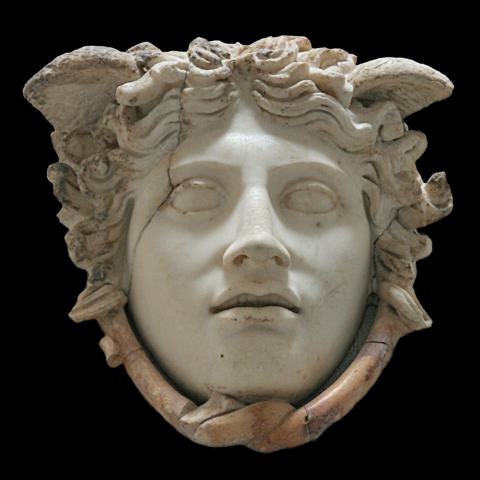
The Gorgon. The only mortal one of three sisters, whose gaze turned men to stone and whose severed head became the most powerful protective emblem in Greek art.
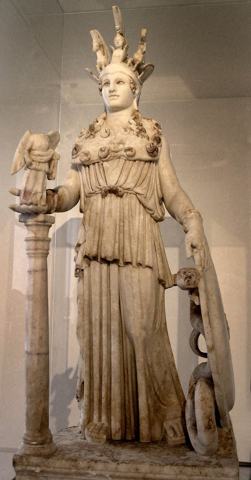
Goddess of wisdom, strategy and craft, born fully armed from the head of Zeus. Patron of Athens, of heroes, and of Odysseus above all.
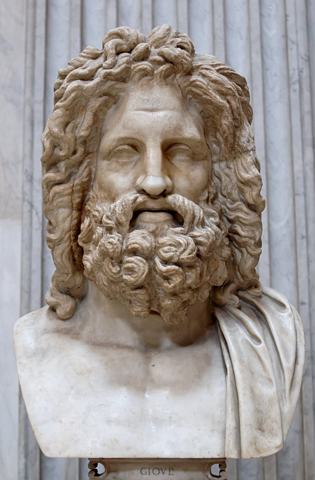
King of the gods and lord of the sky, thunder and justice. He overthrew his own father, divided the universe by lot, and guaranteed the laws of hospitality.
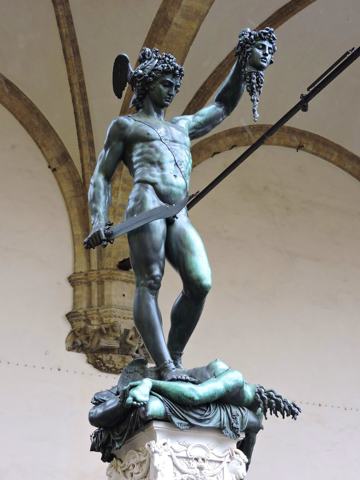
The hero who beheaded the Gorgon Medusa with borrowed weapons, rescued Andromeda from a sea-monster, and fulfilled the prophecy he spent his life escaping.
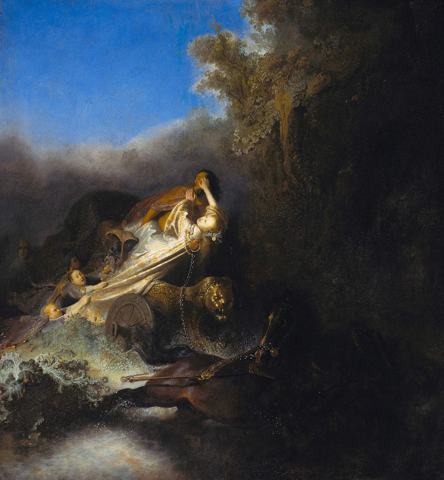
Lord of the underworld and of the wealth beneath the earth. Not a devil — a grim, lawful king whose only rule is that no one leaves.
Sources & Further Reading
- 1.Hesiod, Theogony (c. 700 BCE), lines 270-286.
- 2.Pindar, Olympian 13 (464 BCE).
- 3.Pindar, Isthmian 7 (454 BCE).
- 4.Apollodorus, Bibliotheca (1st-2nd century CE), 2.3.1-2.4.3.
- 5.Ogden, Daniel. Drakon — Dragon Myth and Serpent Cult in the Greek and Roman Worlds. Oxford University Press, 2013.
- 6.Gantz, Timothy. Early Greek Myth — A Guide to Literary and Artistic Sources. Johns Hopkins University Press, 1993.
Spot an error or have a source to suggest? Write to info@viseterna.com. We cite primary sources and modern scholarship, and we correct fast.