
Osiris
Lord of the afterlife — the murdered king remade as the first mummy, whose resurrection promised every Egyptian a life beyond the grave.
Osiris, Tomb of Nefertari (QV66), Valley of the Queens, c. 1255 BC · Public domain · source
The Name and the Image
Osiris is the Greek form of the Egyptian Wsir, a name written with a throne and an eye whose literal sense Egyptologists have never settled 6,7. He first appears by name in the Fifth Dynasty Pyramid Texts, the oldest body of religious writing to survive from Egypt, where the dead king is not merely protected by Osiris but becomes him — addressed as "Osiris the King" in spell after spell 1,8.
His image is fixed early and barely changes across three thousand years. He stands wrapped as a mummy, arms crossed over his chest, holding the crook and the flail; he wears the tall atef crown flanked by plumes; his skin is painted green or black 6. Neither colour is decorative. Green is vegetation and returning life, black is the silt the Nile flood leaves behind, and both belong to a god whose defining act is coming back 6,7. His other emblem, the djed pillar, was understood as his backbone, and its ceremonial "raising" enacted a dead god standing up again 6.
Murdered by Set
There is no single Egyptian narrative of the murder. Egyptian religious texts allude rather than tell, on the reasonable assumption that everyone already knew; the only continuous account is Plutarch's, written in Greek more than two millennia after the earliest allusions and shaped for a philosophical readership 5,7. The Egyptian sources supply the facts without the plot: Osiris is struck down by his brother Set, thrown into the water, and dismembered, and the Pyramid Texts repeatedly command that his scattered limbs be gathered and rejoined 1,8.
Plutarch fills in the story. Set measures a decorated chest to his brother's body, offers it as a party prize, and seals Osiris inside when he lies down in it; the chest is thrown into the Nile, drifts to Byblos on the Levantine coast, and is grown over by a tree that a local king cuts down for a palace pillar 5. Isis recovers it, but Set finds the body again and cuts it into fourteen pieces, scattering them across Egypt 5. Later Egyptian temple lists that assign a relic of Osiris to each province suggest the dismemberment motif was genuinely old, whatever Plutarch added to it 7.
The Reassembly and the Heir
The restoration is the theological centre of the whole cycle. Isis and her sister Nephthys, often shown as mourning kites, search out the pieces; Anubis treats and wraps the body, producing the first mummy and the pattern for every Egyptian burial afterwards 5,6. Isis then revives her husband just long enough to conceive Horus, the heir who will contest the throne with Set 1,5.
What Osiris does not do is resume his old life. He is restored to wholeness and to power, but as ruler of the dead rather than of the living — the Great Hymn on the stela of Amenmose praises him as a king whose crown passes to a living son while he himself governs the realm below 3,8. Egyptian doctrine thus keeps two things at once: death is real and permanent, and death is survivable 8.
Judge of the Dead
By the New Kingdom, Osiris presides over the tribunal that every dead Egyptian must pass. In Spell 125 of the Book of the Dead the deceased enters the Hall of the Two Truths, recites the "negative confession" — a list of offences not committed — and watches the heart weighed against the feather of Maat while Osiris sits enthroned at the end of the hall 4. Those who are "true of voice" join him; the rest are eaten by Ammit 4,6.
The reward is agricultural rather than ethereal. The justified dead farm the Field of Reeds, an idealised Egypt of tall barley and easy water, which is why shabti figurines were buried to do the labour on the owner's behalf 4,7. His domain is the Duat, the night country through which Ra also sails; the Book of the Dead and the royal netherworld books describe the union of the two gods, sun and corpse, as the moment that regenerates both 4,7.
Grain, Flood, and the Khoiak Festival
Osiris was tied to the agricultural year without ever being reduced to a harvest symbol. During the month of Khoiak, temples produced "corn mummies" — Osiris-shaped moulds of soil and barley, watered until the grain sprouted through the god's body — and the festival closed with the raising of the djed pillar 6,7. The annual inundation, the black silt, the sprouting of sown seed and the return of the god were all the same statement in different registers 7,8.
Abydos and the Pilgrim Cult
Abydos in Upper Egypt was his great cult centre. From the Middle Kingdom the First Dynasty tomb of King Djer at Umm el-Qa'ab was reidentified as the actual tomb of Osiris and became a destination for offerings 6,7. There Osiris absorbed the older local god Khenty-imentiu, "Foremost of the Westerners," taking over both his title and his temple 6.
The stela of Ikhernofret, an official of Senwosret III, records his role in staging the Abydos "mysteries": a procession carrying the god's image, a staged conflict in which the enemies of Osiris are defeated, the funeral, and the triumphant return to the temple 7. Pilgrims who could not be buried at Abydos set up cenotaph stelae there so as to be present at the festival forever 7. Seti I later built the Osireion behind his temple, a subterranean hall surrounded by water — an artificial primeval mound and tomb for the god 6.
Why He Mattered
Osiris turned funerary practice into a promise. In the Old Kingdom the identification was royal; by the Middle Kingdom the Coffin Texts extend it to anyone whose family could pay for a coffin and the spells written on it, and by the New Kingdom every provisioned burial makes its owner "the Osiris N." 2,8. Scholars now resist calling this a "democratisation of the afterlife," since access still depended on wealth and correct ritual rather than on any spread of rights 8. Still, the logic was open to all who could reach it: what happened to the god could happen to you, provided the body was preserved, the rites performed, and the heart came out true 4,8.
Continue Exploring
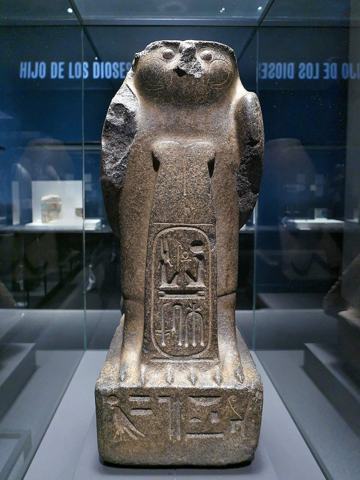
The sun itself as a god — Ra sails the sky by day, fights the serpent of chaos by night, and is reborn on the horizon every dawn.
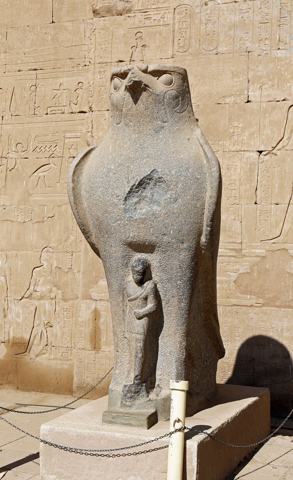
The sky falcon — god of kingship whose torn-out eye became the symbol of healing, and who won Egypt's throne from Set after eighty years of litigation.
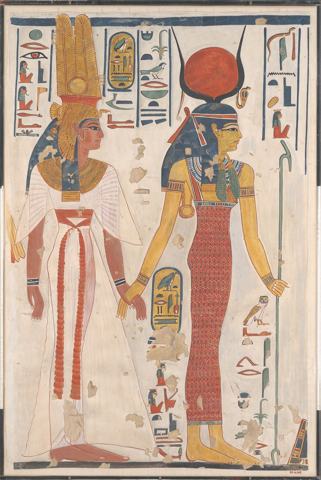
Goddess of magic — the widow whose spells restored Osiris, the mother who hid Horus in the marshes, and the one Egyptian deity Rome adopted whole.
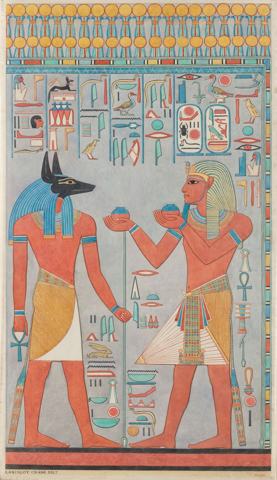
Guardian of the dead — the black jackal god who embalmed Osiris, watched over the necropolis, and weighed the heart against the feather of truth.
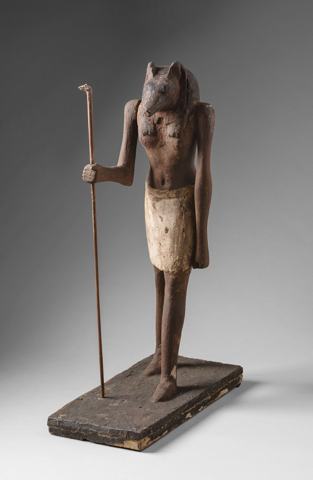
God of chaos — the red god of storm and desert who murdered Osiris, yet stood in the sun's boat each night to spear the serpent of nonexistence.
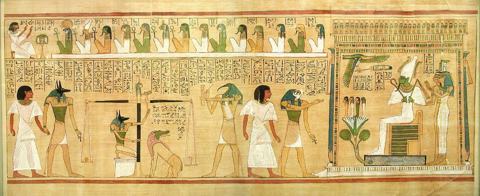
Egypt's judgment of the dead: the heart set on a scale against the feather of Maat, with oblivion waiting for whichever side tips wrong.
Also mentioned inAmmitAnkh (Egyptian Symbol of Life)Bennu (Egyptian Phoenix)Eye of Horus (Wedjat)HathorKa and Ba (the Egyptian Soul)Khepri (the Scarab God)NephthysNut and Geb (Egyptian Sky and Earth)PtahSobekThe DuatThe Ennead of HeliopolisThe Opening of the Mouth CeremonyThe Pyramid TextsThoth
Sources & Further Reading
- 1.Pyramid Texts (Old Kingdom, c. 2400–2300 BCE).
- 2.Coffin Texts (Middle Kingdom, c. 2100–1800 BCE).
- 3.The Great Hymn to Osiris, stela of Amenmose (Louvre C 286, Eighteenth Dynasty).
- 4.The Egyptian Book of the Dead (Book of Going Forth by Day), New Kingdom — esp. Spells 17 and 125.
- 5.Plutarch, On Isis and Osiris (Moralia, 1st–2nd century CE).
- 6.Wilkinson, Richard H. The Complete Gods and Goddesses of Ancient Egypt. Thames & Hudson, 2003.
- 7.Pinch, Geraldine. Egyptian Mythology: A Guide to the Gods, Goddesses, and Traditions of Ancient Egypt. Oxford University Press, 2002.
- 8.Assmann, Jan. Death and Salvation in Ancient Egypt. Cornell University Press, 2005.
Spot an error or have a source to suggest? Write to info@viseterna.com. We cite primary sources and modern scholarship, and we correct fast.