
The Duat
The Egyptian underworld — the night country crossed by the sun in twelve hours and by every dead Egyptian hoping to come out reborn at dawn.
Sennedjem and Iineferti in the Fields of Iaru, Deir el-Medina, c. 1295-1213 BC; facsimile by Charles K. Wilkinson (Metropolitan Museum of Art), CC0 · CC0 · source
What the Word Means
Duat (also written Dat, and often anglicised "Tuat") is the Egyptian name for the realm the dead enter, and it is written with a star inside a circle 7,8. That sign is a warning against translating it too quickly as "underworld." Egyptian texts place the Duat under the earth, in the western desert, in the body of the sky goddess Nut, and among the stars, sometimes in the same document 6,8.
The reason is that the Duat is defined by when, not by where. It is the region the sun occupies between setting and rising — the other half of the daily circuit, out of sight of the living 6,7. Everything that happens in it happens at night, and everything in it is arranged around the sun's passage through it 6.
The Twelve Hours
The fullest descriptions come from the royal tombs of the New Kingdom, where whole compositions were painted across the burial chamber walls for the king's use 6. The oldest and most systematic is the Amduat, "the Book of What Is in the Underworld," which divides the night into twelve hours and gives each hour a map, a cast of inhabitants, and a set of names 4,6.
Ra enters the west at sunset and travels the hours in his barque, no longer the blazing disk but a ram-headed figure in a shrine, escorted by gods who tow the boat through regions of sand, water and fire 4,6. In the sixth hour comes the event on which the whole system turns: the sun's ba unites with the corpse of Osiris, and the two regenerate each other — the dead god receives life, the tiring sun receives renewal 4,6. In the seventh hour the serpent Apophis blocks the channel and must be defeated so the journey can continue 4,5. At the twelfth the boat is dragged through the body of a giant serpent and the god emerges at dawn as the scarab Khepri, newly born 4,6.
The related Book of Gates organises the same night around twelve gates, each guarded by a serpent and a name that must be known, and includes a famous register showing four groups of humanity — Egyptians, Nubians, Libyans and Asiatics — all under the sun god's care 5,6.
The Dead Traveller
For everyone who was not the king, the Duat was a route to be navigated with the right equipment. The Middle Kingdom Book of Two Ways, painted on coffin floors from Deir el-Bersha, is effectively the oldest illustrated map in the world: a blue waterway and a black land route running through the netherworld, separated by a lake of fire, with the perils annotated along the way 2,6.
New Kingdom funerary papyri turn this into a system of passwords. Spells 144 to 147 of the Book of the Dead list the gates and mounds of the Duat with the names of their keepers, because knowing a being's true name gives authority over it 3,7. Other spells ward off crocodiles, snakes, nets, decapitation, and the humiliations the dead most feared — walking upside down, eating excrement, forgetting one's own name 2,3,8.
Its population is genuinely strange. Alongside the great gods stand knife-wielding guardians, fire-spitting cobras, executioner demons, ropes and lakes and doorways that are themselves alive 6,8. Egyptian artists drew them plainly and captioned them, treating the underworld as documented terrain rather than as an atmosphere 6.
Judgment at the Centre
Somewhere in that passage stands the Hall of the Two Truths, where the heart is weighed against the feather of Maat and Osiris gives his verdict 3. Anubis steadies the balance; the hybrid Ammit waits to swallow the heart of anyone who fails; the vindicated are declared "true of voice" and admitted 3.
There is no eternal torment on the far side of a failed judgment. The condemned are destroyed — annihilated in the "place of destruction," their names and memories ended — which Egyptians regarded as far worse than any punishment that let you continue to exist 7,8.
The Field of Reeds
The reward at the end of the road is described in Spell 110: the Field of Reeds (Sekhet-iaru), an idealised Egypt of tall barley, straight canals and reliable water, where the justified dead plough, sow and harvest 3,7. It is a farmer's paradise rather than an ethereal one, which is exactly why tombs were stocked with shabti figurines — small mummiform servants inscribed with a spell obliging them to answer if the owner is ever called up for agricultural work in the next world 3,7.
That combination is characteristically Egyptian. The afterlife is a better version of this life, run on the same terms, with the labour outsourced.
How We Know Any of This
The Duat is unusually well documented because Egyptians wrote its geography down and buried it with people. The Pyramid Texts of the late Old Kingdom, the Coffin Texts of the Middle Kingdom, and the Book of the Dead of the New Kingdom form a continuous tradition, each partly rewriting the last, and the royal netherworld books add the illustrated versions painted in the Valley of the Kings 1,2,3,6.
Hornung's survey of these compositions makes the essential point about them: they are not literature about the afterlife but equipment for it, copied and adapted for particular owners, and their contradictions were never a problem to be fixed 6. The sun sets in the west and rises in the east, and whatever happens in between happens in the Duat — described from several angles at once, in the confident manner of people writing about a place they fully expected to visit 6,8.
Continue Exploring
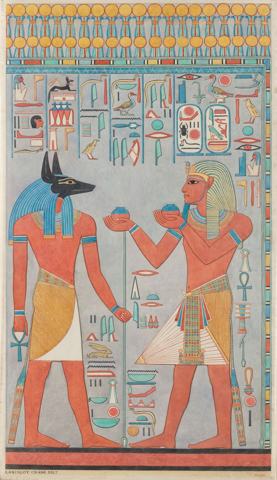
Guardian of the dead — the black jackal god who embalmed Osiris, watched over the necropolis, and weighed the heart against the feather of truth.
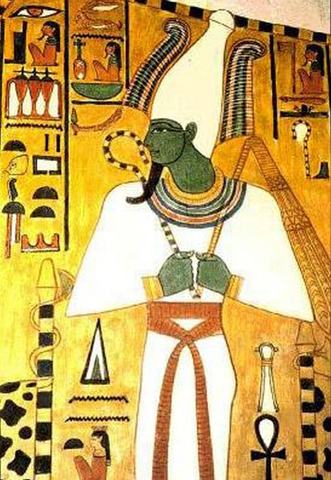
Lord of the afterlife — the murdered king remade as the first mummy, whose resurrection promised every Egyptian a life beyond the grave.
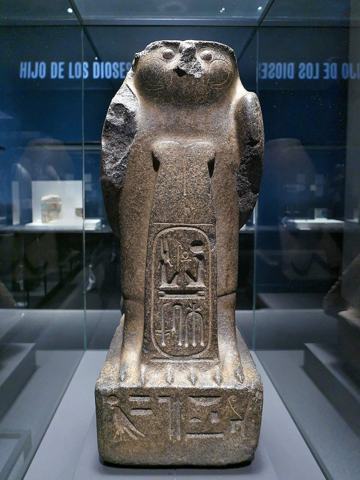
The sun itself as a god — Ra sails the sky by day, fights the serpent of chaos by night, and is reborn on the horizon every dawn.
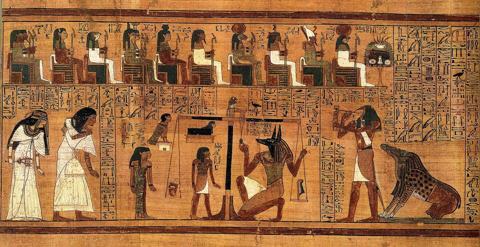
Devourer of the dead — the crocodile-lion-hippopotamus hybrid who crouched beside the scales and swallowed the hearts that failed the weighing.
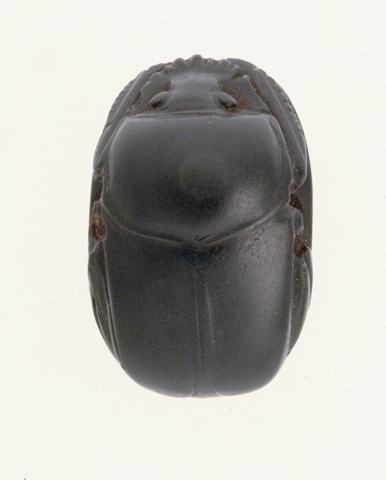
The self-created scarab god who pushes the morning sun into the sky, and whose beetle form became ancient Egypt's most common amulet of rebirth.
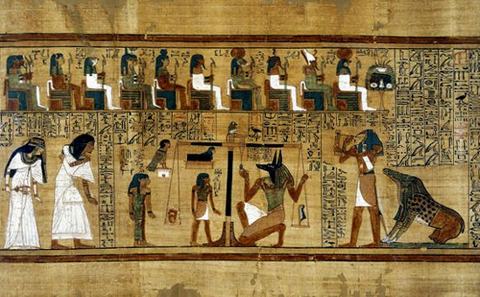
The New Kingdom funerary spells the Egyptians called "Going Forth by Day" — copied for the dead, and renamed the Book of the Dead by Lepsius in 1842.
Also mentioned inApophis (Apep)Bennu (Egyptian Phoenix)Ka and Ba (the Egyptian Soul)The Opening of the Mouth CeremonyThe Weighing of the Heart
Sources & Further Reading
- 1.Pyramid Texts (Old Kingdom, c. 2400–2300 BCE).
- 2.Coffin Texts (Middle Kingdom, c. 2100–1800 BCE), including the Book of Two Ways.
- 3.The Egyptian Book of the Dead (Book of Going Forth by Day), New Kingdom — esp. Spells 17, 110, 125, 144–147.
- 4.The Amduat (Book of What Is in the Underworld), New Kingdom royal tombs.
- 5.The Book of Gates, New Kingdom.
- 6.Hornung, Erik. The Ancient Egyptian Books of the Afterlife. Cornell University Press, 1999.
- 7.Taylor, John H. Death and the Afterlife in Ancient Egypt. British Museum Press, 2001.
- 8.Pinch, Geraldine. Egyptian Mythology: A Guide to the Gods, Goddesses, and Traditions of Ancient Egypt. Oxford University Press, 2002.
Spot an error or have a source to suggest? Write to info@viseterna.com. We cite primary sources and modern scholarship, and we correct fast.