
Horus
The sky falcon — god of kingship whose torn-out eye became the symbol of healing, and who won Egypt's throne from Set after eighty years of litigation.
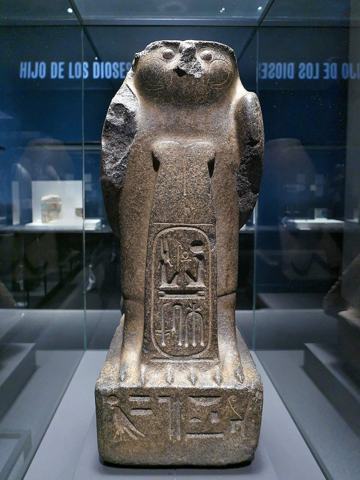
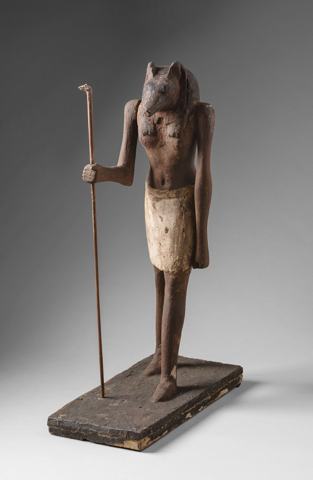
Statue of Horus, Temple of Edfu, Ptolemaic period; photo Marc Ryckaert, CC BY-SA 4.0 · CC BY-SA 4.0 · source
One Name, Many Gods
"Horus" is the Greek form of Egyptian Heru or Hor, a name usually connected with the idea of distance or height — the one far above 7,8. He is a falcon, and the falcon's eyes are the sun and the moon; when a text says the god's eye is dimmed or wounded, it is describing an eclipse, a waning moon, or a disorder in the world 7,8.
He is also not one god but a family of related falcon deities whose identities merged and split over three thousand years 7,8. Horus the Elder (Haroeris) is a primeval sky god and Set's brother. Horus son of Isis (Harsiese) is Osiris's posthumous heir and Set's nephew. Horus of the Horizon fuses with the sun as Ra-Horakhty. Horus of Behdet is the winged disk carved above temple doorways across Egypt 7. Egyptian theology never tried to reconcile them; the same name could carry several theologies at once without embarrassment 8.
The Child in the Marshes
The best-known Horus is the son of Osiris and Isis, conceived after his father's murder and hidden in the papyrus swamps of Chemmis while Set hunted them 5,8. That childhood is a catalogue of dangers survived: snakebite, scorpion stings, fever, hunger. Egyptians used it as medicine. The "cippi of Horus" — small stelae showing the naked child gripping snakes, scorpions and crocodiles — were doused with water that the sick then drank, on the logic that what once cured the god would cure the patient 8.
The Greeks met this figure as Harpocrates, from Hor-pa-khered, "Horus the child." His conventional gesture, a finger at the lips meaning childhood, was misread as a sign for silence, and he became a god of secrets in Greco-Roman art, a career built entirely on a mistranslation 7,8.
The Eye of Horus
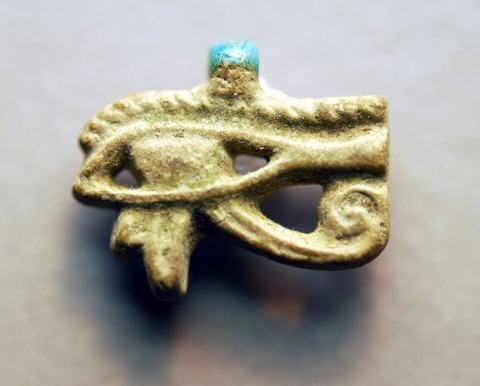
In the fight with Set, Horus loses an eye — torn out, in the usual telling, and in some versions swallowed or trampled 1,6. Thoth finds and restores it, and the restored eye, the wedjat, becomes the standard Egyptian emblem of wholeness, protection and healing: painted on coffins, worn as amulets, and set on the prows of boats 4,7.
Its most important use is ritual. The healed eye is what Horus presents to his dead father, and Egyptian offering formulae therefore describe every offering as the Eye of Horus being given to Osiris — the funerary meal restated as a son restoring his father 1,2,7. A long-repeated modern claim that the parts of the wedjat sign encode the fractions of the grain measure is now doubted by specialists, who read the resemblance as later scribal wordplay rather than the origin of the symbol 8.
The Contendings of Horus and Seth
The dispute over Osiris's throne is the longest surviving Egyptian narrative about the gods, preserved on Papyrus Chester Beatty I from about 1160 BCE, and it is far stranger than its solemn reputation 3,6. The tribunal of the Ennead has been hearing the case for eighty years without a verdict: Horus has the better claim as the son of the dead king, Set the better case as a proven fighter strong enough to defend the sun 3.
What follows is part law report, part farce. The gods write to the goddess Neith for an opinion, and she advises awarding the throne to Horus while compensating Set with foreign goddesses 3. Isis disguises herself to trick Set into condemning his own case, and Horus beheads her in a rage when she shows his rival mercy 3. Set attempts to humiliate Horus sexually; Isis turns the plot around so that the seed rebounds onto Set, and the trick is exposed in open court when the contested semen answers from inside Set's own body 3. The two race boats supposedly made of stone, and Set's — actually stone — sinks 3. Only after Osiris himself sends a letter from the underworld, pointedly asking who feeds the gods, does the court find for Horus, while Set is taken up to the sky to thunder for Ra 3.
Griffiths showed that the tale is a late, literary assembly of much older material, and that the earliest layers in the Pyramid Texts already contain the essentials: the wounded eye, Set's lost testicles, and the tribunal that decides between them 6.
Horus and the Living King
The political point of all this was never hidden. From the First Dynasty the pharaoh's oldest title is his Horus name, written inside a serekh — a palace facade with a falcon perched on top — declaring the living king to be the god present on earth 7,8. On his death the king becomes Osiris, and his successor becomes Horus. Every accession therefore replayed the myth, and the legitimacy of the entire Egyptian monarchy rested on a story about a son avenging his father 7,8.
Horus's four sons — Imsety, Hapy, Duamutef and Qebehsenuef — guarded the internal organs removed in mummification, and their heads top the canopic jars found in tombs from the New Kingdom onward 4,7.
Nekhen, Edfu, and the Harpoon
His oldest major cult centre was Nekhen in Upper Egypt, which the Greeks called Hierakonpolis, "falcon city," a site already important before the unification of Egypt 7. His best-preserved temple, and one of the most complete anywhere in Egypt, is the Ptolemaic sanctuary at Edfu, whose walls carry the fullest surviving version of the myth-cycle in ritual form 7,8.
The Edfu texts describe an annual drama, the "Triumph of Horus," in which the god harpoons a hippopotamus representing Set ten times over, the beast is symbolically cut up, and the parts are distributed 8. The performance ends with the enemy destroyed and the king confirmed — the same claim the Chester Beatty papyrus makes in comic form, delivered here as state liturgy 3,8.
Continue Exploring
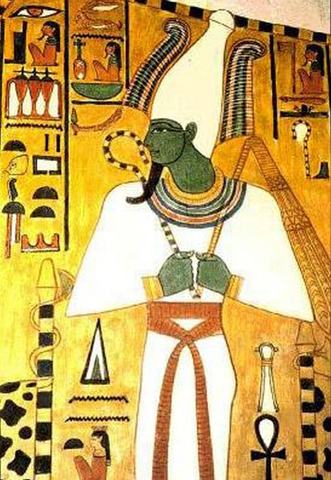
Lord of the afterlife — the murdered king remade as the first mummy, whose resurrection promised every Egyptian a life beyond the grave.
The sun itself as a god — Ra sails the sky by day, fights the serpent of chaos by night, and is reborn on the horizon every dawn.
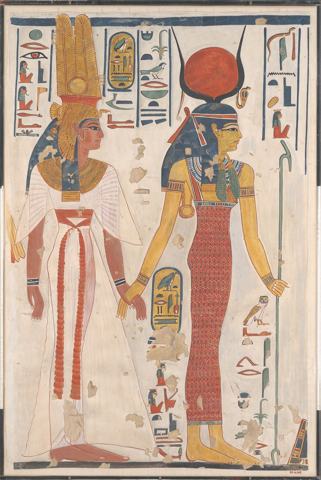
Goddess of magic — the widow whose spells restored Osiris, the mother who hid Horus in the marshes, and the one Egyptian deity Rome adopted whole.
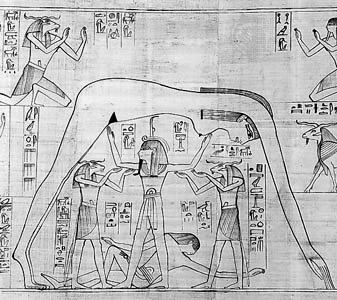
The nine gods of Heliopolis's creation myth, from self-made Atum down to Osiris, Isis and Set — and the tribunal that judged their heirs.
God of chaos — the red god of storm and desert who murdered Osiris, yet stood in the sun's boat each night to spear the serpent of nonexistence.
The healed eye of Horus, ancient Egypt's emblem of offering and protection — and the source of a math myth modern scholars have debunked.
Also mentioned inAnkh (Egyptian Symbol of Life)Bes (Egyptian Household Protector)HathorKarnak Temple ComplexSobekThe Great Sphinx of GizaThe Weighing of the HeartThoth
Sources & Further Reading
- 1.Pyramid Texts (Old Kingdom, c. 2400–2300 BCE).
- 2.Coffin Texts (Middle Kingdom, c. 2100–1800 BCE).
- 3.Papyrus Chester Beatty I, The Contendings of Horus and Seth (Ramesside, c. 1160 BCE).
- 4.The Egyptian Book of the Dead (Book of Going Forth by Day), New Kingdom.
- 5.Plutarch, On Isis and Osiris (Moralia, 1st–2nd century CE).
- 6.Griffiths, J. Gwyn. The Conflict of Horus and Seth from Egyptian and Classical Sources. Liverpool University Press, 1960.
- 7.Wilkinson, Richard H. The Complete Gods and Goddesses of Ancient Egypt. Thames & Hudson, 2003.
- 8.Pinch, Geraldine. Egyptian Mythology: A Guide to the Gods, Goddesses, and Traditions of Ancient Egypt. Oxford University Press, 2002.
Spot an error or have a source to suggest? Write to info@viseterna.com. We cite primary sources and modern scholarship, and we correct fast.