
Eye of Horus (Wedjat)
The healed eye of Horus, ancient Egypt's emblem of offering and protection — and the source of a math myth modern scholars have debunked.
Wedjat-eye amulet, Egyptian faience (Metropolitan Museum of Art) · CC0 · source
A Wound Made Whole
In the long dynastic struggle between Horus and his uncle Set over the throne of Egypt, Set tears out one of Horus's eyes — in most tellings the left, the eye associated with the moon — and in some versions swallows or tramples what he has torn away 1,3. Thoth, god of writing and reckoning, recovers and heals it, and it is the healed eye, not the wound, that Egyptian religion made its emblem 1,3,7. The Egyptian name for it, wedjat, means "the sound one" or "the whole one," and the sign itself is a stylised human eye set beneath a falcon's cheek-marking and eyebrow, since Horus in his oldest form is a falcon god 1,7.
The Standard Gift to the Dead
Long before it became a piece of jewellery, the wedjat was a formula. Egyptian offering texts routinely describe whatever is being given — bread, beer, incense, an entire funeral service — as "the eye of Horus," presented by the living son to his dead father exactly as Horus once presented his restored eye to Osiris 1,2. The equation runs in both directions: an offering makes a god or a dead man whole the way Horus's eye was made whole, and the wedjat painted on a coffin, carved over a tomb door, or set on the prow of a temple barque advertises that the object or place it marks is protected and complete 2,7.
Wearing the Eye
As jewellery the wedjat is one of the most common surviving Egyptian amulet types, produced from the Middle Kingdom onward in faience, gold, carnelian, and lapis lazuli, strung singly or in pairs, and worn by the living for protection as readily as it was placed among grave goods 4. In mummification it had a specific job as well as a general one: an amulet in this shape was regularly laid over the incision cut into the body's left flank to remove the internal organs, standing in for the wound the embalmers themselves had made and asking, in effect, for the same restoration Horus had received 4,5.
The Fractions That Were Never There
A claim still repeated in popular writing holds that the wedjat's component strokes were designed to encode the fractions used to measure grain by the hekat — a half, a quarter, an eighth, down to a sixty-fourth, with the missing sixty-fourth supplied by Thoth's magic to make the sum whole. It is a tidy story, and it is not how the symbol was made. The idea was first proposed in 1911 from a visual resemblance between the eye's parts and a set of hieratic capacity-measure signs; a detailed re-examination by the historian of mathematics Jim Ritter showed that those signs are older than, and independent of, the wedjat itself, originating as ordinary administrative notation rather than as pieces of a sacred eye later assembled into a fraction table 6. No surviving Egyptian text explains the sign this way, and Ritter's account is now the standard view: the resemblance between the eye and the fraction signs is a later scribal convenience, not the eye's origin or a real ancient system of measurement encoded in myth 6.
Judgment and the Living King
The eye's damage and repair sit at the centre of The Contendings of Horus and Seth, the long Ramesside narrative in which a tribunal of gods spends eighty years failing to decide whether Horus or Set should inherit the throne; the wounded eye and Set's own mutilation are treated in the earliest sources as the concrete evidence the court must weigh 3,8. Griffiths traces the pairing of a healed eye with a settled succession back to the Old Kingdom Pyramid Texts, long before the comic Ramesside version was composed, which suggests the symbol of restored kingship came first and the entertaining court case was built around it later rather than the reverse 8.
An Emblem That Outlasted the Religion
The wedjat survived the religion that produced it. It appears on Ptolemaic and Roman-period amulets long after independent Egyptian temple cult had faded, and it has had a long second life as jewellery and tattoo art disconnected from its funerary and ritual origins, much like the Ankh 4,7. What ancient Egyptians actually wore it for was narrower and more specific than either modern decoration or the fraction myth suggests: a promise, repeated on a body or a coffin or a temple wall, that whatever had been torn away would be made whole again 2,7.
Continue Exploring
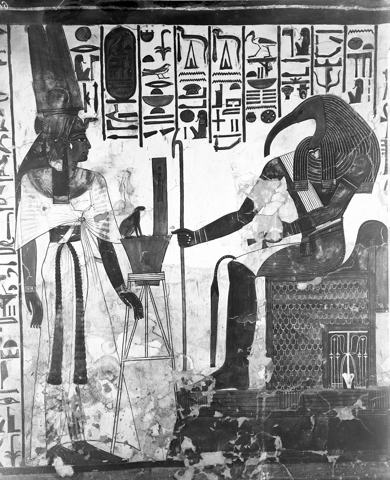
Ibis-headed lord of writing, reckoning and the moon — Thoth keeps the record at the judgment of the dead and settles the quarrels of the gods.
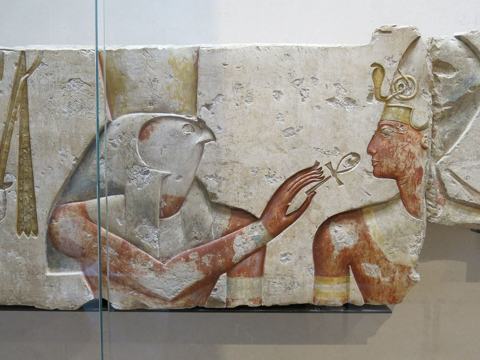
The looped cross Egyptian gods hand to kings on every temple wall, the hieroglyph for life itself, worn as an amulet for three thousand years.
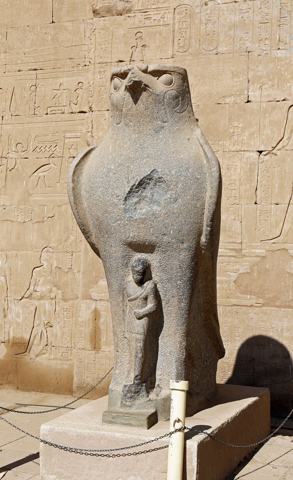
The sky falcon — god of kingship whose torn-out eye became the symbol of healing, and who won Egypt's throne from Set after eighty years of litigation.
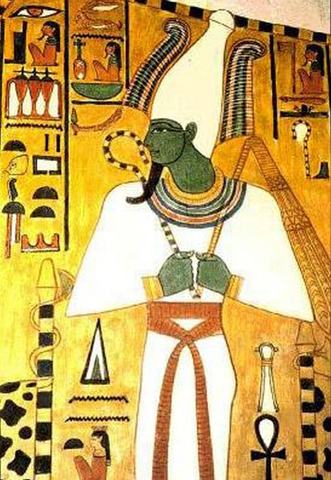
Lord of the afterlife — the murdered king remade as the first mummy, whose resurrection promised every Egyptian a life beyond the grave.
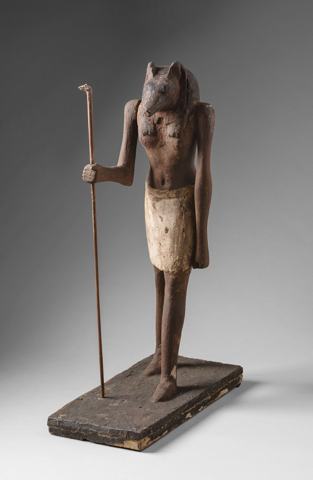
God of chaos — the red god of storm and desert who murdered Osiris, yet stood in the sun's boat each night to spear the serpent of nonexistence.
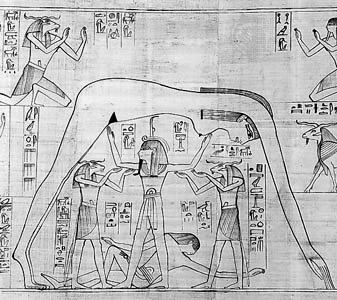
The nine gods of Heliopolis's creation myth, from self-made Atum down to Osiris, Isis and Set — and the tribunal that judged their heirs.
Sources & Further Reading
- 1.Pyramid Texts (Old Kingdom, c. 2400–2300 BCE).
- 2.The Egyptian Book of the Dead (Book of Going Forth by Day), New Kingdom.
- 3.Papyrus Chester Beatty I, The Contendings of Horus and Seth (Ramesside, c. 1160 BCE).
- 4.Andrews, Carol. Amulets of Ancient Egypt. British Museum Press, 1994.
- 5.Pinch, Geraldine. Magic in Ancient Egypt. British Museum Press, 1994.
- 6.Ritter, Jim. "Closing the Eye of Horus: The Rise and Fall of 'Horus-Eye Fractions.'" In Under One Sky: Astronomy and Mathematics in the Ancient Near East, edited by John M. Steele and Annette Imhausen, 297-323. Munster: Ugarit-Verlag, 2002.
- 7.Wilkinson, Richard H. The Complete Gods and Goddesses of Ancient Egypt. Thames & Hudson, 2003.
- 8.Griffiths, J. Gwyn. The Conflict of Horus and Seth from Egyptian and Classical Sources. Liverpool University Press, 1960.
Spot an error or have a source to suggest? Write to info@viseterna.com. We cite primary sources and modern scholarship, and we correct fast.