
Hathor
Cow-horned goddess of love, music and joy — Hathor is the sky that carries the sun, the mother of kings, and the one who meets the dead in the west.
Hathor welcoming Seti I, painted limestone relief from the tomb of Seti I, c. 1290-1279 BCE (Musee du Louvre, N 124); photo Shonagon, 2022 · CC0 · source
The House of Horus
Her Egyptian name, Hwt-Hor, reads literally as "House of Horus" — and the "house" is the sky itself, the enclosure in which the falcon Horus flies, or, on another reading, the womb that carries him 5,6. Both senses run through everything she does. Hathor is the sky as a great cow whose belly is spangled with stars and between whose horns the sun rides; she is the mother of the falcon-king, and therefore the mother and nurse of the living pharaoh; and she is the container in which things are born and held.
She appears in three main forms: as a cow, as a woman with a cow's head, and — most often — as a woman crowned with a pair of cow horns cradling the sun disk. She carries the sistrum, the rattle whose shaking drove off hostile forces, and the menat, a heavy beaded counterpoise worn at the neck and offered to worshippers to transmit her power 5,7. Her face, frontal and cow-eared, was made into a capital form of its own: the Hathoric column, which turns an entire temple portico into a row of the goddess looking straight out at the visitor.
Joy, Love and Intoxication
Hathor's domain is pleasure, understood as a serious religious category. Music, dance, wine and beer, perfume, garlands, sexual love and fertility all belong to her, and her festivals were loud 5,6,7. Egyptian love poetry of the New Kingdom addresses her as the power that brings lovers together, and the Greeks, arriving with their own categories, identified her without hesitation as Aphrodite 5.
The most famous single image of that side of her comes from a court intrigue. In The Contendings of Horus and Seth, Ra is insulted by another god, sulks, and lies down on his back refusing to preside over the tribunal; Hathor comes in, exposes herself to him, and he laughs and goes back to work 3. The episode is often treated as comic relief, but it makes a theological argument as well: it is Hathor's power to restore the sun god's good humour, and a sun god in a good humour is what keeps the world running 3,6.
The Eye of Ra and the Distant Goddess
That role has a dangerous obverse. Hathor is one of the goddesses identified with the Eye of Ra, the sun god's fierce daughter sent out to punish, and in the Book of the Heavenly Cow she is the one dispatched against rebellious humanity — becoming Sekhmet in the act, drinking the ochre-reddened beer, and waking pacified back into Hathor 2,5. The associated cycle of the Distant Goddess, elaborated in later temple texts, has her withdraw in a rage to Nubia and return only when coaxed home with music, dance, and drink, at which point Egypt celebrates 4,6.
This is why Hathor's festivals of drunkenness are not incidental to her cult. Getting the goddess drunk is how the myth ends well. Scholars have long emphasised that Egyptian religion did not think of the loving and the murderous goddess as separate beings so much as one power in two states, and Hathor is the clearest case in the whole pantheon 6,7.
Mistress of the West, Lady of Foreign Lands
Hathor also meets the dead. In the Theban necropolis she is Mistress of the West, and tomb paintings show her as a cow stepping out of the western mountain to receive the deceased, or as the Lady of the Sycamore leaning from a tree to offer bread and water to the newly arrived 5,6. To "become a Hathor" was a way of describing a woman's transfigured state after death, parallel to a man becoming an Osiris 6.
Her reach extended outside Egypt as well. She was Lady of Turquoise at the Sinai mining settlement of Serabit el-Khadim, where generations of expeditions left votive stelae in her temple; Lady of Byblos on the Lebanese coast; and a patron of the incense trade with Punt 5,6. The pattern — a goddess of the frontier and of precious materials pulled out of the ground — fits her association with gold, which the Egyptians called the flesh of the gods.
A further, less predictable role is prophetic. The Seven Hathors appear at a child's birth to pronounce its fate, and they turn up in literary tales, notably the New Kingdom story of the doomed prince, where their pronouncement sets the plot in motion 6.
Dendera and Her Cult
Hathor's great sanctuary was Iunet, modern Dendera, in Upper Egypt. The temple standing there today is a Ptolemaic and Roman rebuilding of a much older foundation, and it preserves her cult in unusual detail: Hathoric columns through the hypostyle hall, crypts for the storage of divine images, a sanatorium for pilgrims seeking healing, and staircases used in the New Year procession that carried the goddess's statue to the roof to be united with the rays of the sun 4,5.
The most theatrical rite was the Festival of the Beautiful Reunion. Once a year Hathor's image left Dendera by river and travelled south to Edfu, to the temple of Horus, for a stay of some days before returning — a divine marriage celebrated with processions, offerings and public festivity along the whole route 4,5. C. J. Bleeker's study of the goddess reads this as the ritual centre of her theology: Hathor is defined by relationship, to Horus as consort, to Ra as daughter and eye, to the king as mother, and to the dead as host 7.
Ordinary Egyptians left her small offerings in enormous numbers — model sistra, cow figurines, mirrors, painted cloth — which makes her one of the best-attested deities in Egyptian personal piety as well as one of the grandest in state religion 5,6.
Continue Exploring
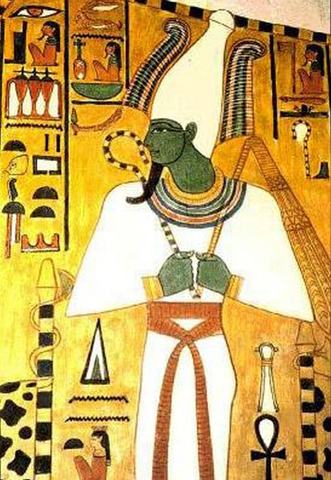
Lord of the afterlife — the murdered king remade as the first mummy, whose resurrection promised every Egyptian a life beyond the grave.
The sun itself as a god — Ra sails the sky by day, fights the serpent of chaos by night, and is reborn on the horizon every dawn.
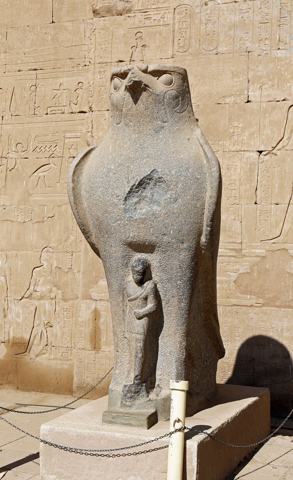
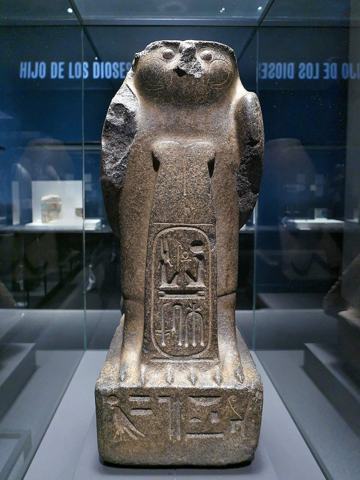
The sky falcon — god of kingship whose torn-out eye became the symbol of healing, and who won Egypt's throne from Set after eighty years of litigation.
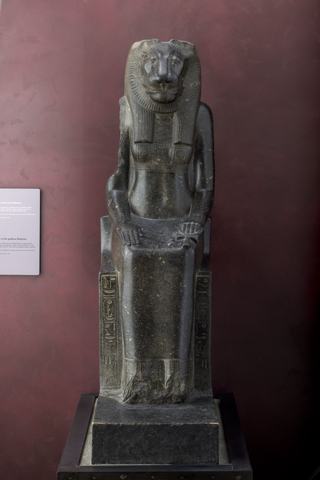
The lion-headed Eye of Ra — Sekhmet is slaughter, fever and desert heat, and the same power that heals when the gods can persuade her to stop.
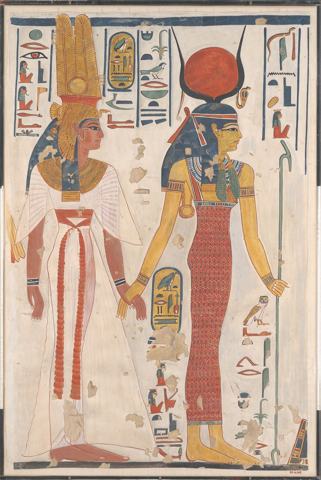
Goddess of magic — the widow whose spells restored Osiris, the mother who hid Horus in the marshes, and the one Egyptian deity Rome adopted whole.
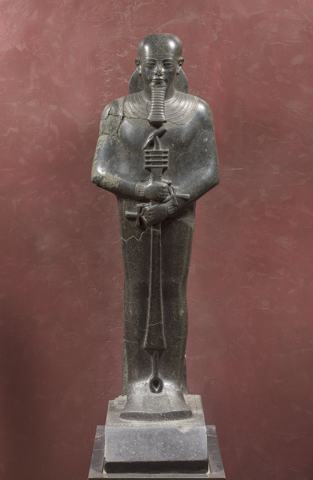
The creator who made the world by thinking it and speaking it — Ptah of Memphis, patron of sculptors and architects, and lord of the Apis bull.
Sources & Further Reading
- 1.Pyramid Texts (Old Kingdom, c. 2400–2300 BCE).
- 2.The Book of the Heavenly Cow (New Kingdom; the Destruction of Mankind).
- 3.The Contendings of Horus and Seth (Papyrus Chester Beatty I, 20th Dynasty).
- 4.Temple inscriptions of Dendera (Ptolemaic and Roman periods), including the Festival of the Beautiful Reunion.
- 5.Wilkinson, Richard H. The Complete Gods and Goddesses of Ancient Egypt. Thames & Hudson, 2003.
- 6.Pinch, Geraldine. Egyptian Mythology: A Guide to the Gods, Goddesses, and Traditions of Ancient Egypt. Oxford University Press, 2002.
- 7.Bleeker, C. J. Hathor and Thoth: Two Key Figures of the Ancient Egyptian Religion. Brill, 1973.
Spot an error or have a source to suggest? Write to info@viseterna.com. We cite primary sources and modern scholarship, and we correct fast.