
Sobek
Crocodile god of the Nile, the marshes and raw pharaonic power — Sobek is the danger in the water turned into a protector, worshipped with living crocodiles.
Relief of Sobek, Temple of Kom Ombo, Upper Egypt; photograph by Hedwig Storch, 2009 · CC BY-SA 3.0 · source
The Danger in the Water
Sobek — Egyptian Sbk, Greek Souchos — is the Nile crocodile made a god. He is shown either as the animal itself, often lying on a shrine or plinth, or as a man with a crocodile's head, usually wearing a crown that combines a sun disk, tall plumes and ram's horns 6,8. The Egyptians had every reason to take the crocodile seriously. It killed people at the water's edge with regularity, and the standard religious response was not to pretend otherwise but to make the killer a patron: a god who can drown you is a god who can be asked not to 6,7.
The result is a deity of unusual doubleness. Sobek is aggression, appetite and fertility all at once — the churning of the water, the abundance of the marsh, and the vigour of the king. Hymns praise him as lord of the waters and of the reed beds, and his epithets pile up the vocabulary of raw physical power 6,8.
Origins in the Texts
He is attested from the Old Kingdom. The Pyramid Texts already speak of Sobek as the son of the creator-goddess Neith of Sais, and identify the dead king with him — "Sobek, green of plume, lord of the winding waterway", surfacing from the flood with sight restored and limbs whole 1,6. Other passages have him emerging from the primeval waters of Nun and laying his eggs on the bank, a creation image drawn straight from crocodile behaviour along the Nile 2,7.
Because the crocodile belongs to the water and the water is where things dissolve, Sobek could also be read as a threat to the dead, and the Coffin Texts contain spells to fend off crocodiles in the netherworld 2,7. He is sometimes associated with Set in this darker aspect; but the more common resolution is the one Egyptian theology reaches everywhere, joining the god to the sun. As Sobek-Ra he becomes a solar deity in his own right, and one tradition credits a crocodile with retrieving the body of Osiris from the water — the predator recast as the recoverer 6,7.
Kings Named for a Crocodile
Sobek's political high point came in the Middle Kingdom, when the Twelfth Dynasty invested heavily in draining and irrigating the Faiyum depression and made its principal god a national figure. The name shows up in the royal titulary from that period onward: Sobekneferu, "the beauties of Sobek", the woman who ruled at the end of the Twelfth Dynasty and is generally regarded as the first securely attested female pharaoh, and a long line of Thirteenth Dynasty kings called Sobekhotep, "Sobek is content" 6,8.
New Kingdom rulers kept up the association. The calcite double statue from Dahamsha now in the Luxor Museum shows Amenhotep III seated beside a crocodile-headed Sobek who extends the ankh toward the king's face — a compact statement of the arrangement, in which the god's ferocity underwrites the king's 6.
Shedet, Kom Ombo, and the Living Crocodiles
Sobek's chief cult city was Shedet in the Faiyum, which the Greeks called Crocodilopolis and the Ptolemies renamed Arsinoe. His other great temple stands at Kom Ombo in Upper Egypt, an unusual double sanctuary shared with Haroeris — Horus the Elder — where the building is mirrored along its axis so that each god has his own gateway, hypostyle and sanctuary 6,8. Further cult sites clustered at Gebelein, Sumenu and across the Delta, and Holger Kockelmann's study emphasises how many local Sobeks there were, each with his own lake, epithets and priesthood, rather than a single centrally defined god 8.
Classical visitors were fascinated by the living animals. Herodotus reports that Egyptians in the region of Lake Moeris and at Thebes kept crocodiles as sacred, tamed them, hung ornaments of glass and gold in their ears, put bracelets on their forefeet, fed them prescribed rations, and embalmed them in sacred chambers when they died — while elsewhere in Egypt people hunted and ate them 4. Strabo, writing four centuries later, describes being taken to see the sacred crocodile at Arsinoe, called Petesouchos, and watching priests open its jaws so visitors could feed it cake, roast meat and honeyed wine 5.
The archaeology bears them out. Crocodile mummies, from full-grown adults to hatchlings and even wrapped eggs, have been recovered in quantity from Kom Ombo, Tebtunis and other Faiyum sites, deposited as votive offerings by pilgrims in the same way that ibises went to Thoth and cats to Bastet 6,7. Some of the mummy wrappings at Tebtunis were made from discarded documents, which is how a good deal of Ptolemaic papyrology reached us — crocodile cartonnage has preserved tax rolls, contracts and letters that no library kept.
The Lake as the God
In the Greco-Roman period the Faiyum produced its own illustrated scripture, the Book of the Faiyum, which maps the lake as the body of the god and walks the reader through the cult places along its shore, merging the local geography with the solar cycle 3,8. It is an unusually literal expression of an idea running through the whole tradition: the water, the animal and the deity were not three things the Egyptians connected by metaphor but one thing seen from different angles 7,8.
Sobek's worship persisted into the Roman period, and the crocodile remained the emblem of the region long after the temples fell out of use. When Roman coinage and imperial art wanted a shorthand for Egypt, the crocodile was frequently what they reached for.
Continue Exploring
Lord of the afterlife — the murdered king remade as the first mummy, whose resurrection promised every Egyptian a life beyond the grave.
The sky falcon — god of kingship whose torn-out eye became the symbol of healing, and who won Egypt's throne from Set after eighty years of litigation.
God of chaos — the red god of storm and desert who murdered Osiris, yet stood in the sun's boat each night to spear the serpent of nonexistence.
The looped cross Egyptian gods hand to kings on every temple wall, the hieroglyph for life itself, worn as an amulet for three thousand years.
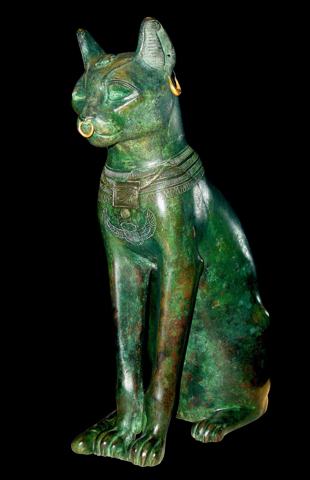
Egypt's cat goddess — a lioness of the Eye of Ra who softened into the guardian of the home, honoured at Bubastis with the loudest festival in Egypt.
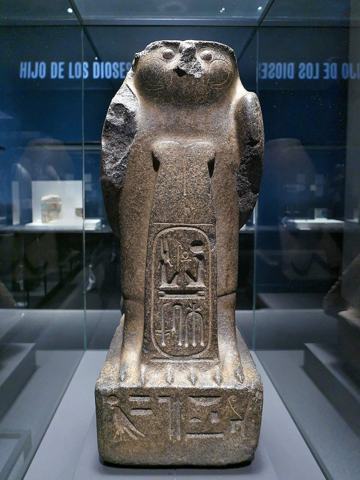
The sun itself as a god — Ra sails the sky by day, fights the serpent of chaos by night, and is reborn on the horizon every dawn.
Sources & Further Reading
- 1.Pyramid Texts (Old Kingdom, c. 2400–2300 BCE), including Utterance 317.
- 2.Coffin Texts (Middle Kingdom, c. 2000–1700 BCE).
- 3.The Book of the Faiyum (Greco-Roman religious papyri).
- 4.Herodotus, Histories II.68–70 (c. 430 BCE).
- 5.Strabo, Geography XVII.1.38 (c. 20 CE).
- 6.Wilkinson, Richard H. The Complete Gods and Goddesses of Ancient Egypt. Thames & Hudson, 2003.
- 7.Pinch, Geraldine. Egyptian Mythology: A Guide to the Gods, Goddesses, and Traditions of Ancient Egypt. Oxford University Press, 2002.
- 8.Kockelmann, Holger. Der Herr der Seen, Sümpfe und Flußläufe: Untersuchungen zum Gott Sobek. Harrassowitz, 2017.
Spot an error or have a source to suggest? Write to info@viseterna.com. We cite primary sources and modern scholarship, and we correct fast.