
Nephthys
Isis's quieter sister — the mourner who helped restore Osiris, was seduced or seducer in Anubis's birth, and stood at the head of every Egyptian coffin.
Nephthys and Anubis, Tomb of Nebenmaat (TT219), Deir el-Medina, 19th Dynasty; photo Mutnedjmet, 2016, CC BY-SA 2.0 · CC BY-SA 2.0 · source
The Sister Without Her Own Story
Nephthys — Egyptian Nebet-hut, "Lady of the House" (the house in question being the sky-temple, not a domestic dwelling) — is one of the four children of Geb and Nut who round out the Heliopolitan Ennead alongside Osiris, Isis, and Set 1,6. She is Set's sister-wife in the standard genealogy, which places her, structurally, as the shadow twin of Isis: paired with a violent brother the way Isis is paired with a murdered one, and defined almost entirely by what she does for other gods rather than by an independent myth cycle of her own 6,7. Egyptologists have long noted how little Nephthys does that is not in direct support of the Osiris family, and readings differ on whether that reflects a genuinely thin original tradition or simply the accident of which texts survived 6,7.
At the Dead King's Side
She is attested early and consistently in funerary contexts. The Pyramid Texts already pair Nephthys with Isis as the two kite-goddesses who protect and revive the dead king, invoking her by name alongside her sister in spell after spell of the earliest funerary corpus Egypt produced 1. By the Coffin Texts of the Middle Kingdom the pairing is fixed formula: wherever Isis mourns, Nephthys mourns beside her, and wherever Isis protects, Nephthys protects from the opposite side of the bier 2,6. This is not incidental staging. Egyptian funerary ritual assigned professional mourners called the kites to wail at the head and foot of the corpse in imitation of the two goddesses, meaning ordinary Egyptian funerals re-enacted Nephthys's role in the Osiris myth as standard practice, whether or not the deceased had any connection to royalty 6,7.
Mourner of Osiris
Nephthys's most important myth is the one she shares completely with her sister. When Set kills Osiris and scatters his body, Isis and Nephthys together search out the pieces, and it is Nephthys who is credited, alongside Anubis, with helping to wrap and restore the corpse — the origin, in Egyptian tradition, of mummification itself 4,6. The fourth-century-BCE Songs of Isis and Nephthys, preserved on the Bremner-Rhind papyrus, are written as a script for two priestesses to perform as the two goddesses, taking turns lamenting Osiris and calling him back to life in language of real emotional force, meant to be recited at his festival rather than merely read 5. That she does this despite being married to his killer is rarely treated as a contradiction in the Egyptian sources themselves; Nephthys's loyalty runs to her dead brother and to her sister, not to her husband's cause 4,6.
The Question of Anubis
Nephthys's one independent story concerns her son. Plutarch's Greek account of the Osiris cycle records that Nephthys, unable to conceive with Set, disguised herself as Isis and slept with Osiris, who realised his mistake only afterward by the garland of flowers he had left behind; the child of that union was Anubis, whom a frightened Nephthys abandoned and Isis found and raised as her own 4. Egyptologists treat this story with some caution — it survives fully only in Plutarch, writing in Greek for a Greek readership centuries after the events he describes, and no known Egyptian-language text tells it in full — while noting that fragments and allusions in genuinely Egyptian sources are consistent with some version of Anubis being reckoned Nephthys's child rather than a child of Ra, his parentage in other periods 4,6.
A Goddess Without Enemies
Unlike Set, Nephthys was never demonised for her family connections, and her cult, though smaller than her sister's, was real rather than merely literary. She received offerings at Osiris's own temples, particularly at Iunu-in-the-North and in cult centres of the Osirian mysteries, generally worshipped as an extension of the same festival calendar rather than at temples built for her alone 6,7. Late Period magical and mortuary texts sometimes give her an epithet as protector of the deceased's viscera specifically, working alongside Isis, Neith, and Serqet as the four goddesses assigned to the canopic jars, though independent evidence for exactly how that fourfold guardianship was understood varies between periods and sources 3,6.
Nephthys on the Coffin
Her clearest and most literal presence in the material record is architectural. New Kingdom and Late Period coffins routinely carry Isis's winged image at the foot and Nephthys's at the head, or place both goddesses kneeling in mourning at either end of the case, so that every mummified Egyptian who could afford a decorated coffin lay, in effect, permanently flanked by the two sisters who had done the same for Osiris 3,6. It is a modest kind of immortality for a goddess who rarely gets a scene to herself, but a remarkably durable one: for three thousand years of Egyptian burial practice, Nephthys stood at the head of the dead, doing the one job she was always trusted with 3,7.
Continue Exploring
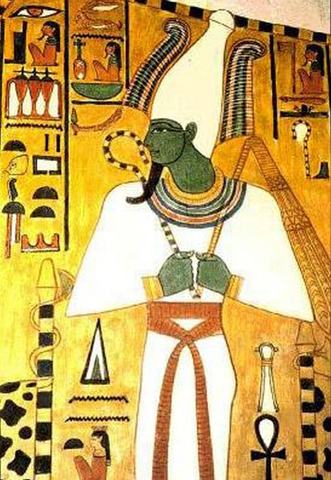
Lord of the afterlife — the murdered king remade as the first mummy, whose resurrection promised every Egyptian a life beyond the grave.
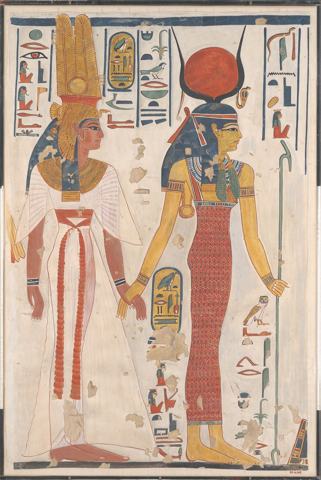
Goddess of magic — the widow whose spells restored Osiris, the mother who hid Horus in the marshes, and the one Egyptian deity Rome adopted whole.
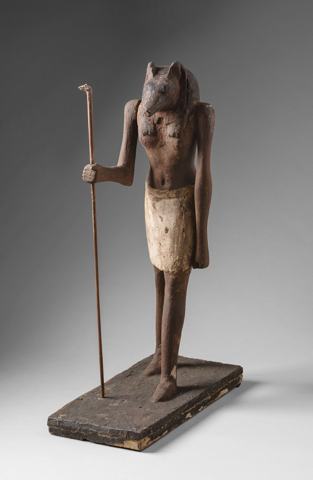
God of chaos — the red god of storm and desert who murdered Osiris, yet stood in the sun's boat each night to spear the serpent of nonexistence.
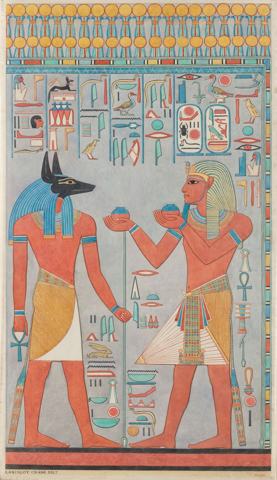
Guardian of the dead — the black jackal god who embalmed Osiris, watched over the necropolis, and weighed the heart against the feather of truth.
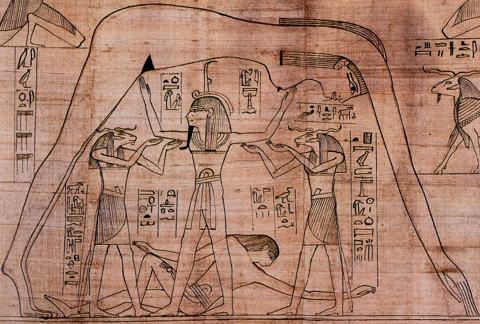
Sky and earth, once locked together and forced apart at creation — she swallows the sun each night, he lies beneath every field and tomb in Egypt.
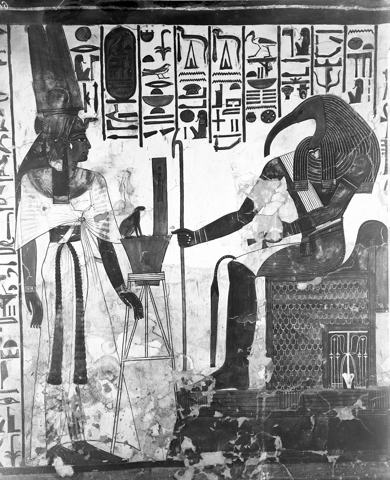
Ibis-headed lord of writing, reckoning and the moon — Thoth keeps the record at the judgment of the dead and settles the quarrels of the gods.
Sources & Further Reading
- 1.Pyramid Texts (Old Kingdom, c. 2400-2300 BCE).
- 2.Coffin Texts (Middle Kingdom, c. 2100-1800 BCE).
- 3.The Egyptian Book of the Dead (Book of Going Forth by Day), New Kingdom.
- 4.Plutarch, On Isis and Osiris (Moralia, 1st-2nd century CE).
- 5.Faulkner, R. O. "The Bremner-Rhind Papyrus -- I: The Songs of Isis and Nephthys." Journal of Egyptian Archaeology 22 (1936): 121-140.
- 6.Wilkinson, Richard H. The Complete Gods and Goddesses of Ancient Egypt. Thames & Hudson, 2003.
- 7.Pinch, Geraldine. Egyptian Mythology: A Guide to the Gods, Goddesses, and Traditions of Ancient Egypt. Oxford University Press, 2002.
Spot an error or have a source to suggest? Write to info@viseterna.com. We cite primary sources and modern scholarship, and we correct fast.